


Make Your Own CBD Oil
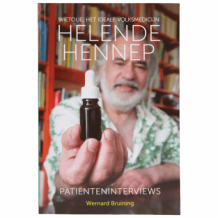
Anyone who wants to make their own CBD oil will need plant material, food-grade alcohol, and the right extraction tools. The method at the heart of this collection is alcohol extraction using the Cannolator from the Medi-Wiet Foundation: a closed extraction system made of borosilicate glass that uses 50% less alcohol than the traditional open method and produces a concentrated paste in about two hours. You can then dilute this paste with hemp seed oil or olive oil to your desired concentration. In addition to the extractors, the book *Healing Hemp* is also available for those who wish to study the background of medicinal cannabis in depth.
5 Items
What is alcohol extraction and how does it work?
Alcohol extraction is the most commonly used method for extracting cannabinoids such as CBD from plant material. Ethanol (food-grade alcohol with a minimum of 96% concentration) dissolves the cannabinoids, terpenes, and fats from the trichomes of the hemp or cannabis plant. The alcohol mixture remaining after rinsing the plant material contains the raw extract. By then evaporating the alcohol, a thick, concentrated paste remains. That paste is the basis of homemade cannabis oil.
The method is scalable: the amount of plant material determines how much paste you make, and the amount of carrier oil you add determines the final concentration of the oil. With 20 grams of dried plant material and 120 ml of alcohol, you can produce about 2 grams of pure paste in approximately two hours. How that paste is subsequently diluted is entirely up to you.
The Cannolator: how the system works
The Cannolator is an extraction system designed by Wernard Bruining of the Medi-Wiet Foundation. It differs from the traditional “wash” method in that the alcohol is not poured freely over the plant material but flows through a closed glass extraction tube. This allows for precise control of the contact time with the plant material and significantly reduces alcohol loss through evaporation during the extraction step. The result is a yield that cannot be achieved with traditional open pouring.
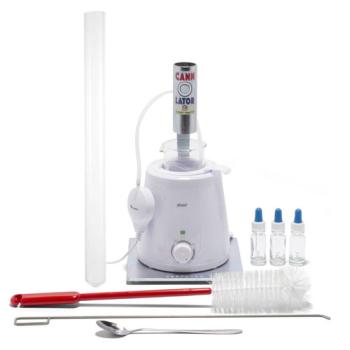
The tubes are made of borosilicate glass: the same material used in laboratory glassware. This glass is resistant to thermal shock and the chemical effects of alcohol, and is easy to clean. The Cannolator is available as a basic set (€92.90) and as a complete set (€124.50). The complete set also includes a baby bottle warmer and an aquarium air pump, which allows the alcohol to evaporate three to four times faster and significantly shortens the total processing time.
What do you need?
In addition to the Cannolator, there are two items you’ll need to purchase yourself: drinking alcohol with a minimum alcohol content of 96% and plant material. For the carrier oil, you’ll need cold-pressed hemp seed oil or olive oil.
96% alcohol for consumption is available at drugstores and some supermarkets. Make sure you buy alcohol for consumption and not isopropanol or industrial alcohol: those are toxic and unsuitable for extraction intended for internal use. The alcohol must contain at least 95 to 96% ethanol. Lower concentrations contain more water, which makes the paste cloudier and the extraction less efficient.
The plant material for CBD oil is industrial hemp with a high CBD content and a maximum of 0.2% THC. This is legal in the Netherlands and available at specialty retailers. For THC oil, you use cannabis that in the Netherlands can only be legally purchased at a coffee shop. Trimmings are a cheaper option that yields results comparable to buds. Always ensure the plant material is thoroughly dried before you begin: moisture hinders alcohol extraction.
Step-by-step: Making CBD oil with the Cannolator
Step 1: Weigh and grind the plant material
Weigh out 20 grams of dried plant material on an accurate scale. Rub the plant material thoroughly between your hands so that it fits loosely and evenly into the extraction tube. You don’t need to grind it too finely: material that’s too fine can clog the tube or cause terpenes to break down too quickly.
Step 2: Fill the extraction tube
Fill the included glass extraction tube with the plant material. Use a teaspoon or a homemade paper funnel. Gently and evenly press down the material with the included tamper. Hang the tube in the Cannolator holder above the measuring cup. Turn on the baby bottle warmer and connect the air tube from the pump to the device (included in the complete set).
Step 3: Add alcohol
Calculate the required amount of alcohol: 6× the weight of the plant material in milliliters. For 20 grams of plant material, that is 120 ml of alcohol. Slowly pour the alcohol into the extraction tube. The alcohol seeps through the plant material, dissolves the cannabinoids, and drips into the measuring cup below. The temperature in the measuring cup must not exceed 80°C: otherwise, the alcohol will evaporate, but the cannabinoids will remain intact. Use a thermometer to monitor this.
Step 4: Evaporate the alcohol and decarboxylate
The baby bottle warmer heats the measuring cup and evaporates the alcohol. Ensure proper ventilation: alcohol vapor is highly flammable and must not accumulate in a room. Never use an open flame or a gas burner. When the alcohol has almost evaporated, the water present in 96% alcohol (4% water) will also evaporate. At that point, the temperature rises above 80°C and small bubbles form in the liquid. This is the decarboxylation process: CBDa is converted to CBD, and possibly THCa to THC. Once no new bubbles form and the liquid is smooth and syrupy, the paste is ready. This takes about 1 to 1.5 hours with the air pump; without a pump, about 2 hours.
Step 5: Dilute with carrier oil
Let the paste cool slightly. Fill a 10-ml dropper bottle with cold-pressed hemp seed oil or olive oil and pour it into the measuring cup with the paste. Stir well so that the oil and paste mix completely. Pour the warm mixture back into the dropper bottle. The oil is ready for use.
You determine the concentration yourself. In the example above (20 grams of plant material, yielding approximately 2 grams of paste), diluted in a 10 ml bottle, you get an oil with a concentration of approximately 20%. If you add two bottles of oil, you get a 10% oil. The more oil you add, the milder the concentration.
Calculations: ratios and yield
As a rule of thumb: grams of plant material divided by 10 gives the estimated number of grams of pure paste. Thus, 20 grams of plant material containing 10% CBD yields approximately 2 grams of CBD paste, the CBD content of which depends on the quality of the raw material. You calculate the amount of alcohol as follows: grams of plant material × 6 = ml of alcohol.
The yield varies depending on the quality of the plant material. CBD-rich industrial hemp with a CBD content of 8 to 12% yields 80 to 120 mg of CBD per gram of plant material. Trimmings from the same plant yield slightly less because the concentration in leaves is lower than in flowers.
Choosing a carrier oil: hemp seed oil or olive oil?
Both oils are suitable as carrier oils. Hemp seed oil has a naturally green color and a slightly nutty flavor, and it also contains valuable fatty acids (omega 3, 6, and 9) and vitamins. This makes it a popular choice among DIY enthusiasts. Olive oil has a milder and more neutral flavor for those who want to avoid the taste of hemp. Always use cold-pressed, unprocessed, food-grade oil.
Storage and Shelf Life
Store homemade CBD oil in a dark, sealed glass dropper bottle, in a cool place away from direct light. At room temperature, the oil has a shelf life of at least one year. In the refrigerator, it can be stored for several years. Never use plastic bottles for long-term storage: some types of plastic dissolve into the oil with prolonged contact.
Safety precautions for alcohol extraction
96% ethanol is highly flammable, and its vapors are explosive at sufficient concentrations. Follow these rules for every extraction:
Always work in a well-ventilated area or under a fume hood. Use only electric heat sources; never use an open flame, tea light, or gas burner near alcohol. Keep the temperature in the measuring cup below 80°C as long as alcohol is present. Use the thermometer included with the complete Cannolator set. Store drinking alcohol in its original, tightly sealed packaging, away from heat sources and children.
Legal Framework in the Netherlands
Making CBD oil from industrial hemp (maximum 0.2% THC) is legal in the Netherlands for personal use. Industrial hemp is not subject to the Opium Act as long as the plant’s THC content remains below the legal limit. However, the sale of homemade CBD oil is prohibited: products you sell must comply with the EU’s Novel Food legislation and cannot simply be placed on the market.
The production of THC oil from cannabis (more than 0.2% THC) is subject to the Opium Act in the Netherlands. Cannabis itself is a Schedule II substance. Personal use and possession of small amounts (up to 5 grams) is tolerated but is not formally legal. Producing THC oil is at your own risk and responsibility.
Making it yourself versus ready-to-use CBD oil
Ready-to-use CBD oil from Wedihemp is produced via CO₂ extraction or ethanol extraction on an industrial scale, externally tested per batch for over 200 substances, and comes with a certified cannabinoid profile. For those who want certainty about concentration and purity, this is the most reliable option. Making it yourself offers more control over the raw material and the final strength, but also requires more knowledge of the process and yields less accurately reproducible results unless you have the plant material tested yourself.
The initial investment in a Cannolator (€92.90 to €124.50) pays for itself if you make oil regularly. After the purchase, the only variable costs are the plant material and the alcohol.
Frequently Asked Questions About Making Your Own CBD Oil
What kind of alcohol should I use to make CBD oil?
Food-grade ethanol with a minimum of 96% alcohol content, also known as drinking alcohol or pure spirit. Available at the drugstore. Do not use isopropyl alcohol (IPA) or industrial alcohol: these are toxic and unsuitable for internal use. A concentration lower than 96% is less effective because the extra water in the extraction process makes the paste cloudier.
What is the difference between the Cannolator Basic and the Cannolator Complete?
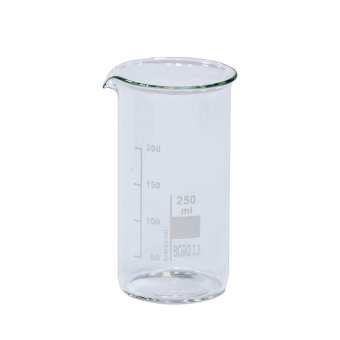
The basic set (€92.90) includes the stand, two glass extraction tubes, a 250 ml measuring cup, three 10 ml pipette bottles, a cleaning brush, a spoon, and an instruction manual. The complete set (€124.50) adds a baby bottle warmer and an aquarium air pump. These two accessories speed up the evaporation process three to four times. Without the warmer and pump, you’ll need an alternative heat source (such as an electric hot plate), and the extraction will take longer.
Can I replace the measuring cup if it breaks?
Yes. The Cannolator 250 ml Measuring Cup (€4.90) is available separately, as is the extraction tube (€17.50). Replacement parts are available so you can use the set for a long time.
How much CBD oil can I make from 20 grams of plant material?
On average, 20 grams of dried plant material yields approximately 2 grams of raw paste. You dilute that paste in 10 to 20 ml of carrier oil, depending on the desired concentration. With 10 ml of oil, that is approximately 20% (200 mg CBD per ml with 10% CBD plant material). With 20 ml of oil, that is approximately 10%. The exact yield depends on the CBD content of your raw material.
Is decarboxylation required?
Decarboxylation converts CBDa to CBD through heat. With the Cannolator method, this occurs automatically during the evaporation process, as soon as the alcohol has evaporated and the temperature rises above 80°C. You do not need to decarboxylate the plant material beforehand. If you specifically want to make a raw oil with CBDa instead of CBD, stop the evaporation process earlier: as soon as the alcohol has evaporated but before the bubbling phase begins. This requires precise temperature measurement.
Can I sell the homemade oil?
No. Homemade CBD oil falls under EU Novel Food regulations. Products containing CBD may only be sold commercially if they meet all applicable food safety and labeling requirements. Making it yourself for personal use is permitted when using legal raw materials; selling it without authorization is prohibited.
What is the book "Healing Hemp"?
The book "Helende Hennep" (€19.90) provides extensive background on the medicinal applications of cannabis and hemp, their history, the endocannabinoid system, and how cannabinoids work. It is a useful supplement if you want to go beyond the technical extraction process and understand the theoretical basis.
