


Last updated: March 25, 2026
Harvesting magic mushrooms: how and when?
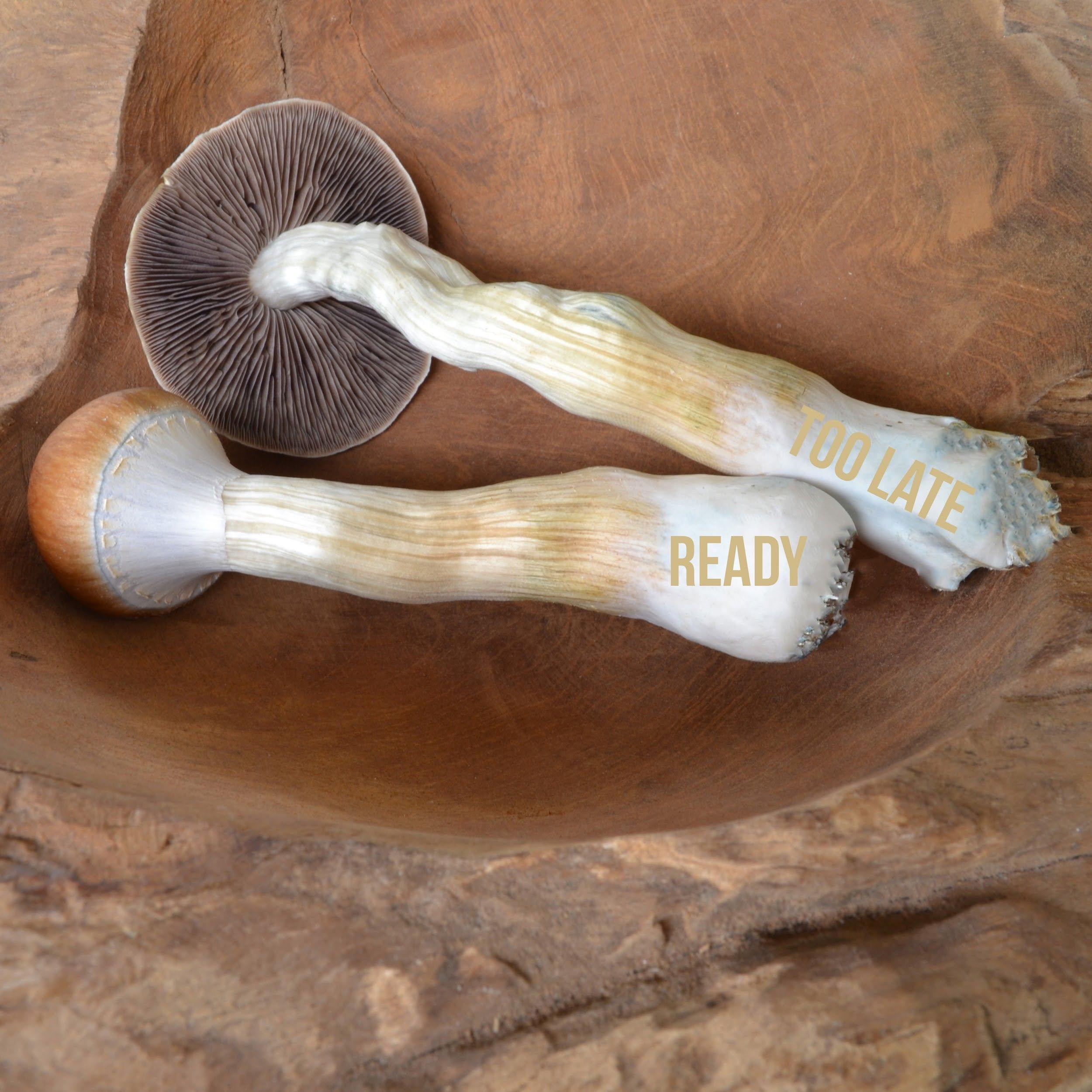
If you grow your own magic mushrooms, you naturally want to get the most out of your harvest. But when exactly should you pick them? Too early and you’ll miss out on yield. Too late and you’ll lose potency and jeopardize the production of your next flush. The difference lies in one detail: the membrane under the cap.
The perfect harvest time
Under the cap of every mushroom is a thin membrane (the veil ) that protects the gills. As long as this membrane is intact, the mushroom is still in its growth phase and the psilocybin content is increasing. The moment the veil tears, the cap opens and the mushroom begins to release spores. That is the tipping point.
Mycologist Paul Stamets describes in *Psilocybin Mushrooms of the World* that after the cap opens, mushrooms shift their energy toward spore production, at the expense of psilocybin content. Furthermore, the spores fall onto the substrate, where they form a dark layer that can inhibit or completely block new growth. This means fewer or no subsequent flushes.
Recognize the right moment by these characteristics: the veil is about to detach but is still intact, the cap still has a convex, round shape, and there are no dark spore deposits on the substrate or on neighboring mushrooms.
In practice, you have a window of a few hours. If you see in the morning that the membrane is taut but hasn’t torn yet, it’s a good time to harvest. If you wait until the evening, it may already be too late.
How to harvest without damage
Wash your hands thoroughly with soap or put on sterile gloves. Contamination of the substrate is a real risk after harvesting, because you’re exposing the mycelium.
Grasp the mushroom at the base of the stem, as close to the substrate as possible. Gently twist counterclockwise while pulling lightly. The mushroom should come off without much resistance. Never pull straight up, as this tears off pieces of mycelium and damages the growing medium for your next flush. Also remove the smaller, lagging mushrooms and any "aborts" (mushrooms that have stopped growing). Left-behind material can rot and cause contamination.
Do not rinse mushrooms under the tap. Moisture accelerates spoilage. If necessary, gently brush away any substrate residue with a soft brush or damp paper towel.
Read and watch manuals and instructional videos for growing magic mushrooms here
After the first harvest: subsequent flushes
A good grow kit yields 2 to 4 harvests (flushes), sometimes more. After harvesting, the substrate has dried out and needs to be rehydrated. Fill the grow box with cold tap water, place the saved lid on top, and let it soak for 8 to 12 hours in the refrigerator. This is called cold shocking and stimulates a new growth cycle.
Carefully drain the excess water, place the kit back in the grow bag with fresh water at the bottom, and resume the normal growing process. Many growers report that the second or third flush yields the highest harvest. A standard 1200cc kit can yield 300 to 500 grams of fresh mushrooms across all flushes combined.
Drying: the key to long-term storage
Fresh mushrooms are approximately 90% water. They can be stored in the refrigerator for up to 5 to 10 days. For longer storage, you must dry them until they are “cracker-dry”: they should snap when you try to bend them.
Temperature is crucial here. Research by Jurók et al. (2021, Drug Testing and Analysis) shows that psilocybin remains stable when dried at room temperature in the dark. The concentration per gram actually increases after drying, as the water weight is lost. However, heating above 70°C can accelerate degradation, and above 137°C, psilocybin is completely destroyed. Therefore, never use an oven at high temperatures.
Drying methods
Food dehydrator: The most reliable method. Set to a maximum of 40°C. Drying time: 4 to 8 hours, depending on size. Check regularly to see if they break when bent.
Air-drying with a fan: Place the mushrooms on paper towels or cardboard in a well-ventilated room at 20 to 25°C. Set a fan to low speed. Change the absorbent material regularly. Takes 5 to 10 days.
Silica gel as a finishing touch: Silica gel packets absorb the last residual moisture. Place pre-dried mushrooms together with silica gel in an airtight container. This is not a standalone drying method, but a good finishing touch.
Storage for maximum shelf life
The four enemies of psilocybin are light, oxygen, moisture, and heat. The same study by Jurók et al. found that mushrooms stored in light at 20°C lost 36% of their psilocybin content after 15 months. Therefore, store dried mushrooms as follows:
- In an airtight, opaque container (glass jar or vacuum-sealed bag)
- With a silica gel packet included to absorb residual moisture
- In the refrigerator (2 to 10°C) for storage of up to 1 to 2 years
- In the freezer and vacuum-sealed for storage of 2 years or longer
Some users store dried mushrooms in honey. Honey is hygroscopic and inhibits bacteria, but it makes dosing more difficult because the weight of the honey is included. If desired, grind dried mushrooms into a fine powder and divide them into pre-weighed doses; this makes them easier to use later. A precision scale is indispensable for this.
Frequently Asked Questions
What if I’m too late and the spores have already fallen?
The mushrooms are still usable, but the potency may be slightly lower than in optimally harvested specimens. The bigger problem is the effect on the next flush: spores on the substrate can inhibit new growth. If possible, remove the spore layer with a damp piece of paper towel (work in a sterile manner) before starting the soaking process.
Do I have to harvest all the mushrooms at once?
Yes, harvest everything at once, including the smaller specimens and “aborts” (stunted mushrooms). If you pick selectively and leave smaller mushrooms behind, you risk them rotting and contaminating the substrate.
How do I recognize contamination after harvesting?
Healthy mycelium is white. Blue spots after harvesting are normal: this is an oxidation reaction of psilocin and not contamination. Green, gray, or black spots that feel fuzzy and spread indicate mold (Trichoderma, Penicillium). A sour or rotting smell indicates bacterial contamination. In both cases, the kit is beyond saving.
How many grams fresh equals how many dried?
Fresh mushrooms lose approximately 90% of their weight when dried. 10 grams fresh is equivalent to about 1 gram dried. This is a rule of thumb; the exact ratio varies by species and drying method.
The complete cultivation range, from 100% mycelium kits to XL grow kits and cultivation supplies, can be found in the webshop. More background information is available at kennisbank.dutch-smart.nl. Questions? Email support@dutch-smart.nl.
Sources
Jurók, R. et al. (2021) — Stability of psilocybin and its four analogs in the biomass of Psilocybe cubensis, Drug Testing and Analysis, 13: 439-446
Stamets, P. (1996) — Psilocybin Mushrooms of the World: An Identification Guide, Ten Speed Press
About the author

Editor
Derek writes for Dutch Smart about smart shop products, cultivation techniques, and harm reduction. He combines practical experience with factual, well-researched information, without hype or vague promises.


