


The world of music is intertwined with that of psychedelics and hallucinogenic drugs. For thousands of years, mind-expanding herbs, mushrooms, and cacti have been used to boost creativity and provide people with different—sometimes spiritual—insights. It was around 1960 that the relationship between psychedelics and music began to be studied more frequently. In fact, researchers discovered that the combination of music and psychedelics can have genuine therapeutic effects.
"There is always a message in music, and under the influence of psychedelics, people seem to respond to this more," says psychedelic researcher Mendel Kaelen. "Emotions can be processed more deeply. It’s a beautiful story. It’s like a snake biting its own tail.” That unique combination remains deeply rooted in the music world even today. That’s why this article highlights a number of musicians who have drawn on psychedelic influences to create their catchy tunes—but there are many, many more.
The Beatles
Many people essentially view The Beatles’ later music as synonymous with LSD, and the band members themselves regularly spoke about their unique experiences with the drug. According to Rolling Stone, the first time Lennon and Harrison took it was actually a complete accident. A friend slipped LSD into their coffee without their knowledge, and at first, Lennon was furious.
But after the horror and panic faded, everything changed. “I had such an overwhelming sense of well-being, that there was a God, and I could see him in every blade of grass. It was as if I had gained hundreds of years of experience in 12 hours,” Harrison said. Paul McCartney had similar revelations. LSD “opened my eyes to the fact that there is a God,” he said in 1967. “Obviously, God isn’t in a pill, but it explained the mystery of life. It was truly a religious experience. It started to find its way into everything we did, really. It colored our perceptions. I think we began to realize that there weren’t as many limits as we had thought. And we realized that we could break through barriers.
Bob Marley
Just as The Beatles became identified with LSD, so Bob Marley is synonymous with cannabis. He is one of the world’s most iconic marijuana figures. Bob Marley smoked marijuana because he practiced the Rastafari religion, in which the use of “ganja,” as it is called, is a sacred sacrament. The word ganja is the Rastafari term derived from the ancient Sanskrit word for marijuana, which itself is a Spanish word for cannabis.
Marley converted from Christianity to Rastafarianism in the mid-1960s, long before he gained any international fame as a reggae musician. The artist did not use cannabis recreationally and did not view its use as a casual matter. He regarded marijuana as a sacred ritual, just as Catholics view Holy Communion or some Native Americans view the ceremonial use of peyote. Marley saw himself as a holy person (like all Rastafarians) and strongly believed that marijuana opened a spiritual door through which he could become the artist and poet he was deep down.
Rihanna
Real “yellow diamonds” exist as gemstones and can mostly be found at your local jeweler, but we’re talking about a completely different kind of crystal here, according to Rolling Stone—one that’s only available from sources that don’t exactly advertise their wares. That “hopeless place” in “We Found Love”? That was MDMA. And if you can’t spot the reference in the lyrics, the dilated pupils in the music video might point you in the right direction. But the real giveaway? Rihanna and actor Dudley O’Shaughnessy are having passionate sex amidst a whole pile of pills.
Jim Morrison
Jim Morrison was a heavy drug user. He used many different drugs during his life, including cocaine, but apparently LSD held a special place and he avoided it while working. "LSD was a holy sacrament that had to be taken on the beach in Venice, under the warmth of the sun, with our father the sun and our mother the ocean nearby, and you realized how divine you were," said Ray Manzarek, fellow member of The Doors. "It wasn’t a drug for entertainment. You could smoke a joint and play your music, like most musicians did back then. But when it came to LSD, it had to happen in a natural setting."
Morrison was the kind of artist who had visions of poetry and sex, but ultimately got lost in his own mind. "The psychedelic Jim I knew a year earlier, the one who constantly came up with colorful answers to universal questions, was slowly being tortured by something we didn’t understand," said John Desmore in *Riders on the Storm: My Life With the Doors*. According to experts, the life of The Doors’ singer may reveal that when using hallucinogens and psychedelics as a path to spiritual experiences, one must be more cautious than one might think, and that is never bad advice.
Eminem
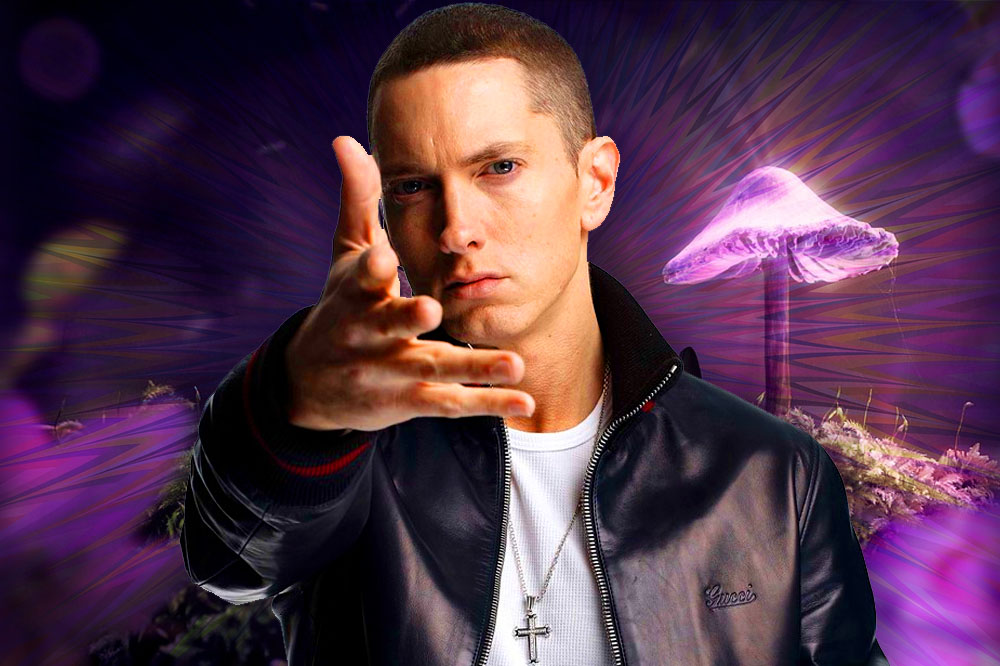
It’s not all positivity, because Eminem’s song “My Fault” is quite dark and negative—and it’s about our beloved Magic Mushrooms…A quick look at the lyrics (or listening to the song) tells you in vivid detail what it’s about: It’s about Eminem going to a rave party with two friends. There he meets a girl named Susan. He finds some magic mushrooms, finds a room with her, and hands them out. He takes 3 caps, she takes 22! The result: a really intense bad trip full of panic. Ultimately, a somewhat unrealistic ending: the girl in question dies from the magic mushrooms, which wouldn’t happen in real life—magic mushrooms are considered the safest drugs in the world.
A$AP Rocky
Well, if you make a song called LSD, it’s clear where the inspiration for writing the song comes from. The rapper himself says he has a unique approach to his psychedelic experiments. "We were all in London at my place," he said about his experience writing LSD. "I have a psychedelic professor; he studies LSD. I had him come over to record and monitor us to actually test the product while we were making the music. We made all kinds of tunes while we were tripping hard,” the rapper said.
LSD changed his entire approach to music and success. “I never really gave a fuck, man, but this time I really don’t give a fuck,” he said. “I don’t care about making hits.” Instead, he focuses on the process of creation. “It’s so hard to be progressive when you’re tripping,” he said. “You make stuff that’s really far out there.”


