


We analyzed three years of truffle sales data. Here’s what stood out.
A lot has been written about psilocybin—about clinical trials, microdosing as a Silicon Valley trend, and its therapeutic potential. But hard sales data? That didn’t exist. Even though the Netherlands is one of the few countries where truffles are sold legally over the counter.
We wanted to do something about that. I combed through, categorized, and compared our sales data from the past three years (2023–2025). Nearly 25,000 orders, more than 12,000 truffle and microdosing products. No survey, no self-reporting, just point-of-sale data. This analysis is based on aggregated, anonymized sales data. No personal data was processed or shared.
The results are confirming in some respects and surprising in others.
Microdosing: from 9% to 14%
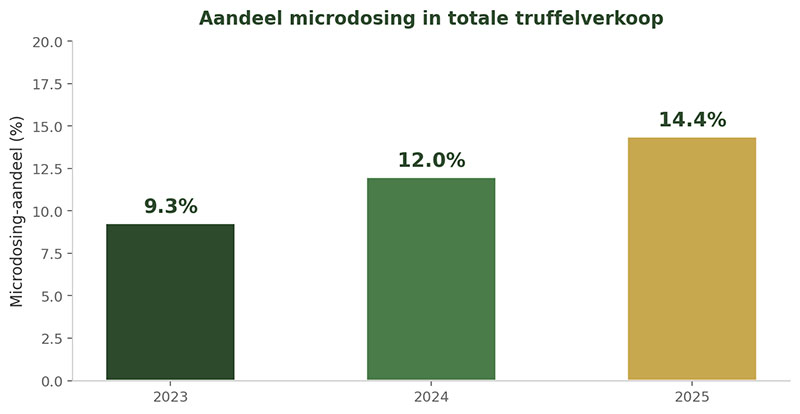
Let’s start with the most striking finding. In 2023, 9.3% of all truffle sales were microdosing products. In 2024, that figure was 12%. In 2025: 14.4%.
Photo: Dutch-Smart.nl | Smartshop Monitor 2026
That’s not explosive growth in a single year; it’s a steady, structural shift. And that’s precisely what makes it interesting. This isn’t a fad that comes and goes. The group of people who use truffles in small amounts—for focus, for creativity, or just to see what it does—is growing a little bit every year.
At the same time, sales of full-dose truffles remained fairly stable. So microdosing is being added to the mix; it’s not coming at the expense of existing use. That points to a new type of customer. Someone who isn’t necessarily looking for a full psychedelic experience, but uses psilocybin functionally through microdosing truffles. Similar to how some people use CBD: not to get high, but as part of their daily routine.
The total growth of microdosing over three years is nearly 50%. During the same period, full-dose sales declined slightly by about 9%. The truffle market as a whole remained stable in volume, but its composition is indeed changing. The graph below illustrates this shift.
Source: sales data from Dutch-Smart.nl, 2023–2025
January is Microdosing Month
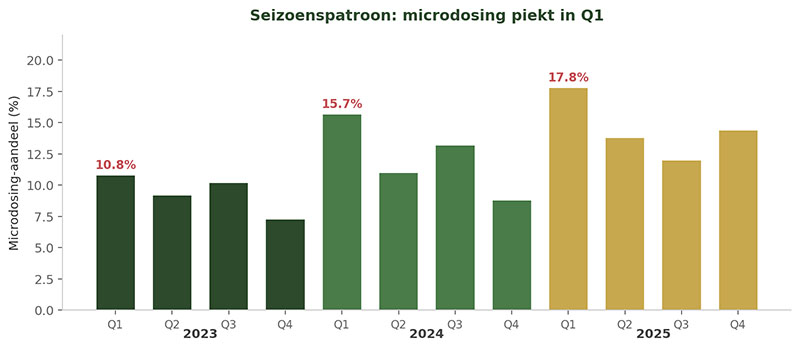
One of the things we didn’t expect: there is a clear seasonal pattern. The microdosing share consistently peaks in the first quarter of the year. In Q1-2024, it was 15.7%. In Q1-2025, it was even 17.8%, nearly one in five truffle sales.
New Year’s resolutions? A fresh start? We’re not sure. But the pattern is there every year. In Q4, the share actually drops, while full-dose sales pick up. The holiday effect, presumably.
It seems that people associate microdosing with a fresh start. Just as gym memberships and vitamin supplements peak in January, a group of consumers starts the year with a microdosing regimen. Whether that lasts three months or twelve, these figures don’t tell us. But the peak is there, three years in a row.
The pattern is clearly visible in the graph below. The dark green bars represent 2023, light green is 2024, and gold is 2025. The red percentages mark the Q1 peaks. Each year starts higher than the previous one.
Source: sales data from Dutch-Smart.nl, 2023–2025 | Quarterly breakdown estimated based on order sequence
Customers are making stronger choices
Another thing that stands out when you compare three years of data side by side: within the full-dose market, preference is shifting toward stronger strains.
In 2023, 58% of full-dose sales were strong strains (High Hawaiians, Double Vision, Hollandia, Utopia). In 2025, that figure will be 64%. The mid-range segment, including strains like Atlantis and Dragon’s Dynamite, dropped from 32% to 24%. Mild strains such as Mexicana and Tampanensis remained stable at around 10–12%.
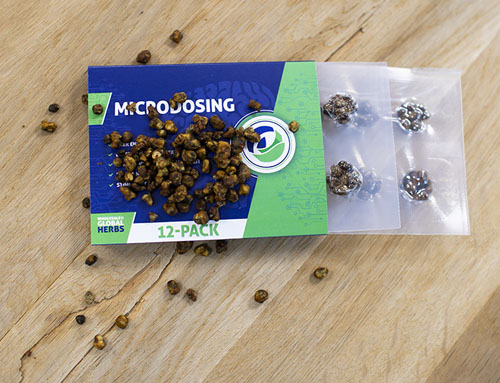
Photo: Dutch-Smart.nl
In 2023, Atlantis was by far our best-selling truffle. Now it’s High Hawaiians. That shift can be partly explained by the fact that in 2024 we replaced the 22-gram package of High Hawaiians with a 25-gram version, but that’s not the whole story. Double Vision (25 grams, strong) and Pink Paradise are also holding their ground, while milder varieties like Mexicana and Tampanensis are losing a few percentage points each year.
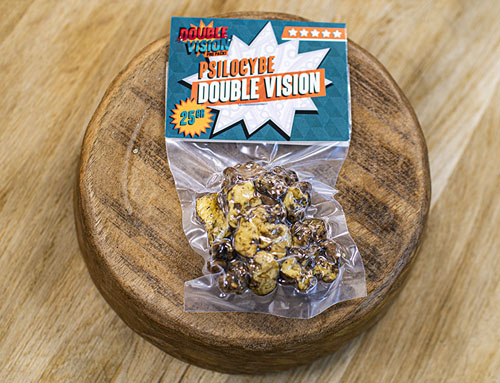
Photo: Dutch-Smart.nl
Experienced users who know what they want, or new users who are well-informed online and go straight for a stronger variety? Probably both. One thing is certain: consumers are becoming more critical and selective in their choices. The days when someone would “just buy a box of truffles” without doing any research seem to be over.
The breakdown over three years shows where the shift is occurring. The mild segment is growing every year at the expense of the medium segment. Mild remains virtually unchanged, suggesting that beginners are not leaving the market but that the medium segment is shifting toward stronger varieties.
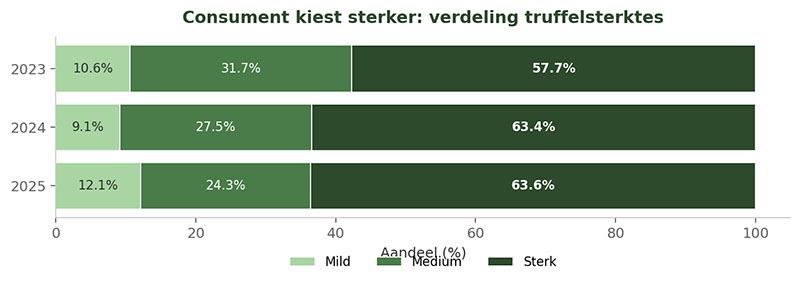
Source: sales data from Dutch-Smart.nl, 2023–2025 | Mild = Mexicana, Pajaritos, Tampanensis | Medium = Atlantis, Dragon’s Dynamite | Strong = High Hawaiians, Double Vision, Hollandia, Utopia
All key figures at a glance
The table below summarizes the key findings. What stands out is the consistency: each year, the market shifts a little further in the same direction. Microdosing is growing, full-dose consumers are opting for stronger strains, and the seasonal peak in Q1 becomes more pronounced each year.
| Indicator | 2023 | 2024 | 2025 |
|---|---|---|---|
| Microdosing share | 9.3% | 12.0% | 14.4% |
| Microdosing growth compared to 2023 | reference | +51% | +48.5% |
| Share of strong strains (full-dose) | 57.7% | 63.4% | 63.6% |
| Microdosing peak Q1 | 10.8% | 15.7% | 17.8% |
| Most popular strain | Atlantis | High Hawaiians | High Hawaiians |
Source: sales data from Dutch-Smart.nl, March 2023 through December 2025
How does this compare to the official figures?
The Trimbos Institute reports via the National Drug Monitor that about 1% of Dutch adults have used magic mushrooms in the past year. Among young adult partygoers (ages 16–35), that figure is around 10%.
Those figures concern prevalence: how many people use them. Our data concerns something else, namely what they buy and how that is shifting. The two complement each other. Trimbos measures the breadth; we see the movement within the market.
What stands out: the Trimbos figures on truffle use have been relatively stable at around 1% for years. Our sales data confirms that picture for full-dose products, but at the same time shows a shift that isn’t visible in prevalence figures. Microdosing is a different type of use: lower doses, higher frequency, and a different purchasing profile. That nuance disappears if you only look at “Have you used truffles in the past year?”
What this data doesn’t tell us
We are a smart shop, not a research institute. It is important to be clear about what you do and do not read here.
These figures are ours, from our own sales. They say something about what goes over the counter at Dutch-Smart, not about the entire Dutch market. Physical smart shops, other online stores, the informal market: we have no insight into those. We also don’t know why people buy what they buy. We see the transaction, not the motivation. We don’t know if someone buying microdosing truffles is trying this for the first time or has been following a protocol for two years.
And we don’t know what happens after the order is placed. Is the package opened and used immediately? Shared with friends? Forgotten in the fridge? Sales data doesn’t answer those questions.
But what we can say—and that’s why I’m writing this report—is that the composition of the market is shifting measurably. And that shift has been consistent over three years. That’s not noise; that’s a trend.
Why we’re sharing this
Because it wasn’t there before. There’s a lot of speculation about the Dutch truffle market, but there were no concrete figures. I’ve been in this market since 2011, the year I founded Dutch-Smart, and I’ve seen these shifts up close. This report is a first step toward making that shift measurable.
The Netherlands holds a unique position in the world. We are one of the few countries where psilocybin-containing truffles are legally sold, under the Commodities Act, with HACCP certification and NVWA supervision. That also means that here, unlike almost everywhere else, verifiable sales data exists. It would be a shame not to share that data.
The full report with graphs and detailed data is available as a PDF. Researchers or journalists interested in the underlying data can contact us via our customer service.
And for those thinking about microdosing: do your research. Read up on it. Microdosing is not a medical treatment and is not a substitute for professional help. If you have mental health issues: see a doctor. You can read more about responsible use and dosing on our truffle page or in the magic truffle calculator.
About the author
Founder
Rick founded Dutch-Smart in 2011 and has been running the online store from Helmond ever since. This analysis is based on the sales data he has accumulated over those fourteen years.


