
Last updated: March 25, 2026
On April 19, 1943, Albert Hofmann, a chemist at Sandoz Laboratories in Basel, ingested 0.25 milligrams of LSD as a self-experiment. Three days earlier, he had unintentionally absorbed a small amount of the substance through his skin and noticed unusual changes in his perception. The dose taken on April 19, which he himself considered cautious but which, in hindsight, resulted in a powerful trip, brought about intense visual distortions, changes in the perception of time, and a sense of the body dissolving. Together with his lab assistant, he cycled home, a ride that went down in history as Bicycle Day: the day on which the psychedelic effects of LSD were first systematically observed.
What does LSD do to the brain?
LSD (lysergic acid diethylamide) is a semi-synthetic psychedelic derived from lysergic acid, which is extracted from the ergot fungus Claviceps purpurea. Hofmann synthesized the molecule in 1938 as part of research into substances that stimulate blood circulation and respiration, but he did not discover its psychoactive effects until five years later.
Pharmacologically, LSD acts as a partial agonist on5-HT2A serotonin receptors in the prefrontal cortex, a mechanism believed to be responsible for its psychedelic effects: altered visual perception, synesthesia, heightened emotional experience, and a distorted sense of time. In addition, LSD binds to dopamineD2 receptors, which contributes to the reported feelings of energy and motivation. A distinctive feature of LSD is that the molecule forms an exceptionally strong bond with the5-HT2A receptor. Crystallographic research in 2017 showed that part of the receptor folds over the LSD molecule like a “lid,” causing it to remain bound much longer than other serotonin agonists. This partly explains the long duration of action, ranging from 8 to 12 hours at a standard dose of 50 to 200 micrograms.
The effects are highly dose- and context-dependent. At lower doses, users report increased alertness, emotional sensitivity, and mild visual shifts. Higher doses can lead to complete changes in perception, temporary ego dissolution, and experiences that users describe as mystical or transcendent. At the same time, LSD can also cause anxiety, paranoia, and confusion, particularly in an unsafe setting or at a higher dose than expected.
Why testing is essential
LSD is illegal (Schedule I, Opium Act) and is not produced under pharmaceutical quality control. This makes adulteration a real risk. The most common form is a drop of liquid on a paper “tab” (stamp), but it also comes as a liquid, gel, or in capsules.
The greatest danger with counterfeits comes from so-called NBOMe compounds (N-benzylmethoxy derivatives). These substances have frequently been sold as LSD over the past decade, but have a fundamentally different risk profile. NBOMe compounds can constrict blood vessels and thicken the blood, resulting in reported cases of heart attacks, kidney failure, or strokes at higher doses. There have been several documented deaths from NBOMe sold as LSD. In contrast, there are no documented fatal overdoses in humans involving pure LSD.
Other substances sometimes sold as LSD include DOx compounds (DOM, DOB, DOC) and certain lysergamide analogs (1P-LSD, ALD-52). The latter category is pharmacologically related to LSD, but the DOx compounds have a significantly longer duration of action (up to 24 hours) and a different side effect profile, which can lead to serious problems for unprepared users.
How to test your LSD with a Dope or Nope drug test
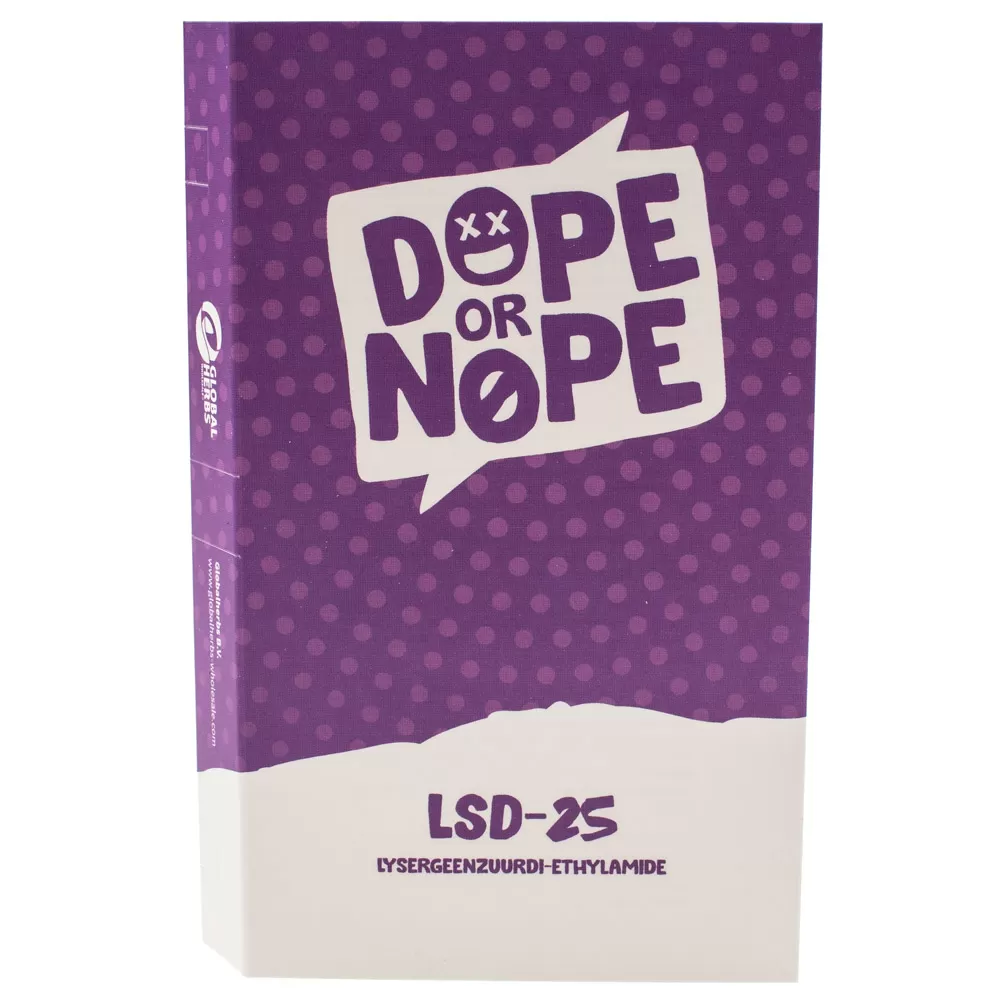 The Dope or Nope LSD test uses Ehrlich’s reagent, a chemical solution that changes color in the presence of indoles, the class of compounds to which LSD belongs. The test is simple: open the vial, add a small piece of the tab or a drop of liquid, and after a few minutes, compare the color to the color code on the packaging. A purple color change indicates the presence of an indole compound (LSD, but also related substances like 1P-LSD or LSA). No color change means there is likely no LSD-like substance in the sample.
What the Dope or Nope test does do: confirm the presence of an indole, which rules out NBOMe adulterants (which are not indoles). What the test does not do: identify the exact substance, determine the dosage, or rule out the presence of other substances besides LSD. It is therefore an indicative test, not a definitive analysis.
For a more complete picture, you can combine the Dope or Nope LSD test with the General drug test from the same range. In addition, Dutch-Smart recommends having your substances professionally tested at a DIMS testing service (Trimbos Institute), which are available at multiple locations in the Netherlands. The reagents used by DIMS are largely the same as those in the Dope or Nope tests, but the laboratory can also determine dosage and adulterants.
Harm reduction with LSD (18+)
Always test. Never take a substance if you don’t know what it is. A Dope or Nope test costs a few euros and can make the difference between a safe and a dangerous experience.
Dosage. The potency of tabs varies widely (50 to 300+ micrograms). If you don’t know the dose, start with a quarter or half a tab and wait at least 2 hours.
Set and setting. Only use in a familiar environment with people you know. Avoid crowded or unfamiliar places, especially on your first time.
Tripsitter. Make sure there is a sober and trusted person nearby who can provide support if the experience becomes difficult.
Avoid combinations. Do not combine LSD with lithium (significantly increased risk of seizures), cannabis (may intensify anxiety), or other psychoactive substances.
Contraindications. Do not use if you have a personal or family history of psychosis, schizophrenia, or bipolar disorder.
Patience. The effects take 30 to 60 minutes to kick in. Never take more because you “don’t feel anything,” as that is the most common cause of an overly intense experience.
Age restriction. For individuals 18 years of age and older only.
You can find more information about drug tests and the full Dope or Nope range in the webshop. Do you have questions? Send an email to support@dutch-smart.nl.
Read also:
About the author

Editor
Derek writes for Dutch Smart about smart shop products, cultivation techniques, and harm reduction. He combines practical experience with factual, evidence-based information, without hype or vague promises.