

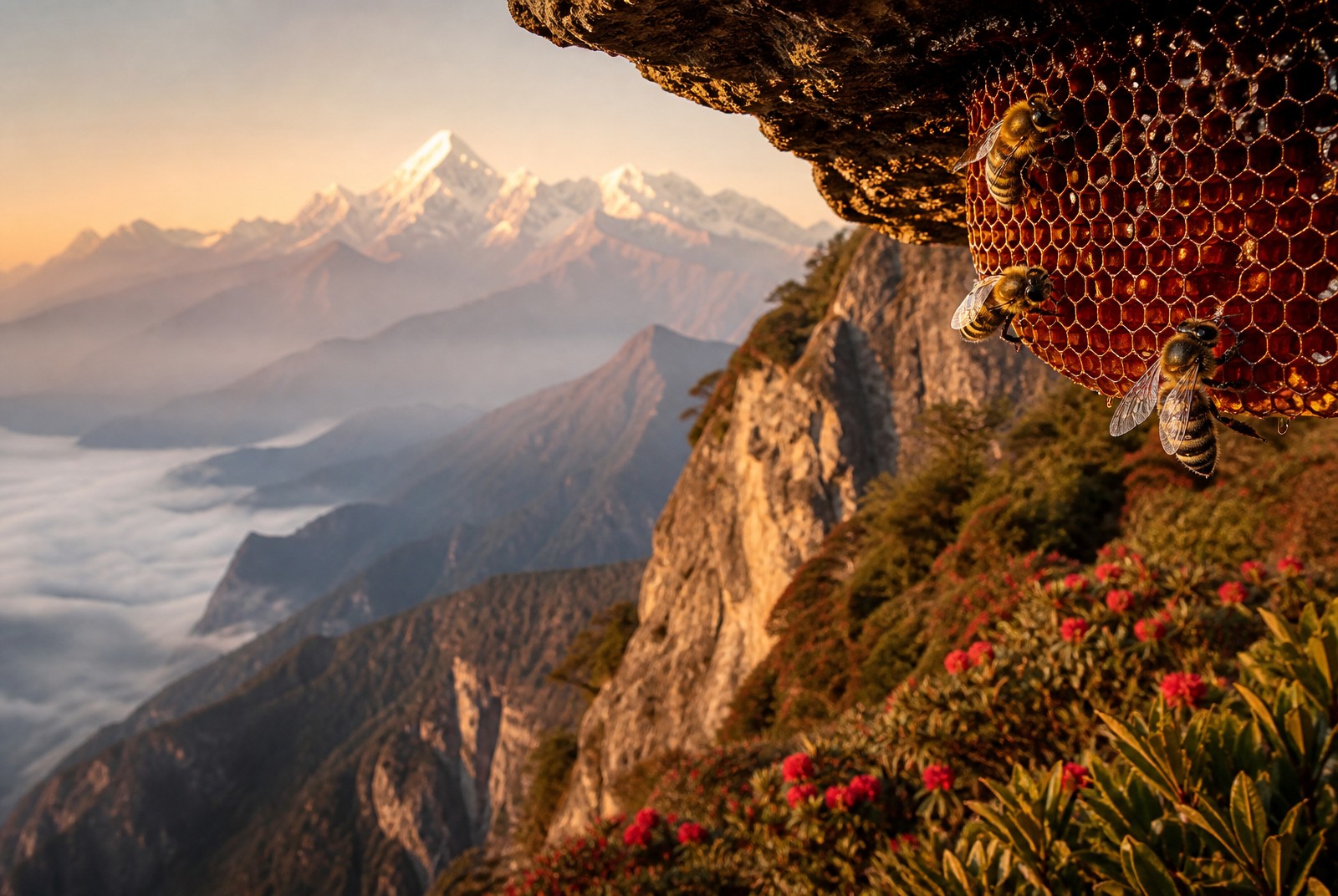
Honey from a cliff at 3,500 metres
Most honey comes from a beehive in a meadow. Mad honey does not. This dark-red honey is harvested on cliff faces in the Himalayas, above 3,500 metres, by the Gurung: an ethnic group in central Nepal that has been climbing vertical rock walls with rope ladders and bamboo poles for centuries to collect honeycombs that ordinary beekeepers will never see.
The bees that produce it, Apis laboriosa, are the world's largest honey bees, measuring up to 3 centimetres in length. They build massive combs under rock overhangs and forage on Rhododendron flowers. The nectar of those flowers contains grayanotoxin, a neurotoxin that gives the honey its remarkable properties. At Dutch-Smart we sell it as Real Mad Honey from Nepal, complete with lab analysis: 11,800 µg/kg Grayanotoxin I and 4,400 µg/kg Grayanotoxin III.
Grayanotoxin: the compound that makes mad honey special
Grayanotoxin is a group of diterpene neurotoxins found in plants of the Ericaceae family, particularly Rhododendron. It acts on voltage-gated sodium channels in your nervous system. Normally, these channels open and close rapidly to transmit signals. Grayanotoxin keeps them open longer, causing prolonged depolarisation of nerve cells.
The result is increased vagal tone: your parasympathetic nervous system becomes more active. In practice, this translates to a slower heart rate (bradycardia) and lower blood pressure (hypotension). At low doses, most people experience this as warmth, relaxation and subtly altered perception. Colours may appear slightly more vivid, sounds fuller.
Concentration varies significantly between batches. The bees do not forage from a single plant species, and the season (spring yields up to three times higher concentrations than autumn), altitude, Rhododendron species and weather all determine how much grayanotoxin ends up in the honey. For reference: the highest measured batch in the scientific literature (Vereenigde Laboratoria Amsterdam, April 2025) contained 35,038 µg/kg Grayanotoxin I. Our honey sits well below that at 11,800 µg/kg, but it is potent enough to produce noticeable effects from a single teaspoon.
The Gurung: honey hunting as a rite of passage
Harvesting mad honey is the domain of the Gurung, an ethnic group in the mountain regions of central Nepal, around the Annapurna and Manaslu massifs. The hunt takes place twice a year: in spring (March to May) and autumn (September to November), each time over a period of roughly two weeks.
Before the harvest, the Gurung perform rituals and prayers to the forest spirits and local deities. These ceremonies are not symbolic: the hunt is life-threatening. Hunters climb self-made rope ladders, sometimes tens of metres down vertical cliff faces, without protective clothing against the bees. Their tools are local: bamboo poles to dislodge the combs, baskets to catch the honey, knives to cut the wax.
Apis laboriosa does not build its combs in hive boxes but under rock overhangs at high altitude. A single comb can span more than a metre in width. The bees defend their colony aggressively; swarms delivering dozens of stings per minute are normal. The hunters smoke them away with smouldering bundles of branches lowered from the cliff top.
For the Gurung, honey hunting is more than gathering food. It is a rite of passage that tests courage and endurance: a young man who climbs for the first time proves his adulthood. The tradition is under pressure as more Nepalis move to cities or work abroad, and the number of experienced hunters is declining. Those who remain actively pass their knowledge to the young people who still show interest.
What does mad honey do to your body?
Effects typically begin 30 to 90 minutes after ingestion. The timeline depends on stomach contents, body weight and batch strength.
At a low dose (a quarter to a full teaspoon, or 1 to 5 grams), most users describe warmth in the chest, mild relaxation and subtly shifted perception. The feeling is sometimes compared to a mild cannabis effect, but without the sedated quality: you stay clear-headed.
At a higher dose (1 to 2 teaspoons, 5 to 10 grams), the effects become pronounced. Heart rate drops noticeably, the sense of relaxation deepens, and some users report mild euphoria or a dreamlike sense of time. Peak effects occur around 2 hours after ingestion, and the full experience lasts 4 to 6 hours.
Above 2 teaspoons, risks increase quickly. Dizziness, nausea, sweating, blurred vision and in severe cases fainting or cardiac arrhythmias have been documented in the medical literature. Most cases of grayanotoxin poisoning resolve within 24 hours on their own, but that is no reason to push the limits.
Dosage: specific and cautious
Always start low. This is not a marketing line; grayanotoxin concentration varies between batches, and you will not know your own sensitivity until the first time.
A quarter teaspoon (roughly 1 to 2 grams) is the safest starting point. Wait at least 90 minutes before considering a second dose. Most experienced users settle on 1 to 2 teaspoons (5 to 10 grams) per session.
The upper limit is 1 tablespoon (15 grams) per 24 hours. That is not a target but an absolute ceiling. Exceeding it significantly raises the risk of serious bradycardia and hypotension.
Three more rules:
- Never combine mad honey with alcohol. Both lower blood pressure, and the combination amplifies that effect disproportionately.
- Limit use to 2 to 3 times per week. Your body needs recovery time between sessions.
- Take it on an empty or lightly filled stomach if you want to feel the effect, and on a full stomach if you want to soften it.
The Real Mad Honey Nepal (50 grams) we sell contains 11,800 µg/kg Grayanotoxin I and 4,400 µg/kg Grayanotoxin III, measured via LC-MS/MS. That is potent enough for noticeable effects from a single teaspoon, yet well below the highest values found in the literature.
Frequently asked questions
How quickly does mad honey take effect?
Expect 30 to 90 minutes, depending on stomach contents and batch strength. Do not take more if you feel nothing after half an hour.
Is Nepalese mad honey different from Turkish?
Yes, in two ways. Nepalese mad honey is harvested at higher altitude (3,500+ metres) than the Turkish variety from the Kaçkar Mountains (1,500 to 2,500 metres), and the Rhododendron species differ: Nepal has primarily R. arboreum and R. campanulatum, Turkey R. ponticum and R. luteum. The Nepalese variety typically contains more grayanotoxin and is considered stronger.
Is mad honey dangerous?
At correct dosage (1 to 2 teaspoons), the effects are manageable and temporary for most healthy adults. Overdose can lead to serious bradycardia and hypotension. People with existing heart conditions, low blood pressure or those taking blood pressure medication should avoid mad honey. When in doubt, consult your doctor.
Can you combine mad honey with alcohol?
No. Both lower blood pressure. The combination significantly increases the risk of dizziness, fainting and cardiac arrhythmias.
How do you store mad honey?
At room temperature, dry and away from direct sunlight. Like all raw honey, it keeps almost indefinitely. Do not refrigerate: it crystallises faster, though the potency remains unchanged.
Mad honey at Dutch-Smart
We sell two sizes: Real Mad Honey Nepal, 50 grams for EUR 31.90 and Real Mad Honey Nepal, 250 grams for EUR 124.50. Both jars contain 100% unprocessed, unfiltered honey from the Himalayas, harvested at a minimum altitude of 3,500 metres. Every batch is tested for grayanotoxin content via LC-MS/MS and the values are printed on the label.
Browse the full range in our Real Mad Honey category.