
Say you swallow a gram of DMT. What happens? Nothing at all. Your body tears the molecule apart before it reaches your brain. Monoamine oxidase, an enzyme in your gut wall and liver, chops it into inactive fragments as if it were garbage. For most substances, that's a good thing. But DMT is not most substances.
Centuries ago, indigenous peoples in the Amazon discovered that DMT does work orally if you combine it with a plant that temporarily blocks that enzyme. The best-known source for that block is Banisteriopsis caapi, the vine from the classic ayahuasca brew. But there is a second plant that does the same thing, far more potent gram for gram, and it doesn't grow in the rainforest. It grows in the dry plains of Iran and around the Mediterranean. That plant is Peganum harmala, commonly known as Syrian rue.
What's in the seeds
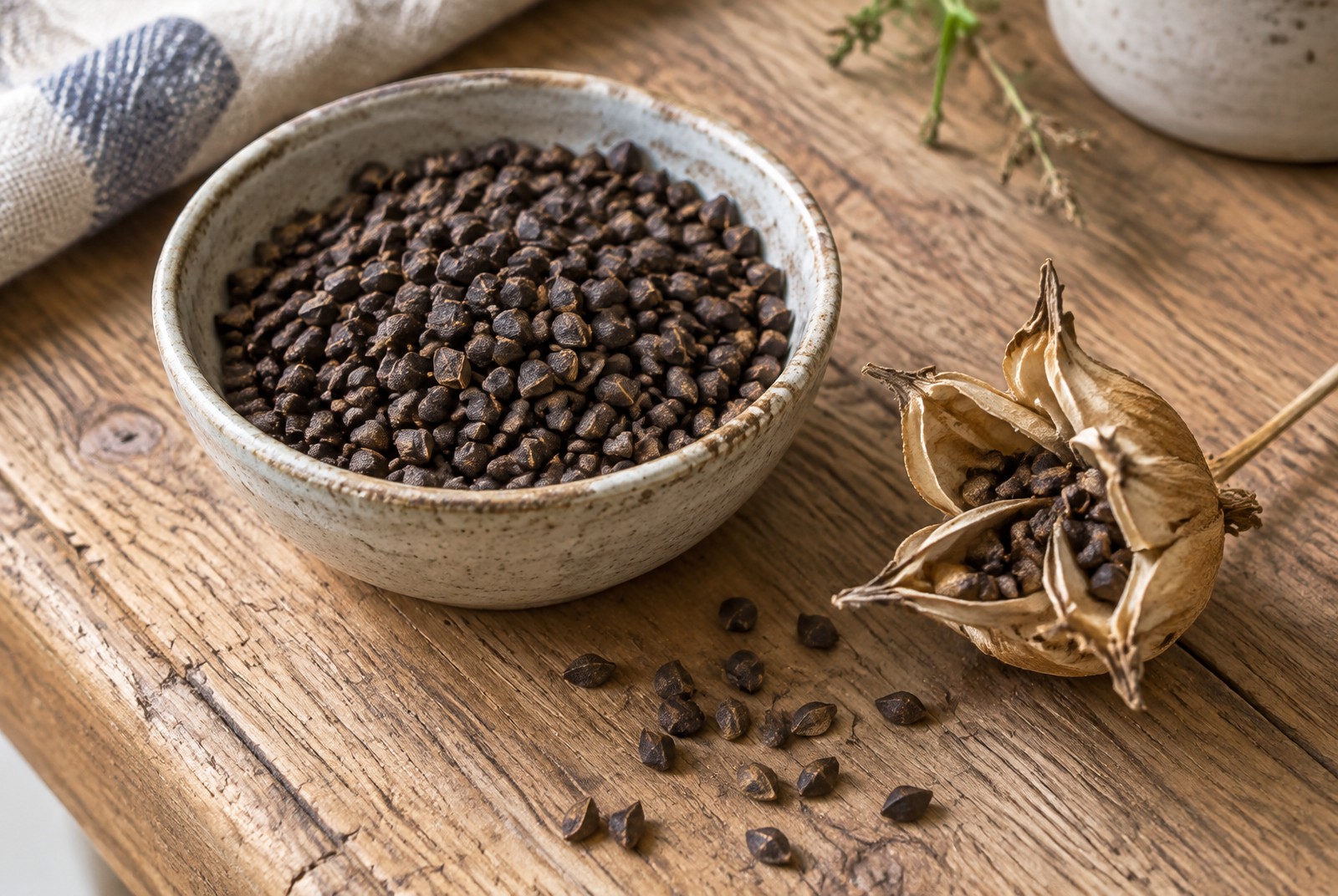
Peganum harmala seeds contain up to 6% beta-carboline alkaloids. The two main ones are harmine and harmaline, both reversible inhibitors of the enzyme MAO-A. Reversible means the block is temporary. After roughly six to twelve hours, the effect wears off and the enzyme functions normally again. That's a meaningful difference from pharmaceutical MAO inhibitors, which are often irreversible.
At Dutch Smart, we carry three forms of these alkaloids. Harmala Freebase is the pure freebase form. Harmine HCL Isolate 99% is harmine as a salt, highly soluble in water. And the Harmala TPA tinctures combine harmine, harmaline and tetrahydroharmine in a single liquid extract.
How MAO inhibition makes DMT orally active
DMT, dimethyltryptamine, is a powerful psychoactive tryptamine found naturally in dozens of plants. Psychotria viridis and Mimosa hostilis are the best known. Smoke DMT and it bypasses the gut entirely, reaching your brain in seconds. Drink it, and MAO in your gut wall breaks it down almost instantly into inactive metabolites.
Take an MAO-A inhibitor like harmine or harmaline first, and that enzyme gets blocked. The DMT survives the passage through your gut, enters the bloodstream via the liver and reaches your brain. That's the entire principle behind ayahuasca. A DMT source plus an MAO inhibitor. No mysticism, just enzyme chemistry.
The difference with Banisteriopsis caapi
In traditional Amazonian ayahuasca, the MAO inhibition comes from Banisteriopsis caapi, a vine that grows in tropical rainforest. The bark containes harmine, tetrahydroharmine and sometimes small amounts of harmaline. In total, less than one percent to just over one percent alkaloids. You need dozens of grams for an effective dose.
Peganum harmala is far more concentrated. The seeds contain four to six percent alkaloids. Three grams of seed delivers roughly as much harmine and harmaline as thirty to fifty grams of caapi bark!
Does that make it better? Our customers buy both, for different reasons. Caapi has a longer cultural tradition and contains tetrahydroharmine, which has its own mild psychoactive properties. Peganum harmala is more practical in terms of dosing and storage. And yes, we think that's something you figure out for yourself. But always start low.
Safety and interactions
MAO-A inhibitors are not harmless supplements. Harmine and harmaline block the enzyme that breaks down serotonin and noradrenaline, among other things. Combine them with a substance that raises serotonin, think SSRIs, MDMA or St. John's Wort, and you risk serotonin syndrome. That can be life-threatening. This is not an exaggerated warning.
Then there's tyramine. Is it dangerous in combination with harmaline? The short answer is that the risk is smaller than with the the classic pharmaceutical MAO inhibitors. Harmine and harmaline selectively inhibit MAO-A and are reversible. MAO-B, which also breaks down tyramine, remains active. But "smaller risk" is not "no risk". Avoid aged cheese, red wine, sauerkraut and other fermented foods in the twelve hours around use. Just do it.
We always advise against combining psychoactive substances with MAO inhibitors unless you know exactly what you're doing. If you're on medication, talk to your doctor.
Legal status in the Netherlands
The plant Peganum harmala and its seeds are not listed under the Dutch Opium Act. They are legal to buy and possess in the Netherlands. DMT as a substance is on List I. That makes preparing a brew with DMT-containing plants a legal grey area, because the plant is legal but the isolated molecule is not.
France has banned Peganum harmala, Canada too. In the rest of Europe, the status varies by country. We sell our harmala products as botanical preparations. How you use them is your own responsibility!
A desert plant with a long past
Peganum harmala grows wild from Iran and Afghanistan to the coasts of the Mediterranean and North Africa. In the Middle East, people have known the plant for centuries as esfand or harmel. In Iran they burn the seeds as incense at celebrations and religious gatherings, to ward off evil spirits. The psychopharmacological effect was only understood in the twentieth century, but the ritual use goes much further back.
Want to learn more about the other side of the ayahuasca formula, the DMT source? Read our blog about Jurema Preta and DMT.