
Bai zhu is a dried root that most Westerners have never heard of, yet in China it's been a staple of herbal medicine for roughly two thousand years. It appears in the Shennong Ben Cao Jing, one of the oldest Chinese herbal texts, where it's considered as important as ginseng. We stock it at Dutch-Smart as dried root pieces, and honestly, we think it deserves more attention than it gets!
What is bai zhu?
Bai zhu is the dried rhizome of Atractylodes macrocephala, a plant from the daisy family (Asteraceae) that's cultivated in southern China. The name translates roughly to "white zhu", and in English you sometimes see it called "largehead atractylodes" or "white atractylodes". The plant itself grows forty to sixty centimetres tall, with coarsely toothed leaves and purplish flowers. But the plant above ground isn't the point. What matters is the root, which is harvested in winter after the rest of the plant has died back.
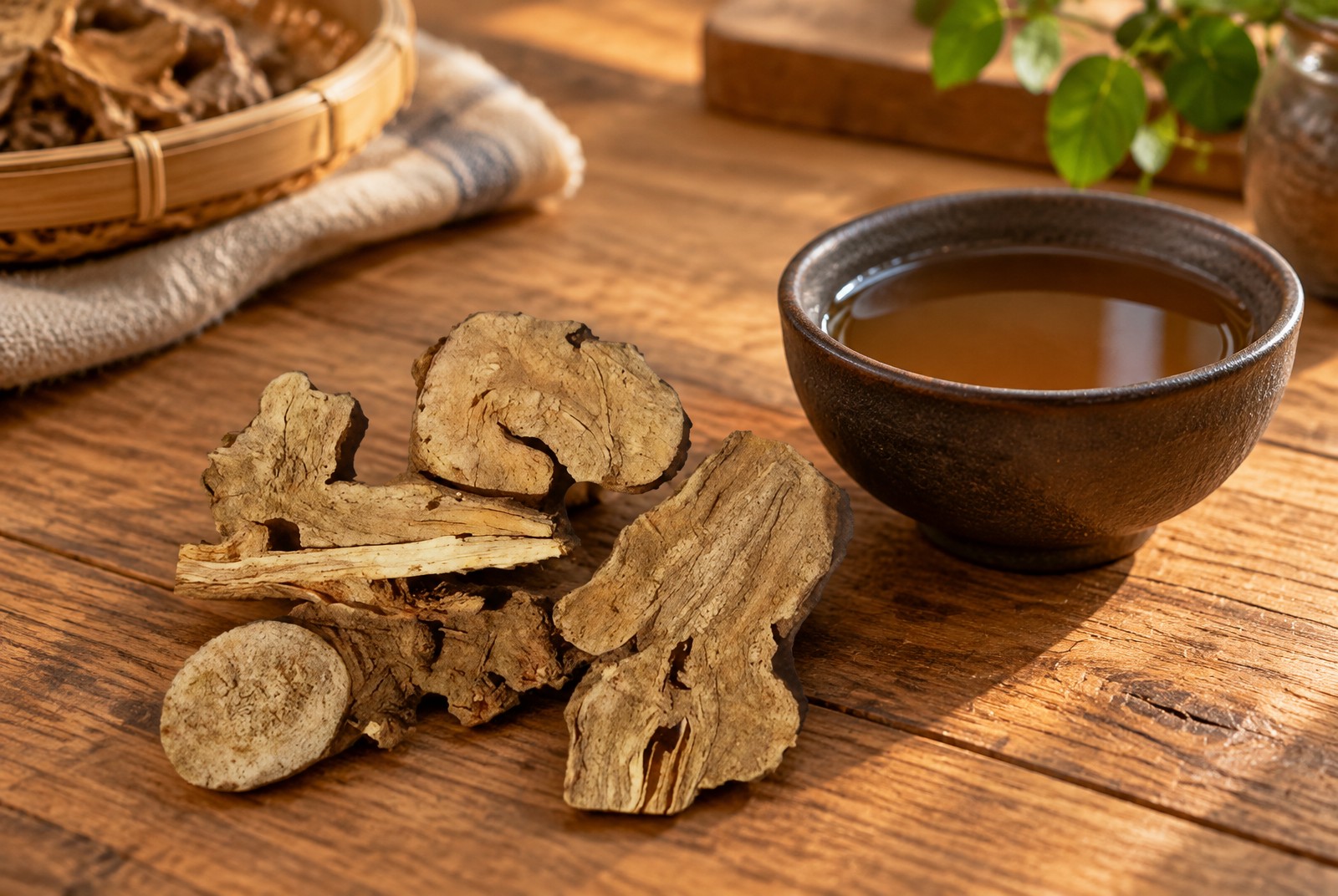
What you get are irregular, yellowish-beige chunks with an earthy smell and a mildly bitter taste. The thing is, they don't look or smell particularly special. Neither do most dried roots.
Why Chinese doctors prescribe it so often
In traditional Chinese medicine, bai zhu is classified as bitter and sweet in flavour, warm in nature, and it acts on the spleen and stomach meridians. What that means in practice: when a patient walks in with poor digestion, fatigue and bloating, bai zhu is typically the first herb a TCM practitioner reaches for. The idea is that the spleen governs nutrient transport, and bai zhu strengthens that function.
The herb is one of the eight famous specialities from Zhejiang province and a core ingredient in Si Jun Zi Tang, the "four gentlemen" formula. That's a foundational recipe in TCM, comparable to how chamomile or valerian are go-to herbs in European herbalism.
Does it actually work? There's no clinical evidence at the standard we expect in Europe. Most research involves animal and cell studies, and those don't translate directly to humans. What we do know is that Chinese practitioners have prescribed it consistently for centuries and millions of people use it daily. That's not proof, but it isn't nothing either.
What's inside the root?
Researchers have identified over 120 compounds in bai zhu. The three main groups are sesquiterpenoids, polysaccharides and polyacetylenes. Among the sesquiterpenoids, atractylenolides I, II and III are the best studied. In 2024, Chinese researchers discovered new compounds, including a type of sesquiterpenoid dimer that showed activity against liver cancer cells in lab studies.
Sounds complicated? It really isn't. The bottom line is that bai zhu is a complex root with many active compounds, most of which we don't fully understand yet. If you read on supplement websites that bai zhu is "clinically proven" to treat all sorts of conditions, take that with a large grain of salt.
Making a decoction
Bai zhu is a hard, woody root. You can't steep it like chamomile or lavender. You need to boil it, the same way you'd prepare muira puama.
Put 6 to 12 grams of dried bai zhu in a pot with 400 to 500 ml of cold water. Bring it to a boil slowly, then let it simmer on low heat for 20 to 30 minutes until the water has reduced by roughly a third. Strain out the root pieces. What you're left with is a light brown, mildly bitter decoction that you drink warm, with a teaspoon of honey if you like.
Can you drink it cold? Yes, but traditionally it's consumed warm because bai zhu is considered a warming herb. Want to combine it with other herbs? Si Jun Zi Tang is the classic starting point, but if you've never done that beforre, just start with bai zhu on its own.
Dosage and precautions
The standard TCM dosage is 6 to 15 grams per day, as a decoction. We recommend starting with 6 grams and seeing how you respond. More isn't necessarily better.
There are two forms in TCM: raw bai zhu, which is said to primarily drain dampness, and dry-fried bai zhu, which is said to focus more on strengthening the spleen. What we sell is the unprocessed, dried root.
Don't use it if you experience excessive thirst and night sweats, have an autoimmune condition, or are pregnant or breastfeeding. On medication? Talk to your doctor or a TCM practitioner first. That's not advice we can give as a shop, and we won't pretend otherwise.
Bai zhu is not a miracle cure and we don't sell it as one. It's a dried herb with a long tradition, and if you're interested in TCM or want to try making decoctions yourself, it's a solid starting point. You can find our bai zhu here in the shop, alongside herbs like annona muricata. Want to read more about preparing herbs? Check our blog on making your own tincture.