


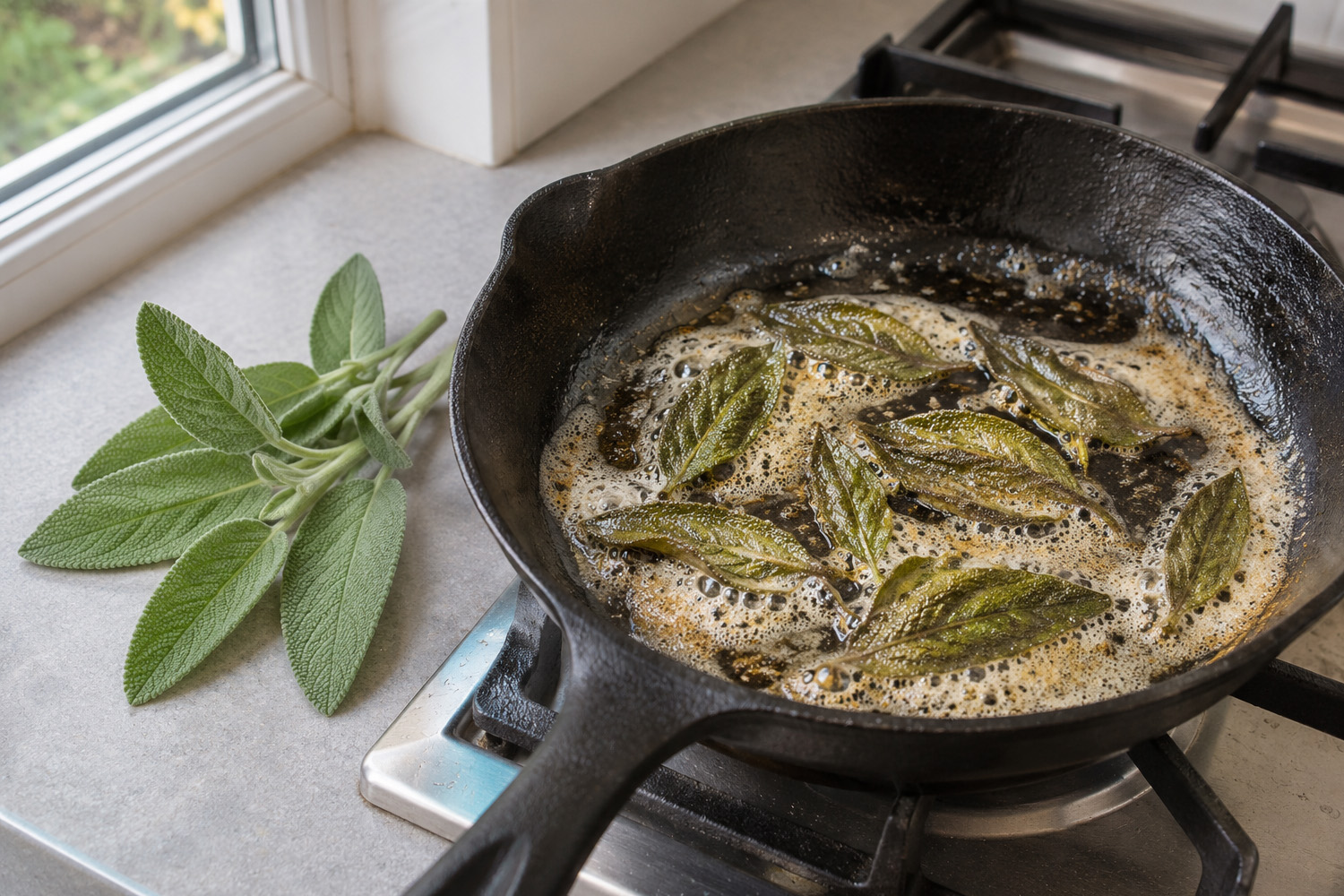
True sage is the grey-green kitchen herb with velvety, wrinkled leaves that you know from sage butter and saltimbocca. You can also make a strong, herbal tea from it, using fresh leaves from the garden or dried leaf. In this guide you'll learn how to tell true sage from the other sages, how to make sage tea, how to sow, prune and harvest the plant yourself, and why you shouldn't drink sage tea every day for weeks on end.
What is true sage?
True sage (Salvia officinalis), also called common sage or garden sage, is an evergreen subshrub from the mint family (Lamiaceae), just like rosemary, thyme and mint. The plant originally comes from the northern Mediterranean and grows 30 to 70 centimetres tall. The stems turn woody at the base. From May to July, true sage flowers with blue-purple, lipped flowers in whorls around the stem, which attract bees and bumblebees.
The name Salvia comes from the Latin salvare, to save or heal, and refers to the plant's long history in the European herb garden. There are also ornamental forms with purple, golden-variegated or tricolour leaves. You can use those just as well in the kitchen and for tea.
True sage or another sage?
There are hundreds of species of sage, and a few plants are called sage without being one. Only true sage is the classic tea and kitchen herb. Here's how to tell them apart:
| True sage | White sage | Wood sage | Russian sage | |
|---|---|---|---|---|
| Botanical name | Salvia officinalis | Salvia apiana | Teucrium scorodonia | Salvia yangii (formerly Perovskia) |
| Leaf | Grey-green, elongated, velvety and wrinkled | Broad, silvery white | Green, triangular to oblong, slightly wrinkled | Finely cut, silvery grey |
| Flower | Blue-purple, May to July | White to pale lilac | Pale green to yellowish | Lavender blue, long spikes in late summer |
| Where | Herb garden, pot on a balcony | Wild in California and Mexico | Wild in the Netherlands, on sandy soil in woods and heath | Ornamental gardens |
| Use | Tea and cooking | Burning, smudging | Don't use | Ornamental plant |
You may know white sage from smudge sticks. You can read how to burn it in our blog on smudging with white sage. Salvia divinorum is also a sage, but a completely different plant with a strong psychoactive effect. You'll find it in its own category, Salvia divinorum, and it doesn't belong in your tea.
What's in it?
True sage leaves contain essential oil with compounds such as cineole, camphor and thujone. They also contain tannins and rosmarinic acid. Together these give sage its herbal, slightly bitter and somewhat astringent taste. How much essential oil and thujone the leaf contains varies by plant, variety and harvest time. In large amounts, thujone is harmful to the nervous system, which is why there are limits to how much sage you should drink (see Safety). Sage has traditionally been drunk as a tea and used as a gargle. No health claims have been approved in the EU for sage, so we don't promise any effects either.
Which form should you choose?
| Form | Use | Best for |
|---|---|---|
| True sage, dried leaf | Tea, 1 to 2 grams per cup | Anyone who wants to make tea right away |
| True sage seeds | Sow your own | Anyone who wants sage in the garden or on the balcony |
| Fresh leaves from your own garden | Tea and cooking, 4 to 6 leaves per cup | Anyone who already has a plant |
You'll find more herbs for tea among our relax herbs, herbal remedies and in the tea category.
Making sage tea in 5 steps
- Take 1 to 2 grams of dried sage leaf, about 1 to 2 teaspoons.
- Pour a cup of boiling water over it, about 150 ml.
- Cover the cup, so the essential oil doesn't escape with the steam.
- Let the tea steep for 5 to 10 minutes. Longer makes it bitter.
- Strain out the leaves. A slice of lemon or a teaspoon of honey softens the taste. Drink no more than three cups a day.
Tea from fresh sage
Pick 4 to 6 fresh leaves, rinse them and tear them into pieces to release the scent. Pour a cup of boiling water over them and let them steep, covered, for 5 to 10 minutes. Fresh sage tastes fresher and less bitter than dried. It's nice combined with a sprig of rosemary or a slice of ginger.
Sage in the kitchen
Sage goes well with rich, savoury dishes. For sage butter, melt a generous knob of butter in a pan, fry a handful of fresh sage leaves in it until they're crisp and the butter turns light brown, then spoon it straight over pasta, gnocchi or pumpkin. Sage also works well in saltimbocca, with pork and chicken, and in stuffing for poultry.
Growing sage yourself
True sage is easy to grow, keeps going for years and is largely hardy, as long as the soil doesn't stay wet in winter.
Sowing in 5 steps
- Sow indoors in March or April, or outdoors from mid-May.
- Place the seeds on moist seed compost and cover them with a thin layer of about half a centimetre.
- Put the tray somewhere bright at about 20 °C and keep the soil moist, not wet.
- After one to three weeks the seedlings appear. Prick them out once they have a few true leaves.
- Plant them out after mid-May, about 40 to 50 centimetres apart, or in a pot at least 25 centimetres wide.
The right spot and pruning
Sage wants full sun and dry, well-draining, preferably chalky soil. Wet feet in winter are its worst enemy: the roots rot. Give little water and no fertiliser, and the flavour stays at its strongest. In April, cut the plant back by a third, but never cut into the bare, woody part without leaves: sage won't regrow from there. After flowering you can cut off the spent stems. After four to five years a plant often becomes woody and bare. Take 10-centimetre cuttings in summer and let them root in a pot of sandy soil.
Harvesting and drying
- You can pick a few leaves all year round. For drying, harvest just before flowering, on a dry morning.
- Cut whole stem tips of 10 to 15 centimetres, which keeps the plant compact.
- Tie them into small bunches and hang them upside down somewhere dark and airy, or dry the leaves in a food dehydrator at no more than 35 °C.
- After one to two weeks they're dry when they crackle between your fingers.
- Strip the leaves from the stems and store them whole in a dark, airtight jar. That way they keep for about a year. Only crumble them just before use.
Safety
- Not too much and not too long: stick to a maximum of three cups a day and don't drink it for more than two weeks in a row. That's because of the thujone in the leaf.
- Don't take the essential oil: pure sage oil contains much more thujone and can cause seizures in large amounts.
- Pregnant or breastfeeding: don't drink sage tea. Normal use as a kitchen herb in food is fine.
- Children and teenagers under 18: don't give them sage tea, its safety hasn't been established for them.
- Epilepsy or medication: check with your doctor or pharmacist first.
- Allergy: if you're allergic to the mint family, such as mint or rosemary, be careful.
Common mistakes
- Using ornamental sage or wood sage: only Salvia officinalis is the tea and kitchen herb.
- Pruning into bare wood: nothing will grow back from there. Always leave green leaves on the branches.
- Watering too much: sage comes from a dry climate and rots in wet soil.
- Feeding it: that gives lots of leaf with little flavour.
- Storing the leaves crumbled: the scent fades quickly. Store them whole.
- Sage tea every day for months: take a break after two weeks.
- Letting the plant go woody: take cuttings for a new plant in time once the old one turns woody.
Frequently asked questions
How do you make tea from fresh sage?
Tear 4 to 6 fresh leaves into pieces, pour a cup of boiling water over them and let them steep, covered, for 5 to 10 minutes.
Is sage tea healthy?
Sage has been used as a tea and gargle for centuries, but no health claims have been approved in the EU for sage. Drink it in moderation: no more than three cups a day and not for more than two weeks in a row.
How much sage tea can you drink per day?
No more than three cups, each with 1 to 2 grams of dried leaf. Take a break after two weeks.
Is sage hardy?
Yes, true sage can handle about minus 15 °C, as long as the soil drains well. In a pot it's more vulnerable: put it somewhere sheltered against a wall in winter.
What's the difference between true sage and white sage?
True sage (Salvia officinalis) is the grey-green kitchen herb for tea and food. White sage (Salvia apiana) has broad, silvery white leaves and is mainly burned for smudging.
Where can I buy sage?
You'll find dried true sage among our relax herbs and the true sage seeds among our exotic seeds.
Sources: Wikipedia (EN), Salvia officinalis, EMA, Assessment report Salvia officinalis folium, Wikipedia (EN), Teucrium scorodonia.


