


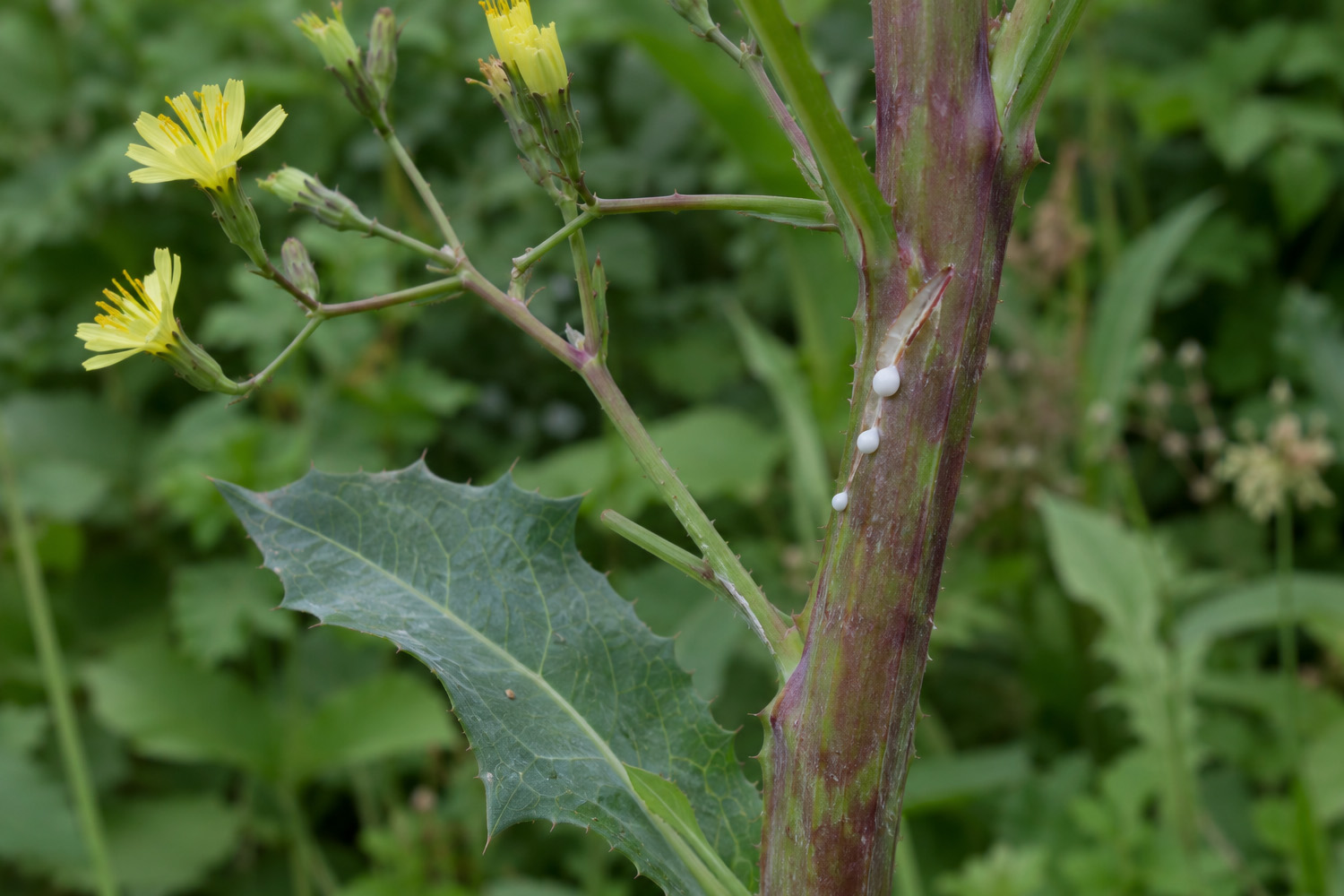
Wild lettuce, also called bitter lettuce or great lettuce, is a relative of the lettuce on your plate, only almost two metres tall and full of bitter milky sap. That sap, lactucarium, was sold in 19th-century pharmacies as "lettuce opium". In this guide you'll learn how to recognise true wild lettuce and tell it apart from the much more common prickly lettuce, what's in the plant, which form suits you, how to grow and harvest it yourself, how to make tea and what to keep in mind.
What is wild lettuce?
Wild lettuce (Lactuca virosa) belongs to the daisy family (Asteraceae), just like garden lettuce, dandelion and chamomile. The plant is biennial: in its first year it forms a flat rosette of leaves, and in its second year it sends up a sturdy flowering stem 1 to 2 metres tall, topped with a loose panicle of small, pale yellow flower heads. After that it sets seed and dies.
Wild lettuce is native to Western and Southern Europe. In the Netherlands it's rare and mainly found in sunny, chalky places: in the dunes, along dykes, roadsides and canal banks. The species name virosa means poisonous and refers to the white milky sap that drips from any damaged stem or leaf vein. Despite the nickname "lettuce opium", the plant contains no opiates.
Wild lettuce, prickly lettuce or sowthistle?
The plant you'll most often see on roadsides and waste ground is prickly lettuce. It looks a lot like wild lettuce. Common sowthistle also has milky sap and is regularly mistaken for wild lettuce. Here's how to tell them apart:
| Wild lettuce | Prickly lettuce | Common sowthistle | |
|---|---|---|---|
| Botanical name | Lactuca virosa | Lactuca serriola | Sonchus oleraceus |
| In the Netherlands | Rare, mainly dunes and chalky roadsides | Very common on roadsides and waste ground | Very common, also in vegetable gardens |
| Height | Up to about 2 metres | Usually 0.5 to 1.5 metres | 30 centimetres to 1 metre |
| Stem | Often flushed purple to dark red | Usually greenish to pale yellow | Hollow and smooth |
| Leaf | Large, blue-green, wavy, midrib often purplish red | Flat, often deeply lobed, whitish midrib | Soft, clasps the stem with pointed lobes |
| Flower head (open) | About 17 to 20 mm, flowers from June | About 8 to 10 mm, flowers a little later | Larger, about 20 to 25 mm, yellow |
| Seed | Purple to very dark maroon, blackish when dried | Olive-grey to brown | Brown, wrinkled |
| Smell of the sap | Like opium poppy | Like garden lettuce | Neutral |
Prickly lettuce is also called compass plant, because in full sun its leaves often turn upright along a north-south line. That isn't a reliable feature, as wild lettuce sometimes twists its leaves upright too. The colour of the ripe seed is the best clue. If you have any doubt about a wild plant, don't use it. With cultivated seeds or the dried Wild Lettuce herb, you know for sure you have Lactuca virosa.
What's in it?
The milky sap of wild lettuce is called lactucarium. It contains bitter compounds known as sesquiterpene lactones, with lactucin and lactucopicrin as the best known. They give it its bitter taste. The concentration is highest during flowering and varies widely by plant, growing site and harvest time. Wild lettuce has traditionally been used as an evening herb. No health claims have been approved in the EU for wild lettuce, so we don't promise any effects either.
Which form should you choose?
| Product | Form | Use | Best for |
|---|---|---|---|
| Wild Lettuce herb | Dried, cut leaf | Tea, 1 to 2 teaspoons per cup | Anyone who wants to brew or blend their own tea |
| Wild Lettuce extract | Concentrated extract | 0.5 to 1 gram per cup of hot water | Anyone who wants to use less leaf |
| Wild Lettuce TPA alkaloid extract | Liquid extract | Start with 5 to 10 drops | Anyone who doesn't want to brew tea |
| Wild Lettuce seeds | 10 seeds | Growing your own | Anyone who wants the plant in their garden |
You'll find more concentrated herbs among our herbal extracts and liquid alkaloid extracts.
Making wild lettuce tea in 5 steps
- Take 1 to 2 teaspoons of dried wild lettuce herb. If you use the extract, take 0.5 gram.
- Pour a cup of boiling water over it, about 200 ml.
- Cover the cup and let the herb steep for 10 to 15 minutes. The extract only needs 5 minutes.
- Strain out the herb. The taste is very bitter, a teaspoon of honey or a splash of lemon softens it.
- Preferably drink it in the evening and always start at the low end. That way you first find out how you react to it.
Tasty combinations
The bitterness of wild lettuce fades in a blend with milder herbs. Try it with passionflower or a pinch of valerian for a classic evening tea. Read in our blogs how to grow passionflower and make tea from it and how to make valerian tea. You'll find more herbs for a quiet evening among our relaxing herbs.
Growing wild lettuce yourself
Wild lettuce is a tough plant that asks for very little. Do give it space: in its second year it's an imposing plant, best at the back of a border or along a fence.
Sowing in 5 steps
- Sow in spring, from March to May, or in autumn. Autumn-sown seed overwinters as a rosette and flowers the following summer.
- Scatter the seeds on well-draining seed compost and press them in. Cover them with no more than a few millimetres of soil.
- Keep the soil lightly moist at about 18 to 20 °C. Germination takes one to several weeks.
- Prick out the seedlings once they have a few true leaves.
- Plant them out in a sunny spot, about 40 centimetres apart.
The right spot and care
Choose full sun or light partial shade and dry to average, well-draining soil. Wild lettuce is happy in chalky and sandy soil. It doesn't like wet feet: permanently wet soil causes root rot. If you let the plant set seed, it will self-sow. If you don't want that, cut off the spent flower panicles before the fluff blows away.
Harvesting and drying
- Leaves: pick the large leaves from the flowering stem in summer, just before or during flowering.
- Milky sap: during flowering, cut off the top of the stem. Collect the white sap that seeps from the cut with a small knife, or let it dry on the stem into a brown, resin-like mass. Over the following days, cut a little lower each time for fresh sap.
- Wear gloves: the sap is sticky and can irritate your skin.
- Dry the leaves on a rack somewhere dark and airy, or in a food dehydrator at no more than 40 °C.
- Store the dried herb in an airtight jar, somewhere cool and dark. That way it keeps for a year.
Safety
- 18+: wild lettuce is for adults only. Not for children, and don't use it if you're pregnant or breastfeeding.
- Drowsiness: wild lettuce can make you drowsy. Don't drive or operate machinery after using it.
- Don't combine with alcohol, sleeping pills, sedatives or prescription painkillers. If you take medication, check with your doctor or pharmacist first.
- Too much: higher doses can actually cause restlessness, dizziness, nausea, dilated pupils and a fast heartbeat. If that happens, stop and take less next time.
- Don't use it if you have glaucoma, difficulty urinating or an allergy to the daisy family, such as chamomile, ragweed or dandelion.
- Mix-ups: don't just pick wild lettuce from the roadside. Only use plants you're certain are Lactuca virosa.
Common mistakes
- Mistaking prickly lettuce for wild lettuce: the species on the roadside is almost always prickly lettuce. Look for the purple-flushed stem, the purple seed and the smell of the sap.
- Too much at once: start with the smallest amount and only increase once you know how you react.
- Trying to harvest in the first year: there's only a rosette then. You get the milky sap from the flowering stem in the second year.
- Sowing the seed too deep: a few millimetres of soil is enough.
- Choosing a wet spot: wild lettuce likes dry, well-draining soil.
- Harvesting without gloves: the milky sap is sticky and can irritate.
Frequently asked questions
Is wild lettuce the same as garden lettuce?
No. It's a relative from the same genus, Lactuca, but it's a wild, bitter species with much more milky sap. Garden lettuce contains a little lactucarium too, but far less.
Does wild lettuce contain opium?
No. The nickname "lettuce opium" comes from the milky sap, which resembles the sap of the opium poppy. Wild lettuce contains no opiates.
Is wild lettuce legal?
Yes. In the Netherlands wild lettuce is freely available as an herb, extract and seed. You do need to be 18 or older.
How do I recognise wild lettuce in nature?
Look for a tall plant up to 2 metres with a purple-flushed stem, purplish red midribs, large flower heads and purple to dark maroon seed. The sap smells like opium poppy. Prickly lettuce has whitish midribs, smaller flower heads and olive-grey seed, and its sap smells like garden lettuce.
When does wild lettuce flower?
In the summer of its second year, usually from June. That's also when the milky sap is strongest.
Where can I buy wild lettuce?
You'll find the dried Wild Lettuce herb among the relaxing herbs, the Wild Lettuce extract among the herbal extracts, the TPA alkaloid extract among the liquid extracts and the Wild Lettuce seeds among our exotic seeds.
Sources: Wikipedia (NL), Gifsla, Wikipedia (EN), Lactuca virosa, BSBI Plant Crib, Lactuca.


