


Chamomile is probably the best-known tea herb there is. Yet on roadsides you'll often find a plant that looks just like it but smells of nothing. You can recognise true chamomile by one simple feature: cut the yellow centre in half and it's hollow. In this guide you'll learn how to tell true chamomile from its lookalikes, what's in it, how to make a good cup of chamomile tea, how to sow, harvest and dry chamomile yourself, and what to keep in mind.
What is true chamomile?
True chamomile, also called German chamomile (Matricaria chamomilla, also Matricaria recutita), is an annual from the daisy family (Asteraceae). It grows 15 to 50 centimetres tall, has finely divided, feathery leaves and flowers from May to September with small flower heads: a yellow, cone-shaped centre with a ring of white ray florets. After a few days of flowering, those white ray florets bend downwards. The whole plant smells sweet and herbal, a little like apple.
Chamomile grows wild throughout Europe and is common in the Netherlands on farmland, roadsides and waste ground. The name Matricaria comes from the Latin matrix, womb, because the plant was once used mainly for women's complaints.
True chamomile or a lookalike?
Several plants have white ray florets and a yellow centre. Only true and Roman chamomile are suitable for tea. Here's how to tell them apart:
| True chamomile | Scentless mayweed | Corn chamomile | Roman chamomile | |
|---|---|---|---|---|
| Botanical name | Matricaria chamomilla | Tripleurospermum maritimum | Anthemis arvensis | Chamaemelum nobile |
| Centre cut in half | Hollow, cone-shaped | Solid, domed | Solid, with small scales between the florets | Solid, with small scales between the florets |
| Scent | Strong, sweet, a little like apple | Almost none | Faint | Strong, herbal |
| Flower | Small, 1.5 to 2.5 cm, ray florets bend down after flowering | Larger, 3 to 4.5 cm | 2 to 3 cm | Often double, with many white ray florets |
| Lifespan | Annual | Annual to short-lived | Annual | Perennial, low and creeping |
| For tea | Yes | No | No | Yes, tastes more bitter |
The quickest test: crush a flower head and smell it, and cut one in half. If it smells strong and the centre is hollow, you have true chamomile.
What's in it?
The flower heads contain essential oil with compounds such as alpha-bisabolol and matricin. When steamed or distilled, matricin turns into chamazulene, which colours chamomile oil deep blue. Chamomile also contains flavonoids such as apigenin. How much of each compound it contains depends on the origin, the harvest time and how fresh the herb is. Chamomile has traditionally been drunk as an evening tea and after meals. No health claims have been approved in the EU for chamomile, so we don't promise any effects either.
Which form should you choose?
| Form | Use | Best for |
|---|---|---|
| Dried flower heads | Tea, 1 tablespoon per cup | Anyone making tea from their own harvest |
| True chamomile 1:1 extract | Drops in water, start with a small number | Anyone who doesn't want to brew tea or wants to add chamomile to another drink |
| Homemade tincture | Drops in water | Anyone who grows chamomile and wants to keep it for a long time |
Want to make your own chamomile tincture? Read our blog on how to make a herbal tincture. You'll find more ready-made extracts among our tinctures.
Making chamomile tea in 5 steps
- Take 1 tablespoon of dried chamomile flowers, about 2 to 3 grams. Fresh flowers? Use twice as much.
- Pour a cup of boiling water over them, about 150 to 200 ml.
- Cover the cup, so the essential oil doesn't escape with the steam.
- Let the tea steep for 5 to 10 minutes. Shorter is milder, longer gets more bitter.
- Strain out the flowers and drink the tea warm. Stick to a maximum of three cups a day.
Tasty combinations
Chamomile is mild and blends easily. Try it with lemon balm for something fresh, a pinch of lavender for a floral evening tea, or together with passionflower or valerian. You can read how to grow and brew those last two in our blogs on passionflower and valerian. You'll find more herbs among our herbal remedies and in the tea category.
Growing chamomile yourself
True chamomile is one of the easiest herbs to sow. It grows fast, flowers about eight weeks after sowing and self-seeds, so you'll see it back every year.
Sowing in 5 steps
- Sow in spring, from March to May, or in September. Autumn-sown seed overwinters as a small plant and flowers early the following summer.
- Mix the tiny seed with some sand, so you sow more thinly.
- Scatter it on the soil and press it in. Don't cover it: chamomile only germinates in the light.
- Keep the soil moist until the seedlings appear, after one to two weeks.
- Thin them out to about 15 to 20 centimetres between plants.
The right spot
Choose a sunny spot. Chamomile isn't fussy about soil: poor, sandy or clay soil is fine, as long as it doesn't stay too wet. There's no need to feed it, on rich soil you mainly get leaves and fewer flowers. It also grows well in a container or pot on a balcony or windowsill.
Harvesting and drying
- Harvest the flower heads on a dry, sunny morning, when they're fully open and the white ray florets still stick straight out.
- Pick them with your fingers or a chamomile rake, with as little stem as possible.
- Harvest every few days. The more often you pick, the longer the plant keeps producing new flowers.
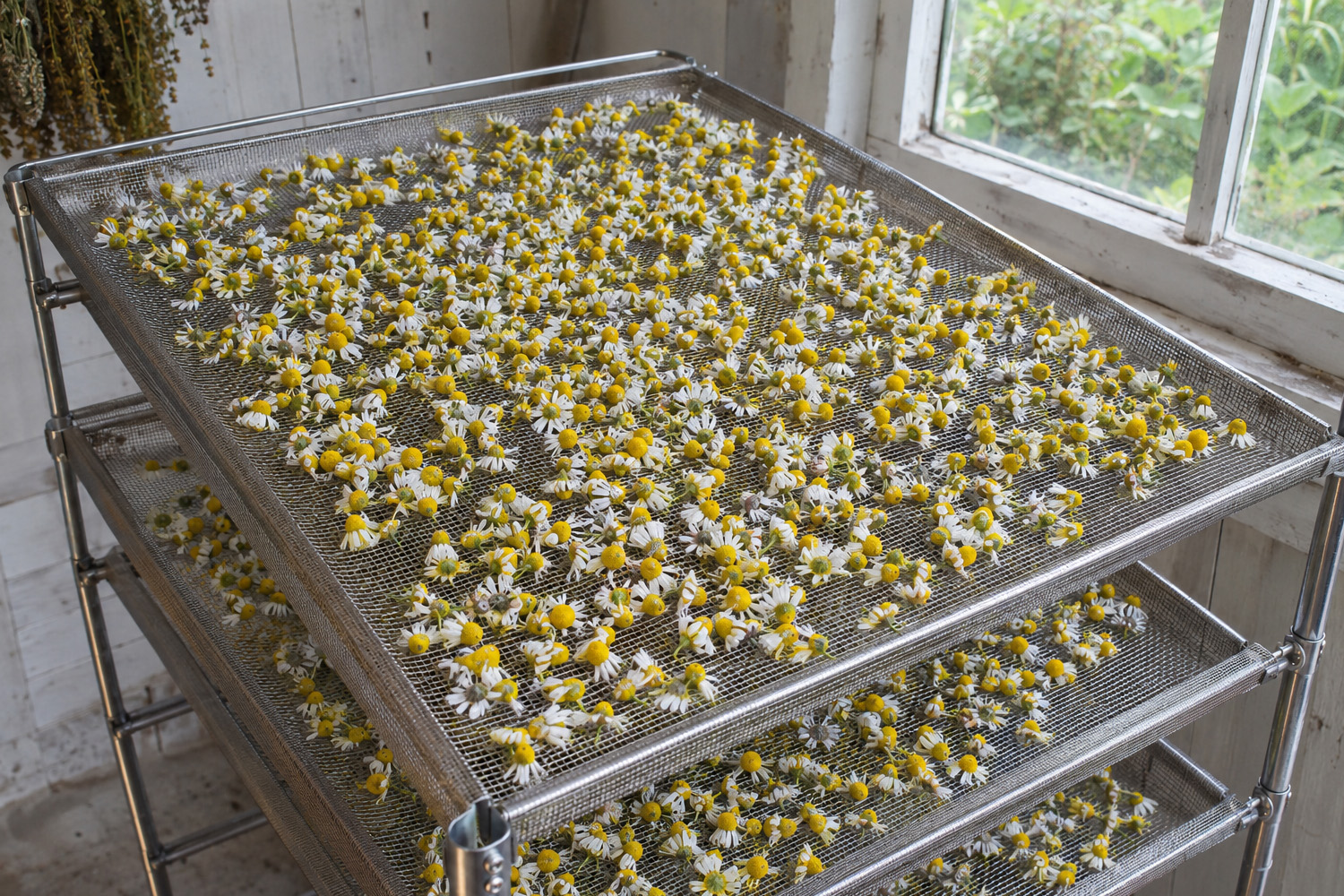
- Dry the flowers in a thin layer on paper or a rack somewhere dark and airy, or in a food dehydrator at no more than 35 °C. Higher temperatures cost essential oil.
- Once they're completely dry and crisp, store them in a dark, airtight jar. That way they keep for about a year.
Safety
- Allergy: if you're allergic to the daisy family, such as ragweed, mugwort, chrysanthemum or ox-eye daisy, don't use chamomile. If you have hay fever caused by mugwort or birch, chamomile can trigger a cross-reaction.
- Not in your eyes: don't use chamomile tea as an eye compress or eye wash.
- Medication: if you take blood thinners or other medication, check with your doctor or pharmacist first.
- Pregnant or breastfeeding: safety hasn't been established, so don't use it without checking with your doctor or midwife.
- Children: don't give the extract to children under 12, and only give chamomile tea to babies and young children after checking with your GP.
- An unexpected reaction: if you get itching, a rash or shortness of breath, stop immediately.
Common mistakes
- Picking scentless mayweed: the large chamomile-like flower on the roadside is often the wrong one. Smell it and cut the centre in half.
- Covering the seed: chamomile germinates in the light. Just press it in.
- Harvesting too late: once the centre turns brown and the ray florets droop, the flower is past its best.
- Drying too warm: above 35 °C the scent disappears, and with it the flavour.
- Steeping without a lid: the essential oil evaporates with the steam.
- Steeping too long: after fifteen minutes chamomile tea turns bitter.
- Picking along busy roads or sprayed fields: choose clean spots or grow it yourself.
Frequently asked questions
How long should chamomile tea steep?
Let the tea steep covered for 5 to 10 minutes, using about 2 to 3 grams of dried flowers per cup.
How much chamomile tea can you drink per day?
No more than three cups a day, using 1 to 4 grams of dried flowers each time. If you have an allergy to the daisy family or take medication, check with your doctor first.
What's the difference between true and Roman chamomile?
True chamomile (Matricaria chamomilla) is an annual with a hollow centre and a mild taste. Roman chamomile (Chamaemelum nobile) is a low, perennial plant with a solid centre and a more bitter taste.
Can you use chamomile from the roadside?
Only if you're sure it's true chamomile and the spot is clean. Better not to pick along busy roads or sprayed fields.
Does chamomile tea contain caffeine?
No. Chamomile tea is caffeine-free, which is why it's popular as an evening tea.
Where can I buy chamomile?
You'll find the true chamomile 1:1 extract among our tinctures. Herbs to blend with it, such as lavender and lemon balm, are among our herbal remedies.
Sources: Wikipedia (EN), Matricaria chamomilla, EMA, Matricariae flos, Plantura, Echte Kamille.


