

Dried lavender still smells of summer months later. You can make a floral tea from it, bake with it, and a small bag in the wardrobe gives your clothes a fresh scent. But not every lavender is equally suitable: for tea and cooking you want true lavender, not the large lavandin from the garden centre. In this guide you'll learn how to tell the species apart, how to make lavender tea, what else you can do with dried lavender, how to grow and dry it yourself, and what to keep in mind.
What is true lavender?
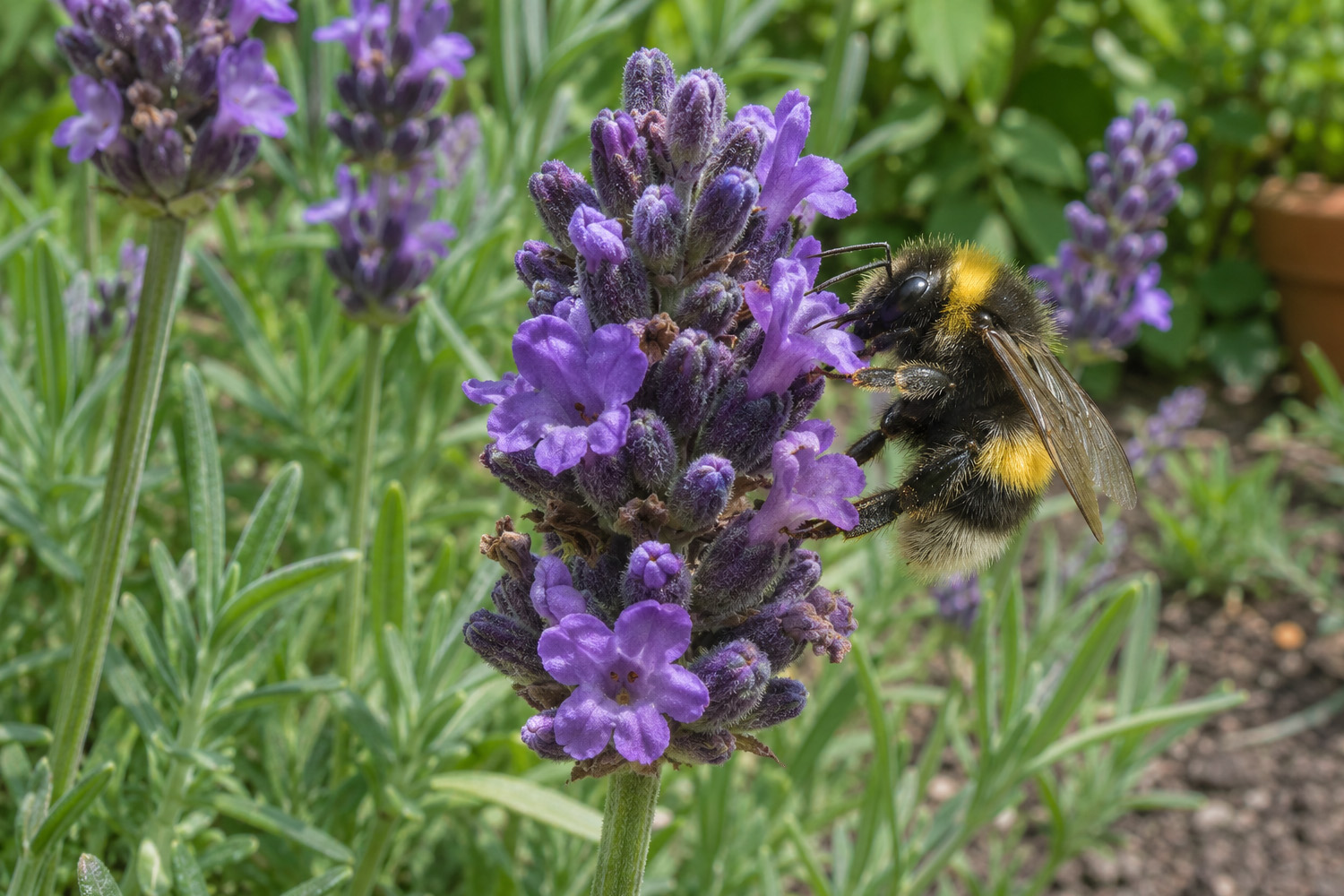
True lavender (Lavandula angustifolia), also called English lavender, is a small, evergreen subshrub from the mint family (Lamiaceae), just like rosemary and sage. It comes from the mountains around the Mediterranean and grows 30 to 60 centimetres tall. The leaves are narrow and grey-green. In June and July it flowers with short, dense spikes full of small purple flowers on sturdy stems. Bees and bumblebees love it.
True lavender is fully hardy and grows in the Netherlands for years on end, as long as the soil is dry enough. The name is often linked to the Latin lavare, to wash, because lavender has been used in bathwater and soap for centuries.
True lavender, lavandin or French lavender?
In garden centres and flower shops you'll mainly see three species. For tea and cooking, true lavender is the best choice:
| True lavender | Lavandin | French lavender | |
|---|---|---|---|
| Botanical name | Lavandula angustifolia | Lavandula × intermedia | Lavandula stoechas |
| Height | 30 to 60 centimetres | 60 to 90 centimetres | 30 to 60 centimetres |
| Spike | Short and dense | Long and pointed, on long stems | Plump, with striking "ears" on top |
| Flowering | June and July | July and August | May to July |
| Scent | Sweet and soft | Stronger, with more camphor | Sharp and resinous |
| Hardy | Yes | Yes | Moderately |
| For tea and cooking | Yes | Better not, tastes sharp and somewhat soapy | No |
Lavandin is a cross between true lavender and spike lavender. It yields far more oil, which is why it's grown on a large scale in Provence for perfume and soap. It's fine for scented sachets, but not for your tea.
What's in it?
The flowers contain essential oil, in true lavender mainly linalool and linalyl acetate, which give it its sweet scent. Lavandin and French lavender contain more camphor, and French lavender also contains fenchone. That makes them smell and taste sharper. Lavender has traditionally been drunk as a herbal tea. No health claims have been approved in the EU for lavender, so we don't promise any effects either.
What can you do with dried lavender?
| Use | How much | Tip |
|---|---|---|
| Tea | 1 to 2 grams per cup, about 1 teaspoon | Blend with other herbs, on its own it quickly tastes like perfume |
| Lavender sugar | 1 teaspoon of flowers per 250 grams of sugar | Leave to infuse for two weeks, then sieve |
| Baking and cooking | A pinch | Lovely in biscuits, scones, honey and with lamb |
| Scented sachets | A few tablespoons per sachet | Squeeze it now and then to refresh the scent |
| Smudge stick | A bundle of fresh stems | See our blog on smudging with white sage |
You'll find dried true lavender (Lavandula angustifolia) among our health herbs.
Making lavender tea in 5 steps
- Take 1 to 2 grams of dried lavender flowers, about 1 teaspoon. If you use fresh, take twice as much.
- Pour a cup of boiling water over them, about 150 ml.
- Cover the cup, so the scent doesn't escape with the steam.
- Let the tea steep for 5 to 10 minutes. Longer makes it bitter and soapy.
- Strain out the flowers. A teaspoon of honey goes well with it. Drink no more than three cups a day.
Tasty combinations
Lavender is strong, so a little is enough. A pinch of lavender in chamomile tea is a classic. It also goes well with lemon balm, passionflower or valerian. You'll find more herbs to blend with in the tea category.
Growing lavender yourself
Lavender is a rewarding plant for a sunny border, an edging along a path or a pot on the balcony. A good plant lasts around ten years.
Sowing in 5 steps
- Put the seed in the fridge for three to four weeks, in a bag with moist sand or kitchen paper. That cold period helps get germination going.
- Sow indoors in March or April. Scatter the seed on moist seed compost and press it in, covering it very thinly at most.
- Put the tray somewhere bright at 15 to 20 °C and keep the soil lightly moist.
- After two to four weeks the seedlings appear. Prick them out once they have a few true leaves.
- Plant them out after mid-May, 30 to 40 centimetres apart.
Cuttings are quicker: in summer, cut young, non-flowering tips of 8 to 10 centimetres and let them root in a pot of sandy soil.
The right spot and pruning
Choose full sun and poor, dry, well-draining soil, preferably chalky. Don't feed it: on rich soil lavender gets floppy and smells less. Prune twice a year. After flowering, cut off the spent spikes with a bit of stem. In April, cut the plant back by a third into a nice rounded shape. Never cut into the bare, woody part without leaves, as lavender won't regrow from there.
Harvesting and drying
- Harvest on a dry morning, when about half of the flowers on the spike are open. That's when the scent is strongest.
- Cut the stems long, just above the leaves.
- Tie them into small bunches of twenty to thirty stems.
- Hang them upside down somewhere dark, dry and airy. After one to two weeks they're dry.
- Strip the flowers off over a bowl and store them in a dark, airtight jar. That way they keep for about a year.
Safety
- Not too much: stick to a maximum of three cups a day, with 1 to 2 grams per cup.
- Pregnant or breastfeeding: don't drink lavender tea, its safety hasn't been established.
- Children under 12: don't give them lavender tea.
- Don't take the essential oil: lavender oil is for an oil burner or cosmetics, not for drinking.
- Allergy: if you get itching, a rash or shortness of breath, stop.
- True lavender only: don't use French lavender for tea.
Common mistakes
- Lavandin in your tea: it tastes sharp and soapy. Choose true lavender.
- Too much at once: lavender quickly dominates. Start with a teaspoon or less.
- Harvesting too late: once all the flowers are open or turning brown, the scent is weaker.
- Feeding and watering a lot: that gives floppy plants with little scent.
- Pruning into bare wood: nothing will grow back from there.
- Sowing seed without a cold period: then it germinates poorly.
Frequently asked questions
Can you use any lavender for tea?
Better not. True lavender (Lavandula angustifolia) tastes best. Lavandin tastes sharp and soapy, and French lavender contains too much camphor.
Is lavender tea healthy?
Lavender has long been drunk as a tea, but no health claims have been approved in the EU for lavender. Drink it in moderation, no more than three cups a day.
Can you drink lavender tea while pregnant?
It's not recommended. There isn't enough data to say it's safe.
How long does dried lavender keep?
About a year in a dark, airtight jar. After that it slowly loses its scent.
When should you prune lavender?
Twice: after flowering, remove the spent spikes, and in April cut it back by a third. Never into bare wood.
Where can I buy dried lavender?
You'll find dried true lavender among our health herbs, next to rosemary and lemon balm.
Sources: Wikipedia (EN), Lavandula angustifolia, EMA, Community herbal monograph Lavandula angustifolia flos, Wikipedia (EN), Lavandula × intermedia.


