


You know rosemary from oven-roasted potatoes and focaccia, but you can also make an aromatic, fresh tea from it, with a fresh sprig from the garden or with dried needles. The plant is evergreen, smells of pine and camphor, and survives an ordinary Dutch winter fine as long as it stays dry. In this guide you'll learn how to recognise rosemary and not confuse it with a poisonous lookalike, how to make rosemary tea, how to take cuttings, prune and harvest the plant, and what to keep in mind.
What is rosemary?
Rosemary is an evergreen shrub from the mint family (Lamiaceae), just like sage, thyme and lavender. Since 2017 its botanical name has been Salvia rosmarinus. Before that it was Rosmarinus officinalis, and you'll still often see that name on packaging. The plant comes from the Mediterranean and usually grows 50 centimetres to one and a half metres tall in the garden. The leaves are narrow and needle-like, dark green on top and white and felty underneath, with rolled-under edges. In spring, and sometimes in autumn too, rosemary flowers with small pale blue lipped flowers that bees visit early in the year.
The name comes from the Latin ros marinus, dew of the sea, because the plant grows along the coast. There are upright forms and creeping forms that trail over a low wall or the edge of a pot. You can use both.
Rosemary or a lookalike?
More plants have narrow, grey-green leaves with a white underside. One of them is poisonous:
| Rosemary | Lavender | Bog rosemary | |
|---|---|---|---|
| Botanical name | Salvia rosmarinus | Lavandula angustifolia | Andromeda polifolia |
| Leaf | Needle-like, dark green on top, white underneath, edges rolled under | Narrow, grey-green and felty on both sides | Narrow, blue-green on top, white underneath, edges rolled under |
| Flower | Pale blue, in spring | Purple, in spikes, in summer | Pink bells, in May and June |
| Scent of a crushed leaf | Strong, of pine and camphor | Sweet, of lavender | No rosemary scent |
| Where | Herb garden, pot | Herb garden, border | Wild in raised bogs, rare, don't pick |
| For tea | Yes | Yes, the flowers | No, poisonous |
Scent is the quickest test: rub a leaf between your fingers. If it doesn't smell of rosemary, don't use it. With dried rosemary from the shop you don't have that problem.
What's in it?
Rosemary leaves contain essential oil with compounds such as 1,8-cineole, camphor and alpha-pinene, which give it its fresh, resinous scent. They also contain rosmarinic acid and carnosic acid, two compounds also found in sage. How much of each it contains varies by variety, growing site and harvest time. Rosemary has traditionally been drunk as a herbal tea. No health claims have been approved in the EU for rosemary, so we don't promise any effects either.
Which form should you choose?
| Form | Use | Best for |
|---|---|---|
| Rosemary 50 grams, dried | Tea, 1 to 2 grams per cup, and cooking | Anyone who wants to get started right away |
| Fresh sprig from your own garden | Tea, a sprig of 5 to 10 centimetres per cup | Anyone who has a plant |
| Homemade tincture | Drops in water | Anyone who wants to keep it for a long time, see our blog on making a herbal tincture |
You'll find more herbs for tea among our health herbs and in the tea category.
Making rosemary tea in 5 steps
- Take 1 to 2 grams of dried rosemary, about 1 teaspoon, or a fresh sprig of 5 to 10 centimetres.
- Bruise the fresh sprig between your fingers or roll it with a knife, so the scent is released.
- Pour a cup of boiling water over it, 150 to 250 ml, and cover the cup.
- Let the tea steep for 5 to 10 minutes. Longer gets bitter and resinous.
- Remove the sprig or strain out the needles. A slice of lemon or some honey softens the taste. Drink no more than three cups a day.
Tasty combinations
Rosemary is punchy and goes well with lemon, ginger and mint. A sprig of rosemary with a few leaves of sage makes a robust herbal tea. For something softer, blend it with lavender or lemon balm.
Rosemary in the kitchen
Rosemary handles heat well and goes with roast potatoes, lamb, chicken, beans and bread. Use whole sprigs and remove them before serving, as the needles are tough. If you make rosemary oil with fresh sprigs, keep it in the fridge and use it within four days. Fresh herbs in oil can let dangerous bacteria grow at room temperature.
Growing rosemary yourself
Rosemary is easy to keep and lasts for years, as long as it stays dry. You can sow it, but the seed germinates slowly and unevenly. Cuttings are far more reliable.
Taking cuttings in 5 steps
- In summer, cut young, not yet woody tips of about 10 centimetres.
- Strip the leaves from the bottom 3 centimetres.
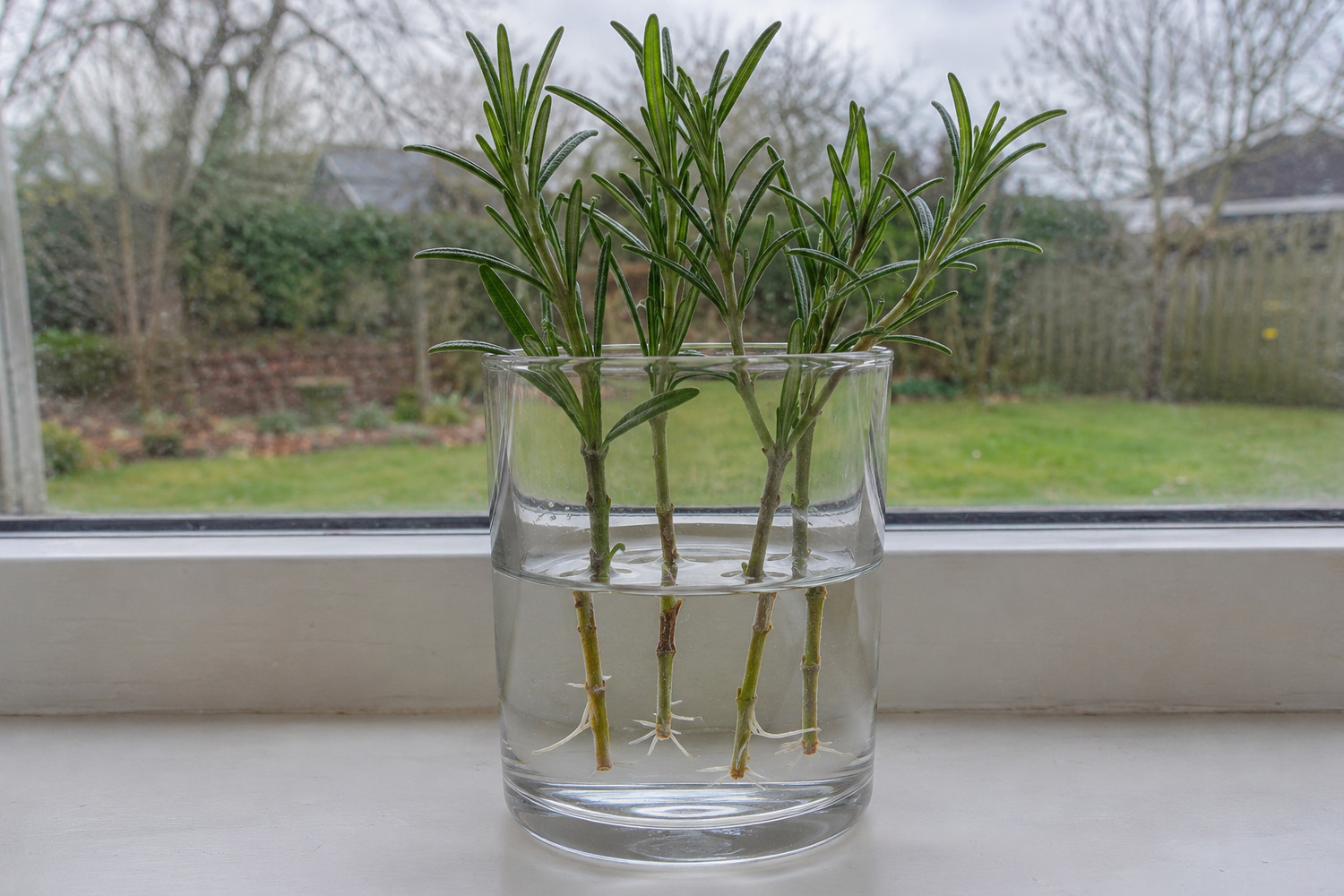
- Put the cuttings in a pot with a mix of sand and seed compost, or in a glass of water on a bright windowsill.
- Keep the soil lightly moist and out of harsh sun. After three to six weeks they form roots.
- Move them into their own pot once you see roots, and plant them out the following spring.
The right spot and pruning
Choose full sun and dry, well-draining soil, preferably somewhat chalky. In the ground, rosemary can usually handle around ten degrees of frost, but wet winters are its worst enemy. A sheltered spot against a wall helps. In a pot it's more vulnerable: put it against the house in winter and give it almost no water. Prune right after flowering, and never cut into bare wood without leaves, as it won't regrow from there.
Harvesting and drying
- You can cut sprigs all year round. For drying, harvest just before flowering, on a dry morning.
- Cut tips of 10 to 15 centimetres, which keeps the plant compact.
- Tie them into small bunches and hang them upside down somewhere dark and airy, or dry them in a food dehydrator at no more than 35 °C.
- After one to two weeks they're dry when the needles fall off easily.
- Strip the needles from the sprigs and store them in a dark, airtight jar. That way they keep for about a year.
Safety
- Not too much: stick to a maximum of three cups a day, with 1 to 2 grams per cup.
- Pregnant or breastfeeding: don't drink rosemary tea, its safety hasn't been established. Normal use as a kitchen herb in food is fine.
- Children under 12: don't give them rosemary tea.
- Gallstones, bile ducts or liver: if you have problems with these, don't drink rosemary tea.
- Don't take the essential oil: pure rosemary oil is much stronger than tea and contains a lot of camphor.
- Allergy: if you get itching or a rash, stop.
Common mistakes
- Steeping too long: after ten minutes the tea turns bitter and resinous.
- Keeping it too wet: rosemary tolerates cold better than wet feet.
- Pruning into bare wood: nothing will grow back from there.
- Sowing and then giving up: seed germinates slowly. Cuttings are faster and more reliable.
- Keeping rosemary oil with fresh sprigs outside the fridge: that's unsafe.
- Picking an unknown shrub: smell it first. Bog rosemary looks similar but is poisonous.
Frequently asked questions
How do you make tea from fresh rosemary?
Bruise a sprig of 5 to 10 centimetres, pour a cup of boiling water over it and let it steep, covered, for 5 to 10 minutes.
Is rosemary tea healthy?
Rosemary has been drunk as a tea for centuries, but no health claims have been approved in the EU for rosemary. Drink it in moderation, no more than three cups a day.
Is rosemary hardy?
In open ground, rosemary can usually handle around ten degrees of frost, provided the soil is dry and well-draining. In a pot it's more sensitive.
Why is rosemary now called Salvia?
DNA research showed that rosemary is so closely related to sage that botanists moved it into the genus Salvia in 2017. It's the same plant.
Can you use the flowers too?
Yes. The pale blue flowers are edible and taste milder than the leaves. They look lovely in a salad or scattered over a dish.
Where can I buy rosemary?
You'll find dried rosemary (50 grams) among our health herbs, next to lavender and lemon balm.
Sources: Wikipedia (EN), Rosemary, EMA, Community herbal monograph Rosmarinus officinalis folium, Wikipedia (EN), Andromeda polifolia.


