Cancer bush. It's a name that stops you mid-scroll, and for good reason. At Dutch-Smart, we get questions about it regularly, because if you're at all interested in herbs and traditional medicine, you'll run into this one sooner or later. But the name is misleading. This shrub isn't called cancer bush because it cures cancer. The name comes from centuries-old South African tradition, and that distinction matters.
A shrub from the Cape
Sutherlandia frutescens, now officially reclassified as Lessertia frutescens, grows across southern Africa. It's a low shrub, half a metre to a metre tall, with grey-green feathery leaves and striking red flowers. The Khoi and Nama people, the original inhabitants of what is now the Western Cape, used leaf decoctions to cleanse wounds and bring down fevers. The Zulu, Xhosa and Sotho knew the plant too, each with their own applications.
The Zulu call it "unwele". The Khoi-San used it for everything from stomach complaints and fevers to swellings. And those swellings are where the Afrikaans name "kankerbossie" comes from. It refers to the traditional use for growths and sores, not to a scientific verdict. That might sound disappointing, but we think it's honest: a name tells you somthing about history, not about evidence.
Three compounds researchers are watching
L-canavanine is an amino acid structurally similar to L-arginine. In lab studies it showed activity against certain cell types, but there's a flip side. A South African study found that L-canavanine combined with certain substances can actually be mutagenic. So it's not all upside.
Then there's GABA. Most people know it as the neurotransmitter that calms your nervous system, and in cancer bush it's present in notably high concentrations. D-pinitol, the third main compound, is a cyclic sugar alcohol that keeps turning up in insulin sensitivity research. Three compounds, three mechanisms, none proven in humans.
Is that all that's in there? No, there are also saponins, tannins and flavonoids. But L-canavanine, GABA and D-pinitol are where most of the lab work has focused.
Brewing the tea
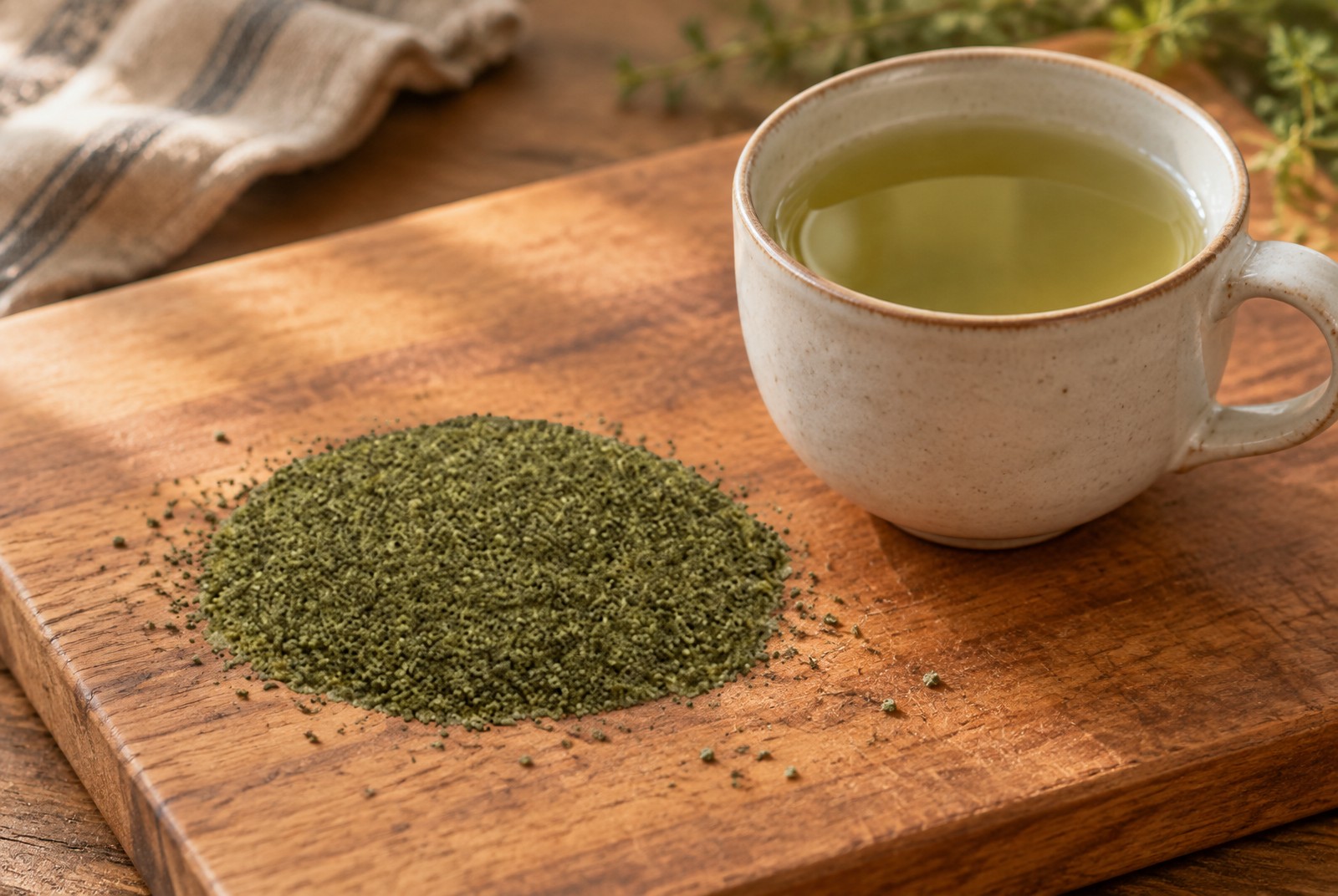
The simplest method is an infusion, just like chamomile. Take one to two teaspoons of dried leaves, put them in a cup or teapot and pour boiling water over them. Let it steep for ten to fifteen minutes. Not less, because the active compounds dissolve more slowly than in a typical herbal blend.
What you get is a mildly bitter, greenish tea with an earthy undertone. Can you add something to improve the taste? Yes, a dash of honey works well. We honestly don't mind the flavour! But we understand not everyone enjoys bitter herbal tea. If you'd rather make a tincture, have a look at our blog on making your own herbal tincture.
What science actually knows
Lab studies show interesting results. Researchers at North-West University in Potchefstroom published findings in 2026 showing that extracts displayed activity against drug-resistant lung cancer cells and colorectal cancer cells. They're developing a product that could serve as a complementary treatment alongside chemotherapy.
But lab results aren't human results. There is currently no clinical evidence that cancer bush treats or cures cancer in people. One safety study in healthy adults showed no side effects at the tested dose, but that tells you nothing about whether it works. Memorial Sloan Kettering Cancer Center puts it plainly: lab activity, not studied in humans.
Honesty beats false hope. And for us at Dutch-Smart that goes double: we sell herbs, not cures.
What to watch out for
There is no established dosage. Start with one cup of tea a day and see how you respond. Don't use it if you're pregnant or breastfeeding. If you have an autoimmune condition or take immunosuppressive medication, talk to your doctor first. The plant contains compounds that affect the immune system, and there are indications that cancer bush may interfere with with antiretroviral medication.
You can find our cancer bush here in the shop, alongside other herbs from distant corners of the world, such as annona muricata and bai zhu. The latter has its own blog: bai zhu, decoction and dosage.