

Incense is one of the oldest scents people make on purpose. A stick, a cone or a grain of resin on a charcoal, and within a few minutes your room smells of sandalwood, sage or nag champa. But which form should you choose, which holder do you need and how do you burn incense without filling your home with smoke? In this guide you'll learn the differences between the types, how to burn them step by step and what to keep in mind.
What is incense?
Incense is the umbrella term for everything you burn for its scent: sticks, cones, resins, wood and herb bundles. The best-known resin is frankincense, also called olibanum, from the frankincense tree (Boswellia), which grows in Oman, Yemen, Somalia and India, among other places. It has been burned in temples and churches for thousands of years. In Dutch, the word wierook covers both the resin and incense in general.
Most incense sticks come from India. They consist of a bamboo stick coated in a scented paste of wood, resin, herbs and often perfume oil. Indian incense is also called agarbatti. Masala incense, such as nag champa, is made from a thick, dry paste of natural ingredients.
Which type of incense should you choose?
| Type | How it works | Burn time (guideline) | Smoke | What you need |
|---|---|---|---|---|
| Bamboo sticks | Scented paste around a bamboo stick, you light the tip | 30 to 60 minutes | Moderate | A holder or a bowl of sand |
| Coreless sticks | A solid stick of scented paste, often Japanese | 20 to 40 minutes | Often less | A holder with a small hole, or sand |
| Cones | A compact cone, you light the tip | 15 to 30 minutes | A lot, in a short time | A heatproof dish |
| Backflow cones | A cone with a hole, the smoke flows downwards | 10 to 20 minutes | A lot, like a waterfall | A special backflow burner |
| Resin | Grains on a glowing charcoal | As long as the charcoal glows | A lot | A burner with sand and charcoals |
| Wood and herbs | Let palo santo or a smudge stick smoulder | Short, a few minutes at a time | Moderate to a lot | A heatproof bowl |
At Dutch-Smart you'll find, among others, the White Sage sticks by Satya, Sandalwood by Satya, Nag Champa sticks, Nag Champa cones and Frankincense by Aztec. For resin there's Copal Manila, among others. The full range is in our incense category.
Which incense holder do you need?
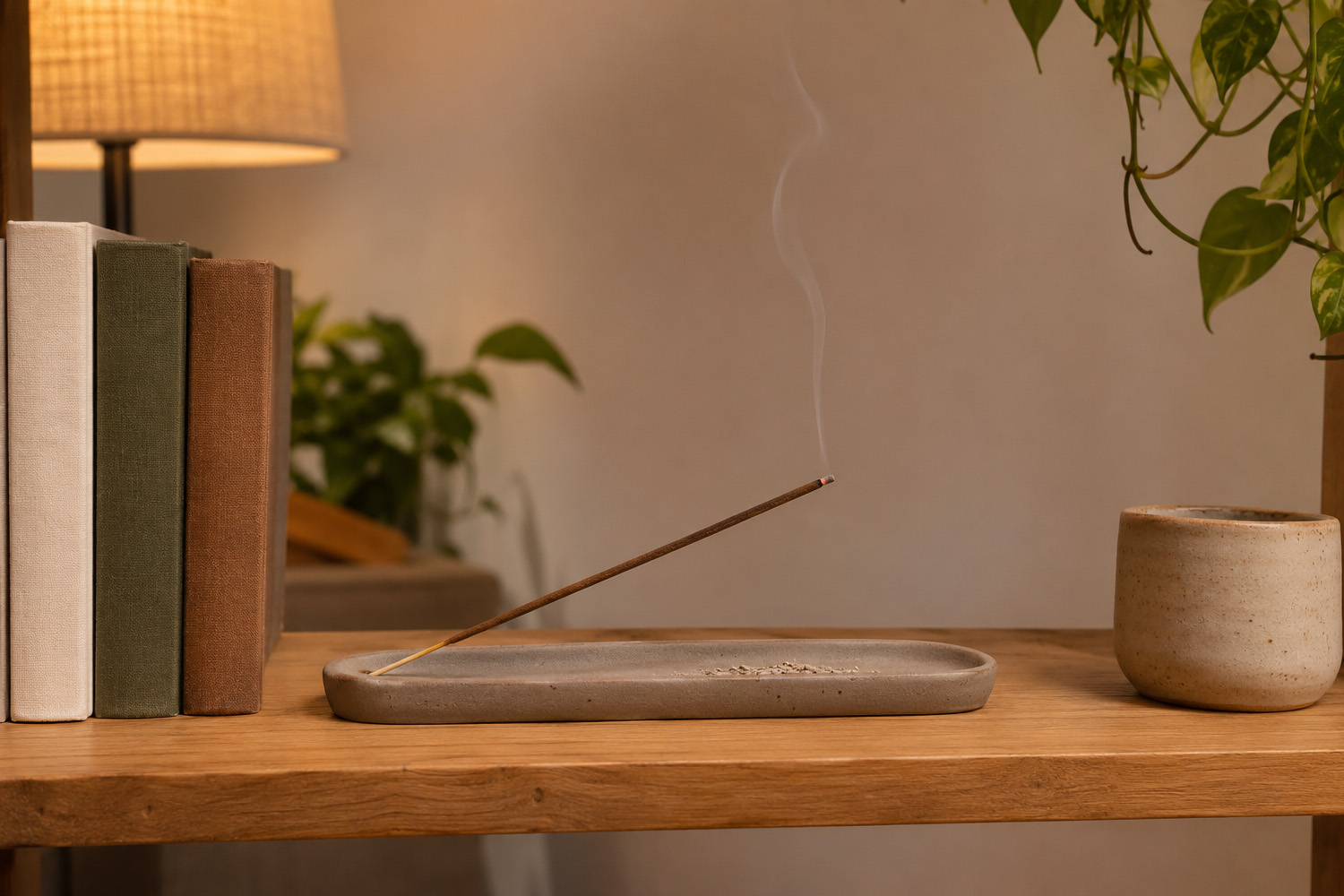
- Board or boat: a long holder with a small hole at one end. The ash falls onto the board. Handy for bamboo sticks.
- Figurine holder: such as the Ganesh incense holder. Beautiful, but always put something underneath to catch the ash.
- Bowl of sand or rice: the simplest and safest holder. Stand the stick upright in the sand. Also works for cones.
- Burner with charcoals: for resin you need a heatproof bowl with sand and charcoals, or a burner such as the brass incense burner. If you want to walk around the room with it, the incense pan with handle is handy.
Burning incense sticks in 5 steps
- Put the holder on a flat, heatproof surface, away from curtains, paper and draughts.
- Hold the tip of the stick in a flame until it catches.
- Let it burn for a few seconds, then blow out the flame. The tip should glow red and give off smoke.
- Put the stick in the holder, angled over the board or upright in the sand.
- Let it burn out, or put it out by pressing the glowing tip into sand or into the ash. Never leave it unattended.
Cones and resin
Light a cone at the tip, blow out the flame and put it on a heatproof dish. Cones give off a lot of scent in a short time, so one is usually enough for a room. You don't light resin directly. Put a charcoal on a layer of sand in a burner, light it and wait until it glows grey. Then put a grain of resin on it, about the size of a pea. You can read how to use resin and palo santo for smudging in our blog on smudging with white sage.
Frankincense and myrrh: what's the difference?
Both are tree resins from north-east Africa and the Arabian Peninsula. Frankincense comes from the Boswellia tree and smells fresh, citrusy and resinous. Myrrh comes from the Commiphora tree and smells warmer, more bitter and somewhat earthy. They're often burned together. Other well-known resins are copal, from Central America or, like Manila copal, from South-East Asia, and benzoin, with a sweet, vanilla-like scent.
Safety
- Always ventilate: burning incense releases fine particles and other combustion products, just like a candle or an open fire. Open a window and don't burn it all day.
- Never unattended: never leave a burning stick, cone or charcoal alone, and don't burn incense when you go to sleep.
- Asthma or sensitive airways: use little or no incense. It's not a good idea in a small, closed room either.
- Children and pets: keep them out of the smoke and away from the holder. Birds are especially sensitive to smoke.
- Fire safety: use a heatproof holder, don't put it under a shelf or next to curtains, and never switch off the smoke alarm.
- Charcoals: get very hot and keep glowing for a long time. Use a burner with sand, don't touch them and only burn them in a well-ventilated room, as glowing charcoal also gives off carbon monoxide.
Common mistakes
- Letting it burn with a flame: incense should smoulder, not burn. Always blow out the flame.
- No ash catcher: the ash ends up on your cupboard or floor.
- Keeping windows closed: the smoke lingers. Ventilate during and after burning.
- Lighting resin directly: resin needs a glowing charcoal.
- Too much at once: one stick or cone is enough for a room.
- Leaving incense out in the open: the scent fades. Store sticks and cones in a closed box or bag.
Frequently asked questions
Which incense isn't harmful?
No smoke is completely harmless. Incense made from natural ingredients without synthetic perfume often smells softer, but it still releases fine particles when burned. So burn it in moderation, one stick at a time, and ventilate well.
How long does an incense stick burn?
An ordinary bamboo stick burns for about 30 to 60 minutes, depending on its length and thickness. A cone burns for 15 to 30 minutes.
What is nag champa?
A classic Indian incense scent with a sweet, floral and woody base. It's made as masala incense, from a dry paste of natural ingredients.
What is a backflow burner?
A burner in which the smoke from a special cone with a hole flows downwards, so it looks like a waterfall or mist. You need backflow cones for it; ordinary cones don't work.
What is incense called in Dutch?
Wierook. The resin of the frankincense tree is also called wierook in Dutch.
Where can I buy incense?
You'll find sticks, cones, resins and holders in our incense category, and burners, charcoals and smudge sticks under smudging.
Sources: Wikipedia (NL), Wierook, Wikipedia (EN), Incense.


