
A tree from the Caatinga that science still cannot fully explain
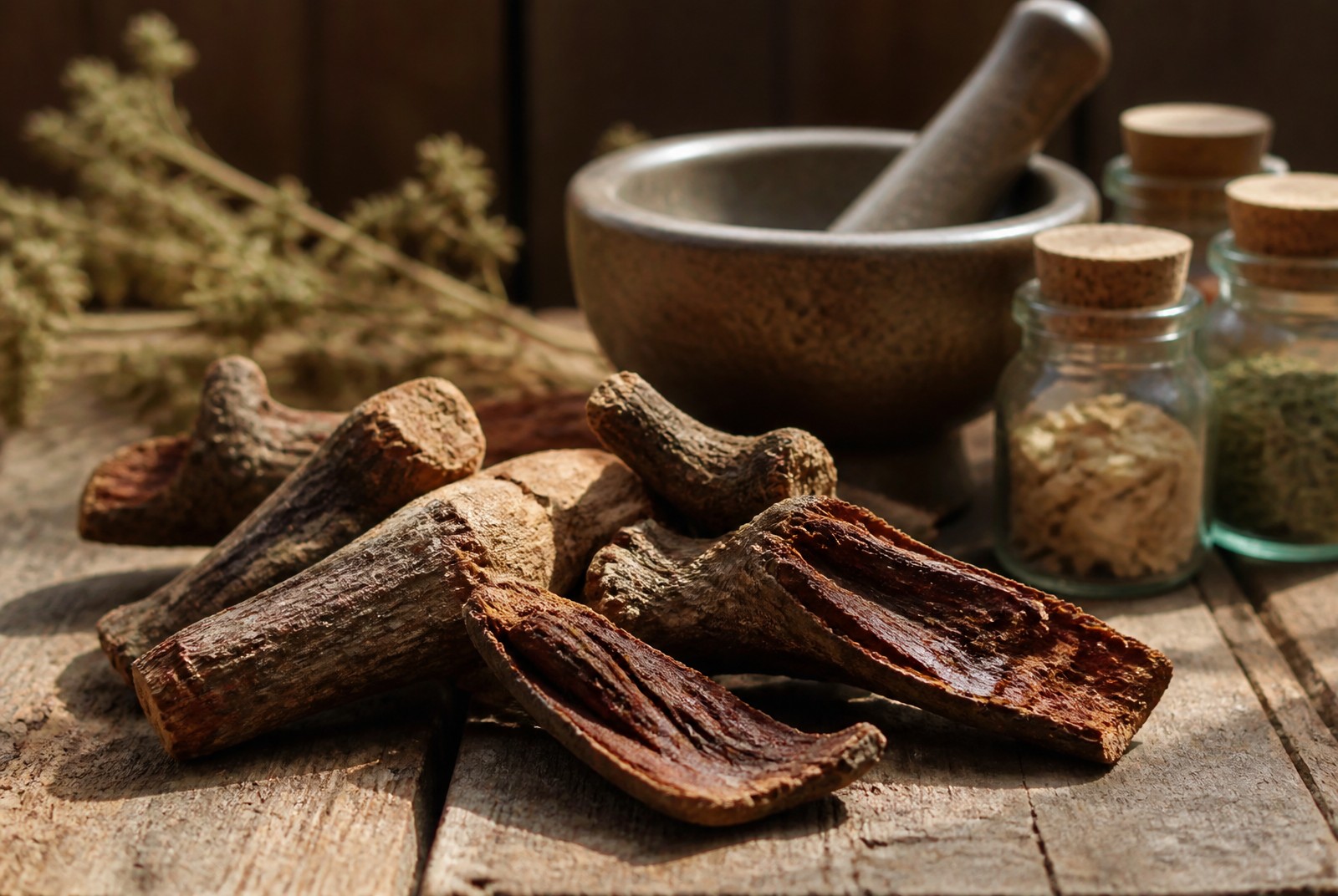
Mimosa hostilis is a tree native to the Caatinga, the bone-dry thornbush biome in northeastern Brazil. Its current scientific name is Mimosa tenuiflora (renamed in the 1990s), but almost everyone still says mimosa hostilis. In Brazil, it goes by Jurema Preta: the black Jurema. At first glance, it is an unremarkable tree with feathery leaves and small white flower clusters that barely stand out among the cacti and thorny scrub of the sertao.
Below the surface, the story changes. The dried root bark contains up to 1.7% N,N-dimethyltryptamine (DMT). That is a lot. For comparison, Psychotria viridis (chacruna), the most common DMT source in traditional ayahuasca, typically sits around 0.1-0.6%. And yet, the root bark is perfectly legal to buy and own in the Netherlands. How that works, and why science still does not fully understand this tree, is what this article covers.
What the Caboclos have done with this bark for centuries
In northeastern Brazil, in the states of Pernambuco, Paraiba and Rio Grande do Norte, the Caboclo people use the root bark in a ceremony called Catimbo. The word can mean "pipe", "poison bush" or simply "magic", depending on whom you ask. The oldest accounts date to the colonial period, when Portuguese missionaries reported on indigenous rituals involving a drink made from the bark of the Jurema tree.
During the Catimbo ceremony, participants drink vinho de jurema: a decoction of peeled root bark boiled in water, sometimes with honey. Singing is accompanied by ilus (deep drums) and maracas (rattles). The ceremony leader invokes Encantados: enchanted spirits dwelling between worlds. The most important ones are the Mestres (masters) and the Caboclos (ancestral spirits of the indigenous population). The ritual revolves around healing, protection and contact with the ancestral realm.
During the twentieth century, Catimbo absorbed elements from Umbanda and Kardecism, two other Brazilian spiritual traditions. Today it is sometimes called Jurema Sagrada, because "Catimbo" has acquired negative connotations in Brazil. The core, the Jurema drink made from root bark, has remained the same for centuries.
The riddle: DMT should not work orally without an MAO inhibitor
Here is where it gets interesting for anyone curious about pharmacology. DMT is normally broken down in your stomach and intestines by the enzyme monoamine oxidase (MAO) before it reaches your bloodstream. That is why traditional ayahuasca always combines two plants: a DMT source (chacruna or chagropanga) and an MAO inhibitor (the vine Banisteriopsis caapi, which contains the beta-carbolines harmine and harmaline). Without that MAO inhibitor, no effect: this is the standard pharmacological model.
Jurema breaks that model. The drink contains only root bark boiled in water. No caapi, no separate MAO inhibitor. Yet the Caboclos have reported psychoactive effects for centuries. How is that possible?
Yuremamine: the possible answer
In 2005, a research team led by Vepsalainen isolated a previously unknown compound from the stem bark of Mimosa tenuiflora. They called it yuremamine, the first member of a new class of phytoindoles. In 2015, a follow-up study suggested that yuremamine might not be a classical indole alkaloid but a flavo-alkaloid. The hypothesis that excites researchers most: yuremamine may function as an MAO inhibitor.
If that is correct, the Jurema tree carries its own MAO inhibition in the same bark as the DMT. Two functions in one plant, where ayahuasca needs two. That would explain the centuries-old efficacy of the Catimbo drink.
To be transparent: research on yuremamine is still in its early stages. No large-scale pharmacological studies have definitively confirmed the MAO-inhibiting effect. The riddle has shrunk considerably, but it is not yet solved.
What the root bark actually contains: the numbers
The dried root bark of Mimosa hostilis contains three groups of bioactive compounds worth noting:
DMT (N,N-dimethyltryptamine) is the principal alkaloid. Reported concentrations in the scientific literature range from 0.31% (Schultes, 1977) to 1.7% (more recent analyses of Mexican material). The inner root bark scores highest, with up to 2% total alkaloids. DMT is internationally a Schedule I substance under the 1971 Convention on Psychotropic Substances, but that same convention explicitly states that plants naturally containing the substance are not subject to control.
NMT (N-methyltryptamine) makes up roughly 3% of the total alkaloid content, equivalent to about 0.04% of dried bark weight. NMT is a lesser-known analogue of DMT. It tends to be sidelined in most discussions about Jurema, but likely contributes to the overall effect.
Yuremamine is the most recently discovered alkaloid (2005). Its exact concentration in root bark has not been established in the available literature. The interest lies not in the quantity but in its suspected function as an MAO inhibitor.
Beyond these, the bark contains tannins, saponins, phytosterols, glucosides and lupeol. Those explain an entirely different use for the same tree.
Tepescohuite: same tree, different application
In Mexico, Mimosa hostilis is known as tepescohuite, and there it is famous not as a psychoactive plant but as a wound-healing tree. After the 1984 Mexico City earthquake, the bark was used on a large scale for burn patients. The high concentration of tannins and saponins in the bark provides antimicrobial properties. Today you can find tepescohuite in Central American cosmetics and skincare products, usually as a bark extract in creams.
We make no medical claims here. But it illustrates that this tree has more to offer than its alkaloids alone.
Legal in the Netherlands: the bark is fine, the extract is not
The Dutch Opiumwet places DMT on List I (hard drugs). Extracted or isolated DMT is illegal to possess, sell or produce. But the law does not list the plant itself, only the isolated substance. Mimosa hostilis root bark is unprocessed plant material.
This distinction is not unique to the Netherlands but international: the Commentary on the 1971 Convention on Psychotropic Substances explicitly states that plants from which psychotropic substances are obtained are not subject to the convention. In practice, this means you can freely buy and possess the dried root bark in the Netherlands. Once someone begins extracting, the legal situation changes: the end product (isolated DMT) falls under List I.
At Dutch-Smart we sell exclusively unprocessed plant material. The Mimosa hostilis root bark (whole, from 10 grams, EUR 12.50) is the dried, unprocessed inner bark. If you are interested in growing the tree yourself, we also carry Mimosa hostilis seeds (10 pieces).
Mimosa hostilis at Dutch-Smart
In our ayahuasca category you will find the Mimosa hostilis root bark alongside the classic ayahuasca ingredients. For those who want to understand the difference: our blog on ayahuasca explains the traditional preparation. The products relevant to this topic:
- Mimosa hostilis root bark (whole), dried inner bark, from EUR 12.50
- Mimosa hostilis seeds (10 pieces), for those who want to grow the tree
- Banisteriopsis caapi (yellow, 50 grams), the MAO-inhibiting vine from the ayahuasca tradition
Frequently asked questions
How much DMT does the root bark contain?
The dried root bark contains between 0.3% and 1.7% DMT according to scientific literature, depending on origin and which part of the root is analysed. The inner bark has the highest concentration.
Is Mimosa hostilis the same as Mimosa tenuiflora?
Yes. Mimosa hostilis is the older botanical name; the plant was renamed to Mimosa tenuiflora in the 1990s. In commerce and the psychonaut community, Mimosa hostilis remains the standard name.
Can I buy the root bark in the Netherlands?
Yes. Unprocessed plant parts of Mimosa hostilis are not prohibited under the Dutch Opiumwet. Only extracted or isolated DMT is illegal.
What is yuremamine?
Yuremamine is a compound discovered in 2005 in Mimosa tenuiflora, possibly a flavo-alkaloid that functions as an MAO inhibitor. This would explain why the traditional Jurema drink is orally active without adding a separate MAO inhibitor. Definitive proof is still lacking.
What is the difference between jurema and ayahuasca?
Ayahuasca combines two plants: an MAO inhibitor (Banisteriopsis caapi) and a DMT source (usually Psychotria viridis). Jurema uses only the root bark of Mimosa hostilis, which may carry its own MAO inhibition via yuremamine. Read more in our blog on ayahuasca.