

Last updated: March 25, 2026
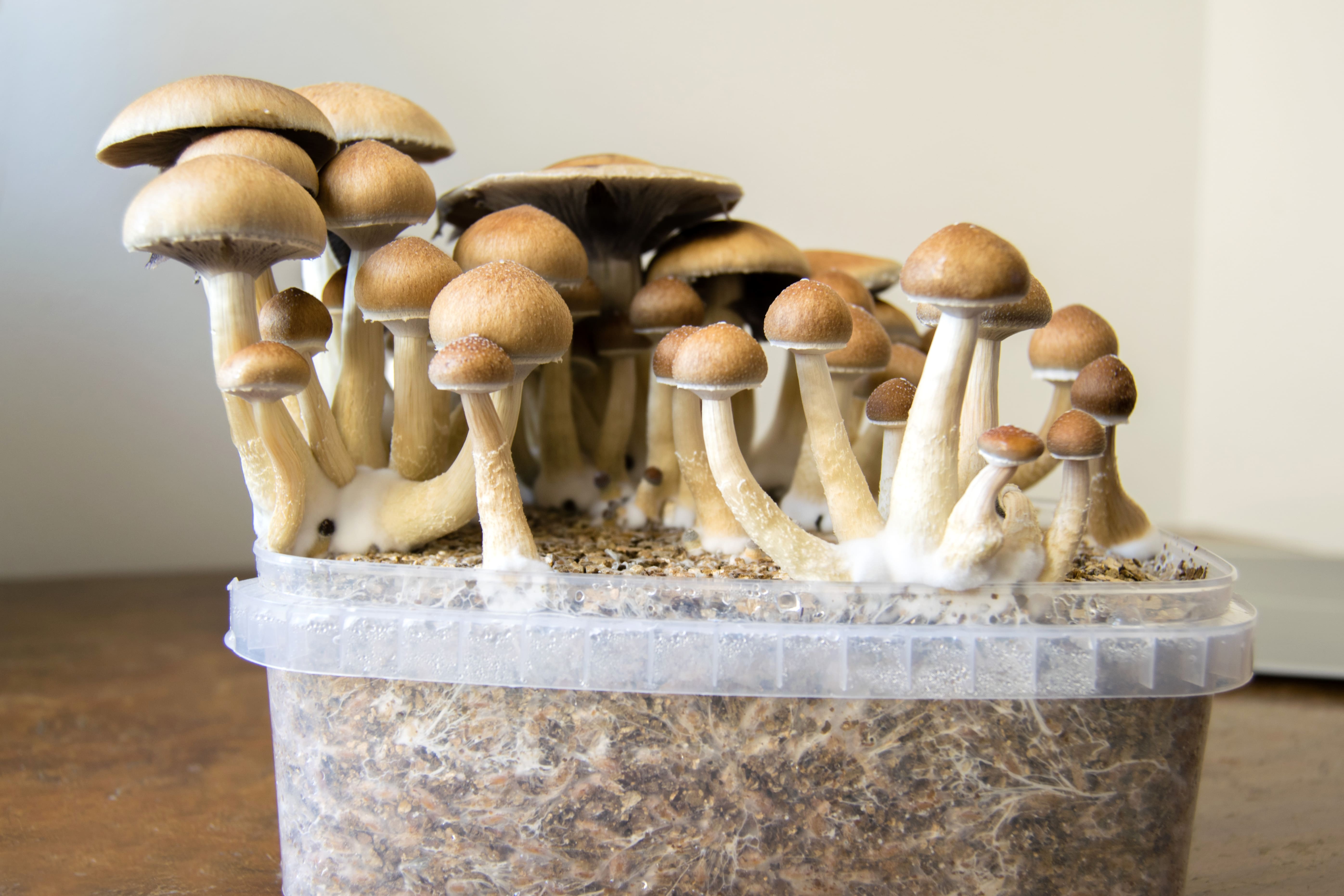
Growing your own magic mushrooms is an educational experience. You get the chance to follow psilocybin-containing mushrooms from seed to harvest, and with a ready-to-use grow kit from our selection, the process is also accessible to beginners. The entire process, from setup to first harvest, takes an average of 2 to 4 weeks, depending on the strain and conditions. Keep that in mind when planning.
Know the effects before you start
Magic mushrooms contain psilocybin, a substance that is converted into psilocin in the body. Psilocin binds to serotonin5-HT2A receptors in the brain and causes changes in perception, mood, and thinking. The intensity varies by strain: some varieties (such as McKennaii or Copelandia) are significantly stronger than others (such as Mexican or Thai). Do your research before you start growing. In this blog, you can read more about the different strains and what to expect.
How do you use a magic mushroom grow kit?
Our grow kits contain everything you need: a fully colonized substrate tray, a grow bag with an air filter, and an instruction manual. Below is a step-by-step guide. Also check out the visual guide for an overview at a glance.
Before you begin
- Wash your hands and arms thoroughly with soap
- Put on sterile gloves to prevent contamination
- Wear a face mask
- Work in a clean, dust-free room without drafts
Step 1: Preparation (soaking)
- Open the corner of the lid and fill the culture kit with cold tap water until it is full
- Close the lid and let the water soak for 9 to 12 hours in a cool place, such as the refrigerator
Step 2: Filling the grow bag
- Remove the kit from the refrigerator after 9 to 12 hours. Take off the lid (save it for later flushes) and drain all excess water from the kit
- Fill the filter bag with about 150 ml of water and place the grow kit inside
- Spray water over the inside of the filter bag. Fold the top over twice and secure it with the clip
- Place the grow kit in a bright spot with indirect sunlight at 22 to 25°C. Never in direct sunlight
Wait 2 to 4 weeks before proceeding to the next step.
Step 3: Fresh oxygen
As soon as you see small mushrooms (pins) appear, refresh the air 1 to 3 times a day. Open the bag, gently blow fresh air into it, and close it again with the clip. Also lightly mist the inside walls of the bag.
Wait 1 to 2 weeks before proceeding to the next step.
Step 4: Harvesting
The right time to harvest is just before the veil (the membrane under the cap) begins to tear. At that moment, the psilocybin concentration is at its highest. Mycologist Paul Stamets describes in *Psilocybin Mushrooms of the World* that after the cap opens, mushrooms shift their energy toward spore production, at the expense of psilocybin content.
Recognize the perfect moment by these characteristics: the veil is about to detach but is still intact, the cap is still round, and no spores have fallen onto the substrate yet. Pick the mushrooms with a gentle twisting motion at the base. Once you’ve harvested everything, you can reuse the kit for the next flush (see below).
After the harvest: drying and storage
Fresh magic mushrooms are about 90% water and, in that form, will only keep for 1 to 2 weeks in the refrigerator. For long-term storage, you need to dry them until they are “cracker-dry”: they should snap if you try to bend them.
Drying methods
Food dehydrator: The most reliable method. Set the temperature to a maximum of 40°C and dry for 4 to 8 hours, depending on size. Temperature is crucial: heating above 137°C completely destroys psilocybin.
Air-drying with a fan: Place the mushrooms on paper towels or cardboard in a well-ventilated area. Set a fan to low speed and aim it at the mushrooms, changing the absorbent material regularly. Takes 7 to 10 days.
Silica gel as a finishing touch: Silica gel packets absorb residual moisture. Place pre-dried mushrooms together with silica gel in an airtight container to remove the final few percent of moisture.
Research by Jurók et al. (2021, Drug Testing and Analysis) shows that the psilocybin concentration does not decrease significantly when dried at room temperature in the dark. In fact, the concentration per gram increases as the water weight is removed.1
Storage
The four enemies of psilocybin are light, oxygen, moisture, and heat. The same study by Jurók et al. found that mushrooms stored in light at 20°C lost 36% of their psilocybin content after 15 months. Therefore, store dried magic mushrooms in an airtight, opaque container (glass jar or vacuum-sealed bag), preferably in the refrigerator (2 to 10°C), with a silica gel packet included. Under these conditions, they will keep for 1 to 2 years. Vacuum-sealed and frozen, they will keep even longer.
Multiple flushes from a single grow kit
A major advantage of grow kits is that you can get multiple harvests (flushes) from the same kit. With good hygiene, 3 to 5 flushes are realistic.
After harvesting, the substrate is dried out and needs to be rehydrated. Replace the lid, fill the box with cold tap water, and place it in the refrigerator for 8 to 12 hours. Drain the excess water, place the kit back in the grow bag with fresh water at the bottom, and repeat the growing process. The first flush is usually the smallest. Many growers report that the second or third flush yields the largest harvest, as the mycelium is now firmly established. A standard 1200cc kit can yield 300 to 500 grams of fresh mushrooms across all flushes combined, which amounts to 30 to 50 grams after drying.
Recognizing Contamination
Contamination is the most common reason a cultivation attempt fails. The main contaminants and how to recognize them:
Trichoderma (green mold): Starts as white mycelium but quickly turns green. Spreads rapidly and cannot be controlled. If you see green spots: immediately remove the kit from your grow room and dispose of it in a sealed plastic bag.
Penicillium (blue-green): Forms circular colonies with a musty odor. The spores are constantly present in the air, so good hygiene is your best defense.
Aspergillus (various colors): Can be yellow, black, green, or brown. Some species produce mycotoxins. Treat a suspicious kit as hazardous waste.
Bacterial contamination (wet spot): Slimy, wet spots on the substrate with a sour odor. Often caused by excess moisture or unsterile water.
Note: Blue discoloration on the mushrooms themselves is not contamination, but an oxidation reaction of psilocin. This is normal and occurs upon contact or damage. You can tell the difference from mold because bruising is flat and does not spread, while mold is fuzzy, grows, and often has a musty odor.
Are magic mushrooms legal?
Psilocybin mushrooms have been banned in the Netherlands since December 2008. Their sale is illegal. Growing them for personal use via grow kits is currently in a legal gray area: the grow kits themselves, including spore syringes and substrate, are legally available. In addition to ready-to-use grow kits, Dutch-Smart also offers individual growing supplies, spore syringes, and spore vials.
Magic truffles: the legal alternative
Both magic mushrooms and magic truffles contain psilocybin and psilocin. The difference is biological: truffles are underground sclerotia (storage organs of the mycelium), while magic mushrooms are above-ground fruiting bodies. In terms of effects, they are comparable, though the concentration varies by species. The legal distinction is significant: magic truffles are legally available in the Netherlands to individuals aged 18 and older. In some respects, the effects are comparable to those of LSA, mescaline cacti, and ayahuasca, but psilocybin has its own distinct character and duration of action (4 to 6 hours).
Psilocybin in Science
Psilocybin has been extensively researched for medical applications in recent years. Compass Pathways completed two Phase 3 studies in 2025–2026 using synthetic psilocybin (COMP360) for treatment-resistant depression, with positive results on the MADRS depression scale. An approval decision by the FDA is expected in late 2026 or early 2027.2 Research by the Johns Hopkins Center for Psychedelic and Consciousness Research also focuses on addiction, anxiety in terminal illness, and obsessive-compulsive disorder.
Neuroimaging research (Siegel et al., 2024, Nature) shows that psilocybin temporarily disrupts the Default Mode Network, the brain network involved in self-reflection and the sense of a fixed “self.” This disruption is linked to the therapeutic breakthroughs reported in clinical studies.3
This research takes place under strictly controlled conditions with professional supervision. It involves synthetic, standardized psilocybin, not home-grown mushrooms. Self-medication is not recommended.
Harm reduction (18+)
- Dosage: Dried magic mushrooms are approximately 10 times stronger than fresh ones. A low dose starts at 1 gram dried; an average dose ranges between 1.5 and 3 grams. Always start low, especially with a new strain or batch.
- Set and setting: Use only if you feel well, in a familiar environment with people you know.
- Tripsitter: With higher doses, make sure a sober and trusted person is nearby.
- Avoid combinations: Do not combine psilocybin with alcohol, stimulants, or antidepressants (especially SSRIs and MAO inhibitors).
- Contraindications: Use is not recommended for those with mental health conditions, a family history of psychosis, or during pregnancy.
- Age restriction: For individuals 18 years of age and older only.
More information on safe use and dosage can be found at kennisbank.dutch-smart.nl. The full cultivation assortment is listed in the “Growing Magic Mushrooms ” category.
Sources
Jurók, R. et al. (2021) — Stability of psilocybin and its four analogs in the biomass of Psilocybe cubensis, Drug Testing and Analysis, 13: 439-446
STAT News (2026) — Compass says its psilocybin drug helped patients with severe depression in two trials
Siegel, J.S. et al. (2024) — Psilocybin desynchronizes the human brain, Nature
Stamets, P. (1996) — Psilocybin Mushrooms of the World: An Identification Guide, Ten Speed Press
About the author

Editor
Derek writes for Dutch Smart about smart shop products, cultivation techniques, and harm reduction. He combines practical experience with factual, well-researched information, without hype or vague promises.


