

Last updated: March 25, 2026
Psychedelics are substances that, through interaction with serotonin and other receptors in the brain, produce auditory and visual hallucinations, changes in the perception of time, and profound alterations in consciousness. Many of these substances have been used ritually for thousands of years; their pharmacological basis has only been systematically studied in recent decades. In recent years, scientific research on psychedelics has gained momentum, particularly in the field of psychiatry. Below is an overview of five of the best-known classic psychedelics: their mechanism of action, effects, duration, and legal status in the Netherlands.
LSD
LSD (lysergic acid diethylamide) was synthesized in 1938 by the Swiss chemist Albert Hofmann at Sandoz Laboratories; he discovered its psychedelic effects by accident in 1943.1 It is a semi-synthetic substance: the raw material is lysergic acid, which is extracted from the fungus Claviceps purpurea (ergot), after which chemical synthesis yields the active molecule.
LSD acts primarily as a partial agonist on5-HT2A serotonin receptors in the prefrontal cortex and other brain regions, leading to disrupted sensory processing and profound changes in thought, visual perception, and the perception of time. A standard dose ranges from 50 to 200 micrograms. The effects begin after 30 to 60 minutes and last an average of 8 to 12 hours, considerably longer than most other psychedelics. LSD is listed on Schedule I of the Dutch Opium Act and is therefore illegal.2 There are legal plant-based alternatives that aim to produce similar receptor interactions, such as LSA seeds available in the smart shop assortment. LSD tartrate (from MindMed) has now received Breakthrough Therapy designation from the FDA in the U.S. for the treatment of generalized anxiety disorder, with Phase 3 results expected in 2026.7
Magic mushrooms and truffles
Psilocybin-containing mushrooms (magic mushrooms) and magic truffles contain the alkaloids psilocybin and psilocin. After oral ingestion, psilocybin is rapidly converted by the body into psilocin via dephosphorylation; psilocin is the pharmacologically active form that binds as a partial agonist to5-HT2A receptors, the same mechanism as LSD, but with a shorter duration of action.3
Evolutionarily, mushrooms likely produced these compounds as a defense against insects and other predators. Effects in humans include visual and auditory hallucinations, altered perception of time, and, depending on dose and set & setting, profound emotional or mystical experiences. A typical dose of dried mushrooms ranges from 1 to 3.5 grams; the effects last an average of 4 to 6 hours. You can find more information about related psychedelics in the knowledge base. Psilocybin mushrooms are listed on Schedule II of the Opium Act; magic truffles are legally available in the Netherlands and exclusively for individuals 18 years of age and older.
Psilocybin is currently the most advanced psychedelic in the clinical research pipeline. In February 2026, Compass Pathways published the results of two Phase 3 studies with their synthetic psilocybin (COMP360) for treatment-resistant depression: in both studies, patients who received 25 mg of COMP360 scored significantly better on the MADRS depression scale than the placebo group.8 Following a positive consultation with the FDA, the company expects an approval decision by late 2026 or early 2027. If that happens, COMP360 will become the first psilocybin-based drug on the market.9 This research involves a synthetic, standardized preparation in a clinical setting; it is not comparable to the use of natural mushrooms or truffles.
Peyote
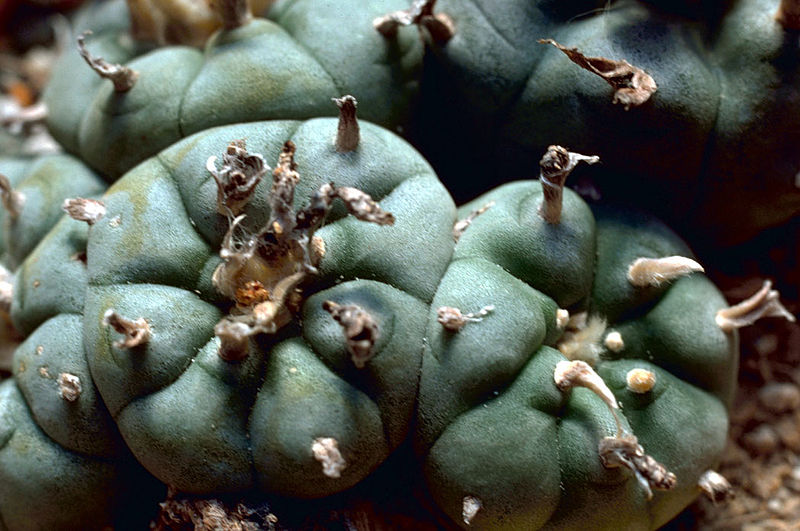
Peyote (Lophophora williamsii) is a small, spineless cactus native to northern Mexico and southern Texas. The psychoactive substance is mescaline, a phenethylamine alkaloid that, like psilocybin and LSD, acts on5-HT2A receptors but also has a pronounced dopaminergic component.4 Peyote has been used ritually for over 5,000 years by indigenous peoples of Central and North America; archaeological finds from Texas date its use to at least 5,700 years ago.
The effects of mescaline include intense hallucinations of color and shape, synesthesia, and a profoundly altered sense of self. They begin after 1 to 2 hours and last 8 to 12 hours. The mescaline concentration in a dry peyote bud averages 1 to 6% of the dry weight. Mescaline is listed on Schedule I of the Dutch Opium Act. The cactus plant itself, including varieties such as San Pedro (Echinopsis pachanoi), is legally available as an ornamental plant; it is the extraction and use of mescaline that is prohibited by law. Psychoactive cacti are available as plants in our assortment.
Salvia divinorum
Salvia divinorum is a plant from the mint family (Lamiaceae), native to the Sierra Mazateca in the Mexican state of Oaxaca. The plant was traditionally used by the Mazatecs in healing rituals and divination. The active ingredient is salvinorin A, a diterpene that acts as the only known completely naturally occurring kappa-opioid receptor agonist, a unique mechanism that differs from virtually all other classic psychedelics, which primarily act on serotonin receptors.5
This makes salvia pharmacologically unique, but also difficult to compare with other psychedelics. The effects are dissociative in nature: users describe a sense of disembodiment, the disappearance of the surroundings, and sometimes the complete loss of self-awareness. When smoked, the effects occur within seconds and last 5 to 20 minutes; when taken orally as a quid or tea, the onset is slower and the effects are milder but longer-lasting. A total of 22 diterpene-like compounds have now been identified in S. divinorum, of which only salvinorin A is psychoactive. In addition to the kappa-opioid receptor, salvinorin A also influences the release of monoaminergic neurotransmitters such as norepinephrine, dopamine, and serotonin.10 In March 2026, Nature Communications published the first genome sequence of S. divinorum, enabling researchers to better map the biosynthetic pathway of salvinorin A, with a focus on developing painkillers and antidepressants based on this molecule.11
Salvia divinorum is legal in the Netherlands. Due to the intensity of the effects, a trip sitter is strongly recommended, even at low doses. Do not combine salvia with other psychoactive substances or alcohol.
DMT
DMT (N,N-dimethyltryptamine) is an indole alkaloid that occurs naturally in dozens of plant species and is also produced in the human body.6 It acts as a partial agonist on5-HT2A receptors and on sigma-1 receptors, which partly explains the extraordinary intensity of the experience. When inhaled or administered intravenously, the effects occur within 60 seconds, peak in 2 to 5 minutes, and subside after 15 to 20 minutes—a timeframe that many users perceive as significantly longer.
DMT is not orally active without an MAO inhibitor, because the enzyme monoamine oxidase in the intestinal wall breaks down the substance before absorption. In ayahuasca, this is circumvented by combining it with MAO-inhibiting plants such as Banisteriopsis caapi, making oral administration possible with a duration of effect of 4 to 6 hours. In the 1990s, researcher Rick Strassman conducted the first controlled clinical trial of intravenous DMT in humans; his findings are documented in *DMT: The Spirit Molecule*. DMT is listed on Schedule I of the Opium Act; ayahuasca plants themselves are legal in the Netherlands.
A 2025 review (Neuropharmacology) describes that recent measurements found DMT levels in the rat brain comparable to those of classical neurotransmitters, suggesting a potential physiological role that extends beyond the known psychoactive effects. DMT is thought to play a role in neuroplasticity, neuroprotection, and the cellular response to oxygen deprivation.12 A 2025 Phase 2a clinical trial investigated vaporized DMT in patients with treatment-resistant depression and reported a response rate of 85.7% and remission in 57.1% of participants, with effects lasting up to three months.13 Preclinical research in Translational Psychiatry (2026) showed that a single dose of DMT in mice reversed depressive behavior and restored neurogenesis in the hippocampus.14 This research is conducted in controlled clinical and laboratory settings and does not apply to home use.
Harm reduction: general guidelines for psychedelics (18+)
All five substances listed above have a powerful effect on consciousness. A number of guidelines apply regardless of which substance you use:
- Set and setting: Your state of mind and environment have a major influence on the nature of the experience. Use only in a familiar, safe environment with people you trust.
- Tripsitter: For more intense experiences, always have a sober, trusted person nearby, especially with DMT, LSD, and high doses of psilocybin.
- Starting dose: Always start low, especially with new substances or new batches. Potency can vary.
- Avoid combinations: Do not combine psychedelics with lithium (significantly increased risk of seizures), MAO inhibitors (except in the case of ayahuasca, where this is intentional), or other psychoactive substances.
- Psychiatric contraindications: Psychedelics are strongly discouraged if you have a personal or family history of psychosis, schizophrenia, or bipolar disorder.
- Age restriction: For individuals 18 years of age and older only.
Questions about specific products or uses? Contact us via customer service or read more about Dutch-Smart on the About Us page.
Sources
Nichols, D.E. (2004) — Hallucinogens, Pharmacology & Therapeutics, NCBI
Wetten.overheid.nl — Opium Act, Schedule I and Schedule II (consolidated text, effective as of July 1, 2025)
Carhart-Harris, R. & Nutt, D. (2017) — Serotonin and brain function: a tale of two receptors, Journal of Psychopharmacology
Halberstadt, A.L. (2015) — Recent advances in the neuropsychopharmacology of serotonergic hallucinogens, Behavioural Brain Research
Roth, B.L. et al. (2002) — Salvinorin A: a potent naturally occurring nonnitrogenous kappa opioid selective agonist, PNAS
Barker, S.A. (2018) — N,N-Dimethyltryptamine (DMT), an Endogenous Hallucinogen, Frontiers in Neuroscience
BLA Regulatory (2025) — Psychedelic Medicine on the Rise: How Regulators Are Responding (overview of FDA status)
STAT News (2026) — Compass says its psilocybin drug helped patients with severe depression in two trials
STAT News (2025) — Compass Pathways expects earlier FDA approval decision on its psilocybin drug
Calado, S. et al. (2025) — Salvinorin A and Salvia divinorum: Toxicology, Pharmacological Profile, and Therapeutic Potential, Int. J. Mol. Sci., 26(12): 5588
Nature Communications (2026) — Comparative genome analysis provides a foundation for defining salvinorin A biosynthesis in Salvia divinorum
Schimmelpfennig, J. & Jankowiak-Siuda, K. (2025) — Exploring DMT: Endogenous Role and Therapeutic Potential, Neuropharmacology, 268: 110314
Falchi-Carvalho, M. et al. (2025) — Rapid and Sustained Antidepressant Effects of Vaporized N,N-dimethyltryptamine, Neuropsychopharmacology, 50: 895-903
Translational Psychiatry (2026) — Single-dose DMT Reverses Anhedonia and Cognitive Deficits via Restoration of Neurogenesis
About the author

Editor
Derek writes for Dutch Smart about smart shop products, cultivation techniques, and harm reduction. He combines practical experience with factual, evidence-based information, without hype or vague promises.


