
Two molecules that almost share a name
DMT and 5-MeO-DMT. Three overlapping letters, the same tryptamine backbone, both short-acting, and both present in plants we sell in the Dutch-Smart ayahuasca category. Yet 5 milligrams of 5-MeO-DMT delivers a more profound experience than 30 milligrams of DMT. The explanation comes down to a single methoxy group (-OCH₃) at position 5 of the indole ring. That one addition changes which serotonin receptor the molecule activates most strongly, and with it the entire nature of the trip.
At Dutch-Smart we stock source plants for both substances. Because customers regularly ask us what sets them apart, we brought together recent scientific literature and our own product knowledge in this article.
The chemistry in brief
N,N-dimethyltryptamine (DMT) is an indole alkaloid: an indole core linked to an ethylamine side chain carrying two methyl groups on the nitrogen atom. 5-MeO-DMT, short for 5-methoxy-N,N-dimethyltryptamine, has the exact same scaffold plus a methoxy group (-OCH₃) at position 5 of the indole ring. This addition increases lipophilicity and shifts receptor affinity.
The difference sounds trivial, but in pharmacology position 5 is a key site. Serotonin itself (5-HT) carries a hydroxyl group (-OH) at that exact spot. The methoxy group on 5-MeO-DMT mimics that pattern slightly differently than DMT's bare indole ring, with sweeping consequences for which receptor responds most strongly.
Receptors: 5-HT2A versus 5-HT1A
DMT binds with high affinity to the 5-HT2A receptor, the receptor responsible for complex visual hallucinations, geometric patterns and the sensation of stepping into another dimension. Most classical psychedelics (psilocybin, LSD, mescaline) work primarily through this same pathway.
5-MeO-DMT takes a different route. The molecule shows four to ten times greater affinity for the 5-HT1A receptor than for 5-HT2A. The 5-HT1A receptor governs emotional states and the sense of self-identity. Activating it does not produce images; it produces what researchers call "ego dissolution": the collapse of the boundary between self and surroundings.
A preclinical study from August 2026 (published on biorxiv.org) confirmed this distinction. DMT produced a bell-shaped dose-response curve in the mouse head-twitch response assay, while 5-MeO-DMT showed a monotonic increase. The researchers also demonstrated that DMT triggers broader neuroplasticity across the default-mode network and hippocampus.
The DMT experience: visuals, entities, breakthrough
Inhaled at a dose of 30 to 50 milligrams, DMT takes effect within 10 seconds. The user experiences a flood of visual information: fractal patterns, geometric tunnels, vivid colours no paint can reproduce. In a full "breakthrough," people describe arriving in a different space populated by entities or architecture that feels impossible yet somehow self-evident. The experience lasts 10 to 20 minutes and ends abruptly. Afterwards it feels like waking from a dream more real than waking life.
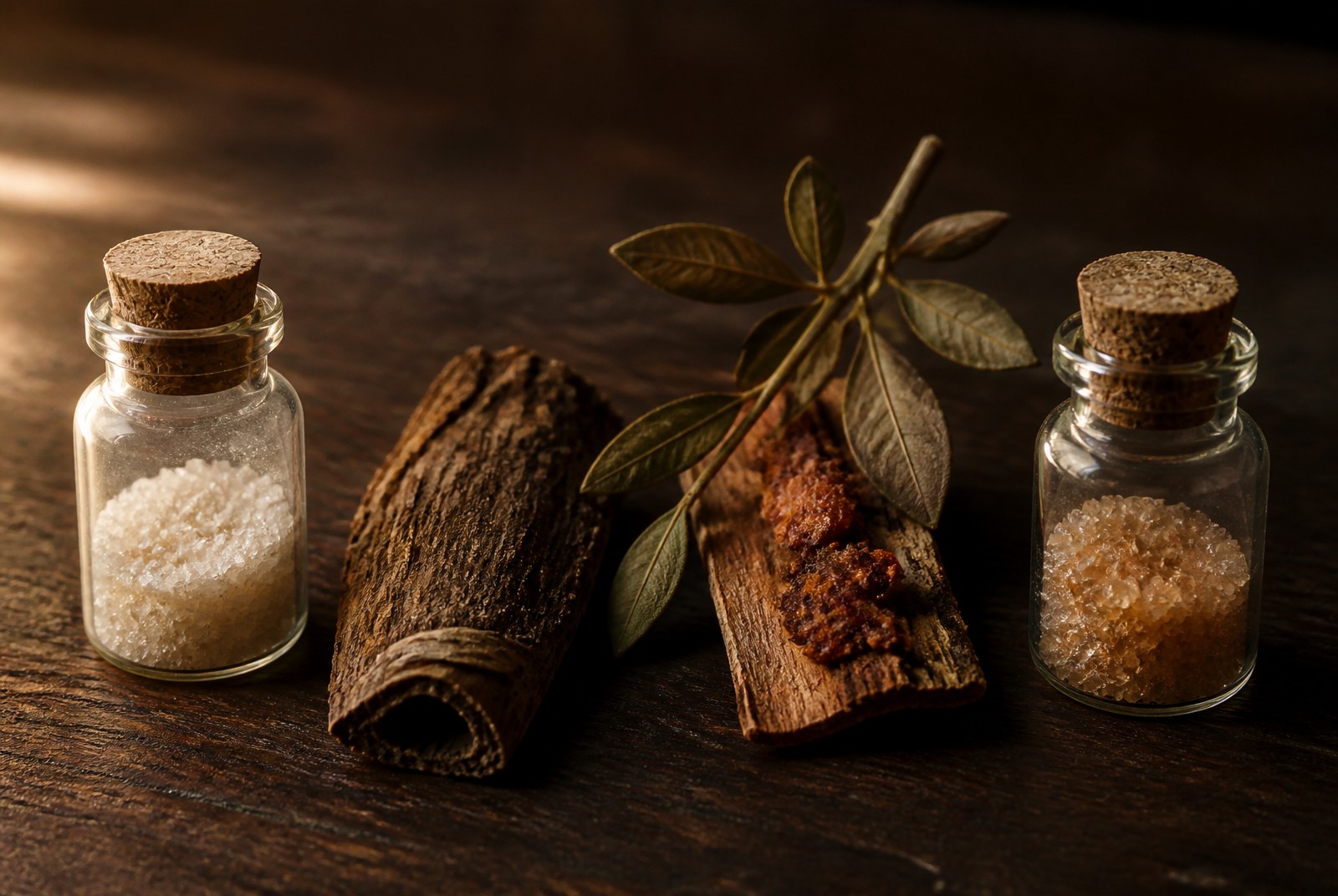
DMT occurs naturally in the root bark of Mimosa hostilis (Jurema Preta), at concentrations up to 1.7-2%. The leaves of Psychotria viridis (chacruna) also contain DMT. Both plants form the basis of ayahuasca, the Amazonian brew in which an MAO inhibitor (usually Banisteriopsis caapi) makes DMT orally active. The bark of Acacia confusa is another well-known DMT source.
The 5-MeO-DMT experience: the self dissolves, without visuals
At 5 to 10 milligrams inhaled, 5-MeO-DMT comes on just as fast as DMT, but the content is radically different. There are barely any visual patterns. Instead, the sense of "I" dissolves. Users describe merging with everything, as though the boundary between body and surroundings simply vanishes.
The Johns Hopkins research team reported in 2018 that 75% of participants given vaporised 5-MeO-DMT had a complete mystical experience, comparable in intensity to a high dose of psilocybin, but in a fraction of the time. The experience is therefore both shorter and more overwhelming. Where DMT presents a panorama, 5-MeO-DMT removes the viewpoint itself. Duration is 15 to 30 minutes.
Natural sources of 5-MeO-DMT include the resin of Virola theiodora (the red Virola tree of the Amazon, whose bark indigenous peoples use to prepare the snuff epéna), the seeds of Anadenanthera colubrina (cebil) and Anadenanthera peregrina (yopo), and the skin secretion of the Sonoran Desert toad (Bufo alvarius). The latter source contains bufotenin and trace N,N-DMT alongside 5-MeO-DMT.
Dosage compared
The potency gap is striking. The values below apply to vaporisation, the most common route for both substances in pure form.
- DMT: threshold 10-15 mg, common 25-40 mg, strong 40-60 mg
- 5-MeO-DMT: threshold 1-3 mg, common 5-8 mg, strong 8-12 mg
5-MeO-DMT is therefore roughly six times as potent. That makes accurate weighing (preferably to 0.001 g) not optional but a necessity. A difference of 3 milligrams can mean the gap between a mild and an overwhelming experience with 5-MeO-DMT.
Legal status in the Netherlands
This is where the two molecules diverge sharply. N,N-DMT, as an isolated substance, sits on List I of the Dutch Opium Act. Possession, production and trade of pure DMT are therefore punishable. Unprocessed plant material (whole root bark, dried leaves) does not automatically fall under the Opium Act, though the legal boundary is grey in practice. We sell only unprocessed botanical products.
5-MeO-DMT is not listed on any Dutch Opium Act schedule. Synthetic 5-MeO-DMT is legally available in the Netherlands and sold openly by smart shops. Note: the secretion of the Bufo alvarius toad contains N,N-DMT alongside 5-MeO-DMT, which means processing that natural material can fall under the Opium Act.
In most other EU countries (Germany, Sweden, France, the UK) 5-MeO-DMT is regulated or banned. Spain and Portugal are exceptions with lighter frameworks.
Safety and risks
Both substances deserve serious respect. DMT rarely causes physical complications in healthy users, but the intensity of the visual experience can be psychologically overwhelming, especially without experience or in an unsettled setting.
5-MeO-DMT carries an additional physical risk. Ego dissolution can come with uncontrolled body movements and brief cardiovascular effects including elevated heart rate and blood pressure spikes. A publication in Nature (2025) documented the cardiac effects of both substances and stressed that 5-MeO-DMT provokes a stronger vagal response. Put more plainly: anyone using 5-MeO-DMT always needs an experienced sitter present.
Combinations with MAO inhibitors, SSRIs or other serotonergic medication are potentially dangerous for both substances (serotonin syndrome). Do not use either if you take serotonergic medication without medical consultation.
Frequently asked questions
Are DMT and 5-MeO-DMT the same substance?
No. They share a tryptamine base structure, but 5-MeO-DMT has an extra methoxy group at position 5. That single addition changes the receptor preference and with it the entire experience.
Can I take 5-MeO-DMT orally like ayahuasca?
Technically yes, combined with an MAO inhibitor, but this is strongly discouraged due to the risk of serotonin syndrome and unpredictable duration. Inhalation is the standard route for 5-MeO-DMT.
Which plants at Dutch-Smart contain 5-MeO-DMT?
Virola theiodora and Cebil (Anadenanthera colubrina) naturally contain 5-MeO-DMT alongside other tryptamines. We sell them as unprocessed botanical products in our ayahuasca category.
Is 5-MeO-DMT legal in the Netherlands?
5-MeO-DMT does not appear on the Opium Act schedules. Synthetic 5-MeO-DMT is legally available. Unprocessed plant material containing 5-MeO-DMT is equally legal. The raw Bufo toad secretion, however, also contains N,N-DMT, which complicates the legal picture.
Which substance is better for a first psychedelic experience?
Neither. Both are extremely potent and short-acting, leaving little room for adjustment if the experience becomes overwhelming. If you are new to psychedelics, start with a gentler path such as low-dose truffles in a safe environment.