


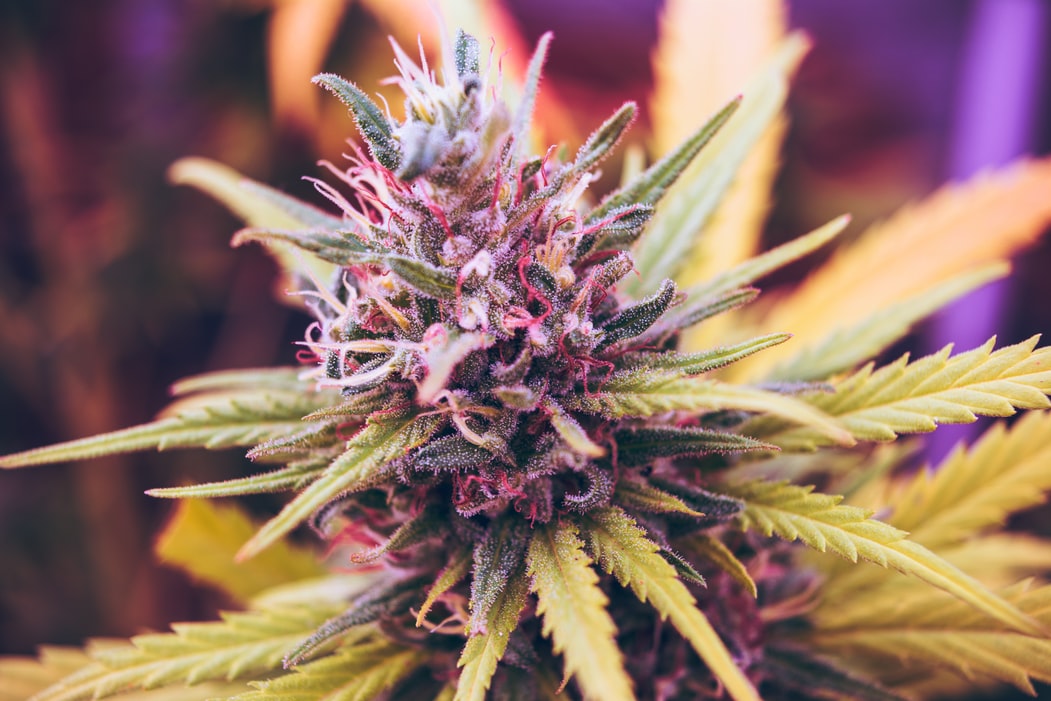
A while back, we told you that the cannabis we smoke (or vape or eat) today is much stronger than the cannabis of decades ago. Now, two cannabinoids have been discovered in the glands of the cannabis plant, one of which can be as much as 30 times more potent than psychoactive THC—the compound that normally gets you high. The only question is whether these specific cannabinoids also have an effect on the human body. If so, the future of cannabis could look very different.
“Even if we assume that THCP can be cultivated in larger quantities, we still don’t know whether the compound would produce a high comparable to that of its psychoactive cousin.”
140 different chemicals
 THC, or tetrahydrocannabinol, binds to receptors in the brain and alters our ability to reason, form memories, coordinate movements, perceive time, and experience pleasure. Cannabis contains more than 140 similar chemicals that interact with receptors throughout the body, but as far as we know, only THC can produce a mind-altering high—something that enthusiasts of our cannabis shop, of course, know well. Now, scientists have discovered two new cannabinoids, one of which is structurally similar to the non-psychoactive compound CBD, and the other resembles THC but could have stronger effects. At least, in theory.
The THC look-alike, called tetrahydrocannabiphorol (THCP), appears to interact with the same receptor as THC—the receptor known as CB1—according to a new study published in the journal Scientific Reports. The main difference between THCP and its cousin lies in a chain of atoms protruding from the newly discovered compound.
Read also: This is how a single dose of ayahuasca can lead to lasting changes in the brain
A bit of science
Research suggests that this specific structure, called an alkyl side chain, allows THC to bind to its preferred receptor. To make it even more scientific (and complicated): A cannabinoid must have at least three carbon rings in its side chain to access CB1, and THC compounds typically contain five.
On paper, a cannabinoid with more than five carbon rings would fit even more snugly into the receptor, and eight carbon rings would provide the absolute perfect fit and elicit the strongest biological response. But such compounds have not been discovered in nature, the authors noted in their paper.
This is where THCP comes into play. This compound has not five, not six, but seven carbon rings in its alkyl side chain. When applied to a makeshift receptor prepared on a laboratory scale, the compound tended to bind to the substance 30 times more reliably than THC.
Read also: Does legalizing cannabis lead to more cannabis users?
Stoned mice and the future of cannabis
And yes, mice have once again proven their worth. The researchers then administered THCP to lab mice and discovered that the animals behaved as if they were using THC, meaning their movement slowed, their body temperature dropped, and their responses to painful stimuli decreased. The animals reached this state at relatively low doses of the newly discovered compound.
But does this mean we’ll all be smoking THCP soon? Well, not necessarily. Although THCP is potent in the lab, it may or may not have dramatic effects in humans, Vice reported. First of all, the compound appears to be present in plants only in small amounts, at least in the low-THC cannabis strain used by the researchers.
Even if we assume that THCP can be cultivated in larger quantities, we still don’t know whether the compound would produce a high comparable to that of its psychoactive cousin. In short: let the scientists do their thing, and we’ll find out eventually anyway!


