


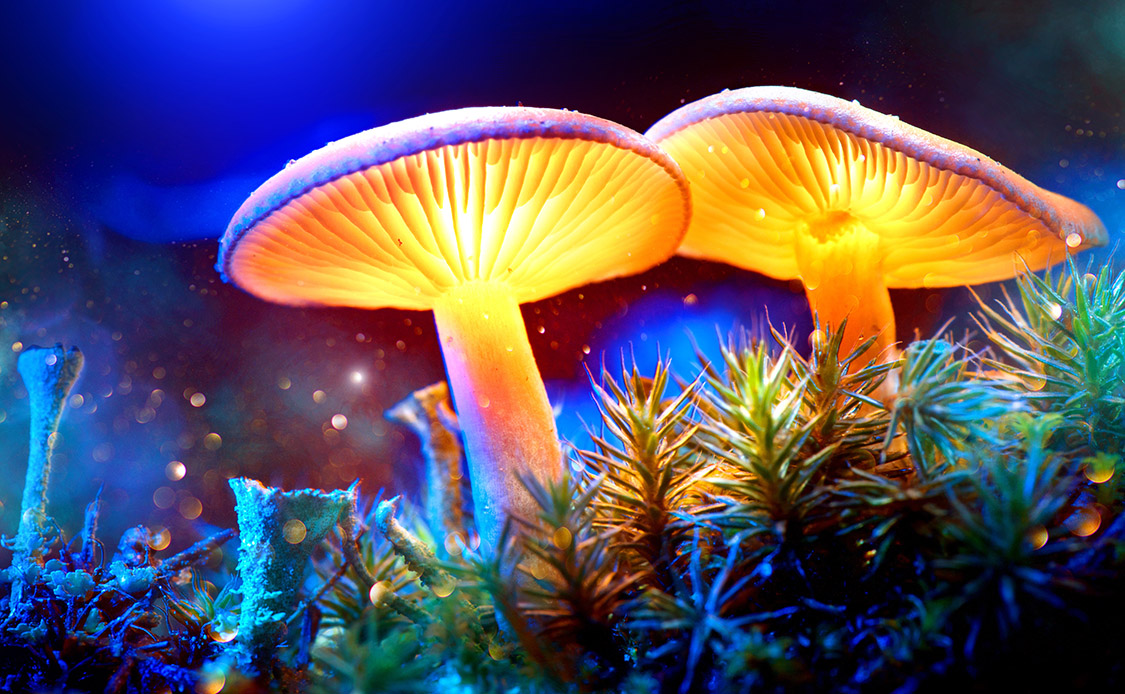
Most of you Dutch-Smart psychonauts have probably seen *Avatar*, the movie in which the beautiful planet Pandora is explored by giant blue creatures. One of the things you might remember from that movie is the amazing luminescent plants and stunning nature found on the planet. Now it seems that the “magic” found in some Earthly mushrooms will soon make our plants glow as well.
Read also: Research reveals why people have been eating magic mushrooms for centuries
More than just psychedelic
We don’t need to tell you how magical a mushroom can be. The fact that you’re reading this on our smartshop’s website probably means you’ve already experienced the wonderful effects of psilocybin-containing mushrooms, better known as magic mushrooms. Now it seems that the magic in these mushrooms goes far beyond their psychedelic nature. Scientists discovered that it’s actually possible to create plants that produce their own visible luminescence by extracting the so-called “bioluminescence” found in some mushrooms. In short: they’re extracting the light from luminous mushrooms.
How exactly does that work? Well, that’s quite a complicated story. The idea is that DNA from these magical-looking mushrooms can be inserted into plants, causing them to start glowing brightly. The findings were published in an article in Nature Biotechnology. Botanists could eventually use this technique to study the inner workings of plants, but it also opens up the possibility of glowing houseplants for our homes.
Read also: Do psychedelics create new connections in the brain?
“In the future, this technology could be used to visualize the activity of various hormones within plants throughout their lifespan in different tissues. It can also be used to track plants’ responses to various stresses and environmental changes, such as drought or injury from herbivores,” says Dr. Karen Sarkisyan, CEO of Planta, the startup that led the work, and a researcher at Imperial College London.
We’ll have to wait at least another year for the follow-up film, so who knows—maybe we’ll have these glowing plants in our homes sooner. Though that’s unlikely, says Dr. Sarkisyan. “We hope to actually bring this to market in a few years, once we’ve made them a bit brighter, once we’ve created ornamental plants using this new technology, and of course once all existing safety regulations have been met,” he said. According to the researchers, the new plants can produce more than a billion photons per minute.
Read also: Your first magic mushroom trip? Here’s what to watch out for!
The beauty of bioluminescence
There are quite a few animals, microbes, and mushrooms that can emit light, a phenomenon known as bioluminescence. This occurs when enzymes interact with chemicals known as luciferins within the organism, releasing energy in the form of light. However, bioluminescence does not occur naturally in plants, so you won’t be able to find any Avatar-like plants in your garden just yet. With this technique, that might change someday.
Previous approaches to creating glowing plants and trees have led to many interesting applications, such as making self-illuminating Christmas trees. But all previous approaches had some drawbacks: supplying luciferin to small particles is more expensive and not self-sustaining, while introducing bacterial bioluminescence genes involves a cumbersome process that results in only a faint glow. This may be different when actually extracting DNA and introducing it into the plants, the researchers say. “The challenge now is to figure out how this artificial bioluminescence can respond to specific environmental, developmental, chemical, or pathogenic stimuli,” John Carr, a professor at the University of Cambridge, told The Guardian. Stay tuned!


