

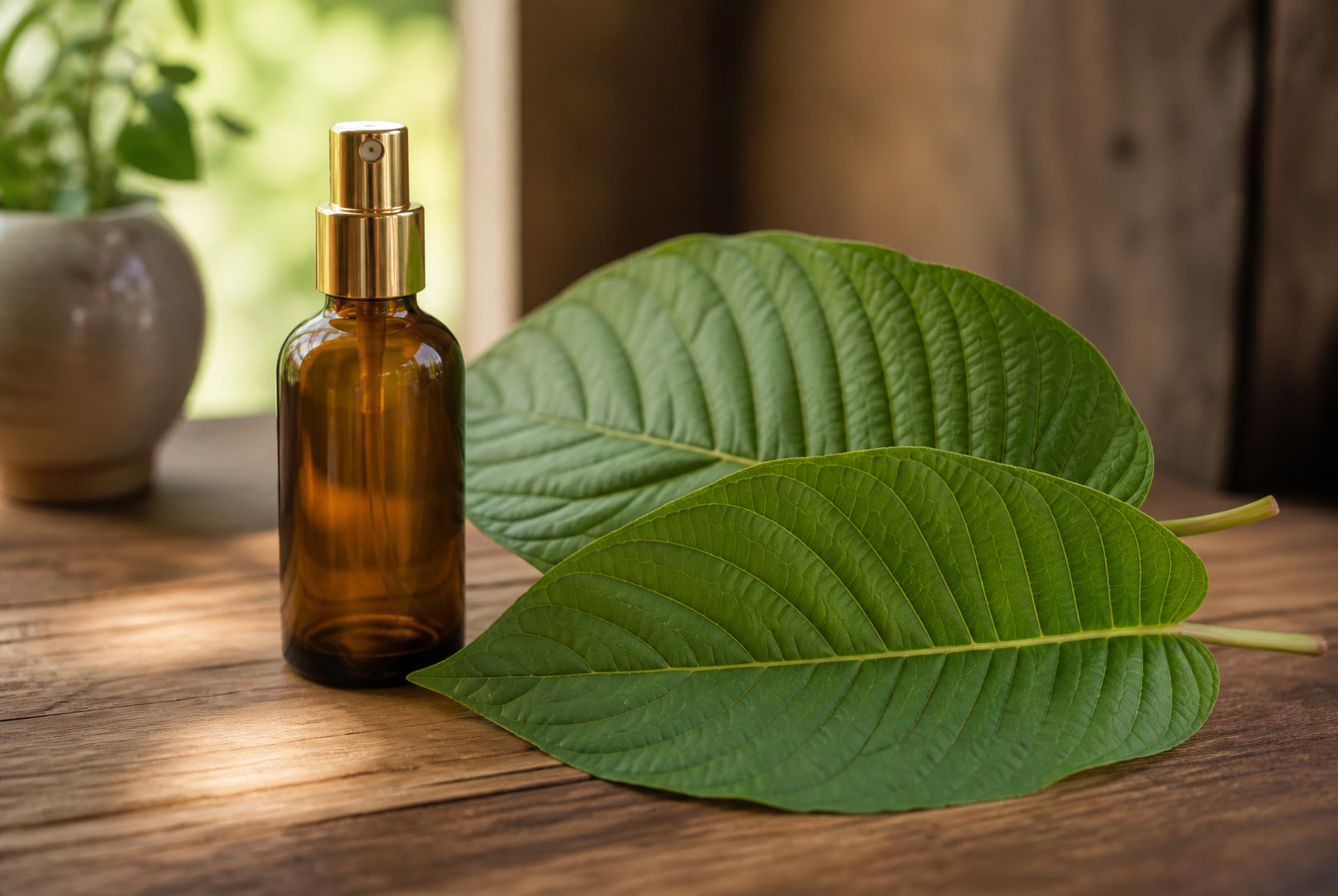
What is 7-OH, and why is it generating so much interest?
Kratom contains over 40 alkaloids. The most abundant is mitragynine, accounting for roughly 60-66% of the total alkaloid content and responsible for most of the effects you experience from kratom. But there is a second player in the leaf: 7-hydroxymitragynine, abbreviated as 7-OH. It makes up less than 2% of the alkaloid profile, yet it is approximately 13 times more potent than mitragynine at the mu-opioid receptor.
At Dutch-Smart, we receive more and more questions about it. What does it actually do? How does it differ from regular kratom powder? And why is it now available as a spray? In this piece, we explain the pharmacology in plain language, discuss dosage and address the risks honestly.
Mitragynine and 7-OH: two alkaloids, two profiles
Mitragynine and 7-hydroxymitragynine both bind to the mu-opioid receptor, the same receptor that morphine targets. But there are three key differences.
1. Potency. Research from the University of Florida shows that 7-OH has an EC50 of 35 nM in vitro, compared to 339 nM for mitragynine. In practice, this means a much smaller amount of 7-OH is needed for a comparable effect.
2. G-protein selectivity. Both compounds activate the mu-receptor through the G-protein pathway but recruit virtually no beta-arrestin. That matters pharmacologically: beta-arrestin recruitment is associated with respiratory depression and constipation in classical opioids. Its near-absence in kratom alkaloids is one reason researchers are studying these compounds as potentially safer alternatives to traditional painkillers, although that research is still in its early stages.
3. Abuse potential. Animal studies (rats) reveal an important distinction. Mitragynine administered as a pure compound does not appear to have abuse potential and may even reduce opioid intake. For isolated 7-hydroxymitragynine, the picture is different: abuse potential has been demonstrated in the same models. This makes responsible use and careful dosing of 7-OH products all the more important.
Why a spray? Sublingual absorption explained
The 7-OH & Kratom Spray by Happy Caps is neither a powder nor a capsule. It is a 5 ml oral spray with a tropical flavour, and that format was chosen deliberately.
When you spray a substance under the tongue or against the inner cheek, it is absorbed through the mucous membranes of the oral cavity. This is called sublingual absorption. The key advantage: the compound enters the bloodstream directly, bypassing the stomach and liver entirely (so-called first-pass metabolism). With oral ingestion, a significant portion of the active substance is broken down in the liver before it ever reaches the bloodstream.
The practical result is twofold. First, the onset is faster: users of the spray report feeling initial effects within 5 to 10 minutes, whereas kratom powder typically takes 20 to 40 minutes. Second, the bioavailability is higher, meaning you can achieve a comparable effect with a lower dose.
Dosage: less is more
Because 7-OH is more potent than mitragynine and the spray has higher bioavailability, dosing works fundamentally differently from kratom powder. If you are accustomed to taking 3 to 5 grams of kratom powder, you cannot simply translate that quantity to the spray.
The manufacturer (Happy Caps) recommends starting with 1 to 2 sprays and waiting for the effect. That is not marketing talk: due to rapid sublingual uptake, you will notice within 10 minutes whether the dose is sufficient. Wait at least 30 minutes before considering an additional spray, and never exceed the maximum stated on the packaging.
Three guidelines we at Dutch-Smart recommend:
- Always start with the lowest possible dose, even if you are experienced with kratom. The spray is not powder in a different package; it is a different product with a different absorption profile.
- Do not use it daily. The higher potency of 7-OH increases the risk of tolerance with frequent use. Reserve it for moments when you are specifically seeking relaxation.
- Do not combine it with alcohol, benzodiazepines or other central nervous system depressants. That combination increases the risk of excessive sedation.
Safety and risks: an honest account
We sell this product and we are writing an informational piece about it, so it is only fair to discuss the downsides as well.
7-hydroxymitragynine, as an isolated compound in animal models, has demonstrated abuse potential. In the United States, the DEA temporarily placed semi-synthetic 7-OH above a certain threshold on Schedule I in July 2026. That regulation does not apply to the Netherlands (see below), but the signal is clear: this is not a substance to take lightly.
Furthermore, case studies report that regular use of concentrated 7-OH products can lead to tolerance (needing progressively more for the same effect) and physical dependence. That risk is greater with daily use and at high doses.
Our advice: treat 7-OH products with the same respect you would give any potent botanical extract. Read the leaflet, stick to the recommended dose and skip days between use.
Legal status in the Netherlands
Kratom, including products containing 7-hydroxymitragynine, is not listed in the Dutch Opium Act (Opiumwet). It is legal to purchase in the Netherlands. It does fall under the Commodities Act (Warenwet) and may not be marketed as a foodstuff for consumption. Packaging rules require kratom to be sold in pre-packaged units with a fixed weight indication.
Note that the legal situation varies by country. In several EU member states (including Denmark, Poland and Sweden), kratom is prohibited. Anyone ordering from outside the Netherlands is responsible for checking local legislation. Browse our full kratom range for more information on available products.
How does this product fit into the Dutch-Smart kratom range?
In our kratom extracts category, you will find products of varying strengths. The 7-OH & Kratom Spray (EUR 24.90 incl. VAT) sits at the potent end of the spectrum. If you have never tried kratom before, we recommend starting with regular kratom powder in a mild variety such as Bali Green or Borneo White. Our article What is kratom? explains the differences between varieties, and Kratom varieties: which one suits your moment? helps you choose.
The spray is intended for experienced users who already know how kratom works and are specifically looking for a more concentrated product with a faster onset.
Frequently asked questions
What is the difference between 7-OH and regular kratom powder?
Regular kratom powder contains primarily mitragynine (60-66% of alkaloids) with trace amounts (<2%) of 7-hydroxymitragynine. The 7-OH spray contains a concentrated amount of 7-hydroxymitragynine, making the effect stronger at a lower dose.
How fast does the spray work compared to kratom powder?
Due to sublingual absorption, you will typically feel the first effects within 5 to 10 minutes. Kratom powder taken with water usually takes 20 to 40 minutes, depending on stomach contents.
Can I become dependent on 7-OH?
With regular and prolonged use, there is a risk of tolerance and physical dependence, similar to other mu-opioid receptor agonists. Therefore, do not use it daily and adhere strictly to the recommended dosage.
Is 7-OH legal in the Netherlands?
Yes. Kratom and products containing 7-hydroxymitragynine are not listed in the Opium Act and are legally available in the Netherlands. Regulations differ per country; always check the legislation in your own country for international orders.
Who is the 7-OH spray suitable for?
The spray is intended for experienced kratom users who are familiar with kratom's effects and are looking for a more potent product with a faster onset. New to kratom? Start with regular powder.