


Last updated: March 4, 2025
Kratom (Mitragyna speciosa) is a tree in the coffee family, native to Southeast Asia, particularly Thailand, Indonesia, and Malaysia. The leaves contain the alkaloids mitragynine and 7-hydroxymitragynine, which bind to opioid receptors in the brain. The ratio of these and dozens of other alkaloids varies by origin and harvest time—and that is exactly what distinguishes the strains and colors from one another. This article explains what those differences mean in practice, so you can make an informed choice.
How the color classification works: red, green, and white
The color of kratom refers to the color of the leaf’s midrib at the time of harvest and largely determines the alkaloid profile. Young leaves have a white midrib and a higher content of mitragynine relative to 7-hydroxymitragynine. As the leaf matures, the ratio shifts: red kratom contains a higher proportion of 7-hydroxymitragynine, which binds more strongly to mu-opioid receptors. Green kratom is harvested at an intermediate stage and has a more balanced profile.
In addition to color, origin plays a role: soil conditions, the microclimate, and the drying method influence which alkaloids are expressed. This explains why a Borneo Red and a Thai Red can feel noticeably different, even though they are both red strains.
Kratom extracts: concentrated and dosage-sensitive
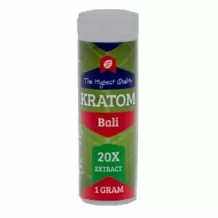
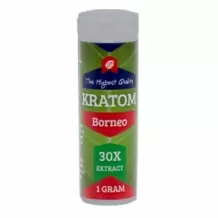
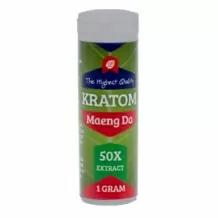
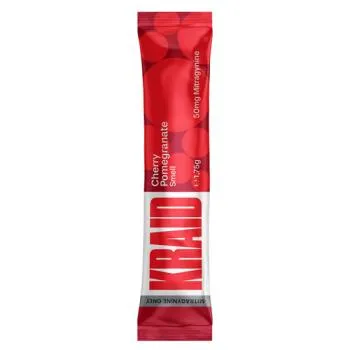
Extracts are made by boiling kratom leaves and reducing them to a resin, which is then dried and ground. The concentration factor on the packaging—20x, 30x, 50x—indicates how many grams of leaf were used per gram of final product. A 50x extract is therefore made from 50 grams of leaf powder per gram of extract, which significantly concentrates the mitragynine content.
This has direct implications for dosing. While a standard starting dose of powder is 2 to 3 grams, you should start with 0.1 to 0.3 grams of extract. Exceeding this dose greatly increases the risk of side effects such as nausea, dizziness, and sedation. Extracts are not suitable as a first introduction to kratom; always start with loose powder before moving on to extracts. Regular use of extracts increases the risk of tolerance development significantly faster than with leaf powder.
Maeng Da: high mitragynine content, widely available
In Thai, Maeng Da literally means "pimp-grade" and refers to a selection criterion: the leaves with the highest alkaloid content are set aside and marketed as Maeng Da. It is not a geographical indication but a quality term, which explains why Maeng Da exists in both Thai and Borneo variants.
Maeng Da is known for its relatively high mitragynine content—typically between 1.5% and 2% of dry weight, compared to 0.5% to 1.5% in standard kratom powders. The red variety contains more 7-hydroxymitraginine, while the white variety contains more free mitragynine. The green Maeng Da falls in between and is used by many users as a starting point when exploring stronger strains. Available in red, white, green, and super green.
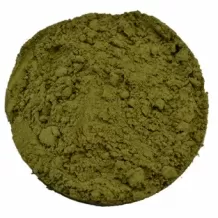
Bali kratom: broad alkaloid profile, large leaves
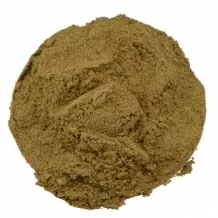
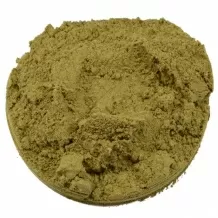
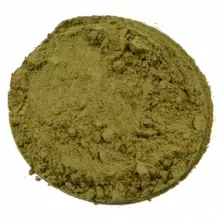
Despite its name, Bali kratom is primarily grown in the Indonesian provinces of West Kalimantan and Sumatra. Historically, the name refers to the export route via the port of Bali. The leaves of Bali kratom are generally larger than those of Thai or Borneo varieties, which is attributed to the fertile volcanic soil and the humid climate.
Bali Red is considered by many users as the benchmark for red kratom: its profile is broad, with a mitragynine/7-hydroxymitragynine ratio that is less pronounced than in some other red strains. This makes its effects slightly more predictable, which can be an advantage for people new to red kratom. The green Bali variety is also popular as an entry-level option within the green segment.
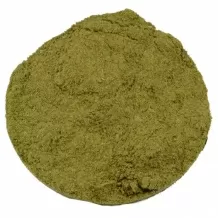
Borneo kratom: low mitragynine, relatively high 7-OH content
Kratom from the island of Borneo (Kalimantan) is known for a different alkaloid ratio than Thai or Maeng Da: the mitragynine content is generally slightly lower, but the proportion of 7-hydroxymitragynine is relatively higher, particularly in the red variety. This makes Borneo Red one of the most potent sedative red kratoms in the lineup. For first-time users, Borneo Red is therefore not the most obvious choice—Borneo Green or White are more accessible.
Borneo kratom is available as red, white, and green powder. The white variety has a distinctly stimulating character compared to other white strains.
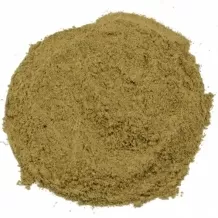
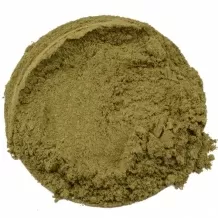
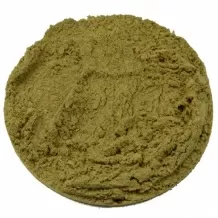
Thai kratom: the original source, thin leaf structure
Thailand is the historical home of kratom—the plant was traditionally chewed by workers for energy and pain relief. Today, kratom is legal in Thailand (2021) and is once again used as a medicinal plant. Thai kratom is botanically distinguished by thinner and narrower leaves than Bali or Borneo varieties. This is related to the slightly drier climate in parts of Thailand compared to the rainforest of Borneo.
Thai White is known as one of the most stimulating white strains in the lineup, with a distinctly high mitragynine content. Thai Red has a characteristic profile that differs from Borneo Red: less deeply sedating, but with a longer duration of effect. Thai Green is a commonly used daily strain due to its balance of activating and calming properties.
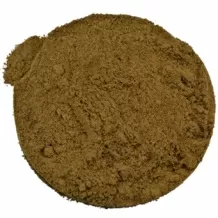
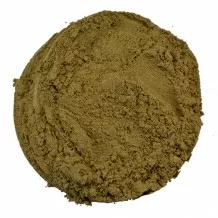

Horn strain: morphologically distinctive leaves
Horn kratom gets its name from the characteristic serrated, pointed leaf edges that resemble small horns. This is a genetic variant found primarily in the forests of Kalimantan (Indonesian Borneo). The irregular leaf shape makes manual harvesting more labor-intensive, which partly explains its relative rarity compared to standard Borneo.
There is less published research on the alkaloid profile of Horn kratom than on Bali or Thai, but user experiences describe the red Horn as comparable to Borneo Red, with a slightly more intense onset. Since the Horn strain in the Dutch-Smart assortment is partly offered through the Horn strain category, it is advisable to consult the product page for current availability by color.
Green kratom: harvested in the middle of the leaf cycle
Green kratom is harvested when the midrib has reached its green color, roughly halfway through the leaf’s maturation cycle. At that point, the mitragynine content is high, but some conversion to the more sedative alkaloids has already begun. The result is a profile that many users describe as versatile.
Experienced users also use green strains to break through tolerance when using exclusively red or white kratom. The switch to green provides the receptor system with enough variation in alkaloid composition to delay re-habituation. Popular green varieties in the range include Thai Green, Borneo Green, Maeng Da Super Green, and Bali Green.
Red kratom: fully ripe leaves, highest 7-OH content
Red kratom is harvested from fully matured leaves. During maturation, mitragynine partially converts to 7-hydroxymitragynine, which has a five- to thirteen-times stronger binding affinity to mu-opioid receptors. This explains why red strains have a different profile than green or white ones, and why dosing with red must be monitored more closely. A standard beginner’s dose for red kratom powder is 1 to 2 grams; with Borneo Red or Maeng Da Red, it’s wise to start on the lower end.
Red strains available in our selection: Borneo Red, Maeng Da Red, and Thai Red.
White kratom: harvested young, highest free mitragynine
White kratom is harvested before the midrib reaches its green color. At that early stage in the leaf cycle, the free mitragynine content is highest, and little conversion to 7-hydroxymitragynine has occurred. This gives white strains a profile that users describe as lighter and more active than red or green.
White kratom is not suitable as a first introduction for people who have no experience with kratom or stimulants, due to its pronounced stimulating effect at higher doses. A starting dose of 1 to 2 grams is recommended. Combining it with caffeine or other stimulants increases the risk of heart palpitations and restlessness.
Harm reduction: dosage, tolerance, and interactions (18+)
Kratom binds to opioid receptors and therefore carries a real risk of tolerance and dependence with daily use. The following guidelines are important for responsible use:
- Starting dose of powder: 1 to 2 grams for inexperienced users. Wait at least 45 minutes before taking another dose.
- Maximum frequency: Limit use to a maximum of 2 to 3 times per week to slow the development of tolerance.
- Rotation: Alternate between strains (red, green, white) and origins to maintain sensitivity.
- Interactions: Do not combine kratom with alcohol, benzodiazepines, opioid painkillers, or MAO inhibitors. These combinations increase the risk of respiratory depression and other serious side effects.
- Medication use: Kratom may affect the efficacy of blood thinners, antidepressants, and other medications metabolized via CYP3A4. Consult a doctor if in doubt.
- Pregnancy and breastfeeding: Kratom is contraindicated.
- Age restriction: For individuals 18 years of age and older only.
More detailed information on safe use, dosage, and risks can be found on the Dutch-Smart kratom knowledge base page.
Frequently asked questions about kratom varieties
What is the difference between a strain and a color?
A strain refers to the origin or type of plant (Bali, Borneo, Thai, Maeng Da, Horn). A color (red, green, white) refers to the harvest time and the associated alkaloid ratio. Each combination of strain and color has its own profile: Borneo Red is therefore different from both Borneo Green and Thai Red.
Is Maeng Da stronger than other kratom?
Maeng Da has, on average, a higher total mitragynine content than many standard powders, but “stronger” depends on what you’re measuring. In red Maeng Da, the 7-hydroxymitraginine content is also higher than in many other red strains, which makes the profile more intense at equal doses. This means that the starting dose for Maeng Da should be kept at the lower end of the usual range.
Can I combine different strains?
Yes, this is common practice in the kratom community. A popular combination is a green and a red strain, where the green slightly tempers the intensity of the red. When combining strains, keep the total dose lower than what you would take from a single strain, and experiment in small increments. Combinations with extracts are strongly discouraged due to the difficulty in controlling total alkaloid intake.
How do I store kratom properly?
Store kratom powder and extracts in a dry, dark place, sealed off from air. Exposure to light and moisture degrades the alkaloids, particularly mitragynine, relatively quickly. An airtight jar in a cupboard at room temperature is sufficient. Freezing is possible for longer storage but not necessary if used within 6 months.
About the author

Editor
Derek writes for Dutch Smart about smart shop products, cultivation techniques, and harm reduction. He combines practical experience with factual, evidence-based information, without hype or vague promises.


