


These days, psychonauts know full well that eating certain mushrooms or magic truffles results in an amazing trip. But have you ever actually thought about why those mushrooms ever developed psilocybin, the substance responsible for this effect? Well, researchers have now figured that out. H
Read also: Magic truffles and quitting smoking—the ultimate combination?
Millions of mushroom species
By studying different types of mushrooms, researchers believe they understand why these organisms began producing a hallucinogenic substance. It apparently serves as a genuine survival mechanism for the mushrooms. Mushrooms have been on Earth for millions of years and are fascinating organisms whose biology has not yet revealed all its secrets. Currently, more than 100,000 species are recorded, but it is estimated that over a million different types of mushrooms exist, and some are characterized by rather unusual traits. This is certainly the case with the famous magic mushrooms, mushrooms containing psychedelic substances.
These specimens are unique in that they produce hallucinogenic substances that cause various sensory disturbances and more general symptoms. One of the most well-known and widespread substances is psilocybin. But why did mushrooms develop such “magical” powers? The mystery has long been intriguing. Especially since scientists have discovered that psilocybin is produced by many fungi belonging to unrelated species.
Thanks to a study published in the journal Evolution Letters, biologists believe they have solved the mystery. As you might expect, mushrooms didn’t become hallucinogenic to give you and other Dutch-Smarters a special trip. Quite the opposite, in fact. This substance was actually developed to ensure that other organisms—like us—stay away from the mushrooms
Read also: Does ayahuasca put an end to atheism?
Horizontal gene transfer
To reach this conclusion, biologists from Ohio State University and the University of Tennessee studied a group of mushrooms that all produced psilocybin but were not related. They discovered that all the genes responsible for producing the substance are very similar to one another. These genes were even more similar to each other than those in closely related fungal species.
This observation suggests that these genetic traits were not inherited from a common ancestor, but rather were directly transferred between distantly related species. A phenomenon known as “horizontal gene transfer” (or HGT). It can occur through various processes, such as viruses carrying genes from one species to another.
However, one question remains: “What is the role of psilocybin in nature?” says Jason Slot, who led the research. The origin of the horizontal gene transfer associated with the substance remains unknown, but experts believe that this type of phenomenon typically occurs in nature in response to environmental stressors or opportunities.
Read also: The proof is in: women get stoned much faster than men!
A Bug’s Life
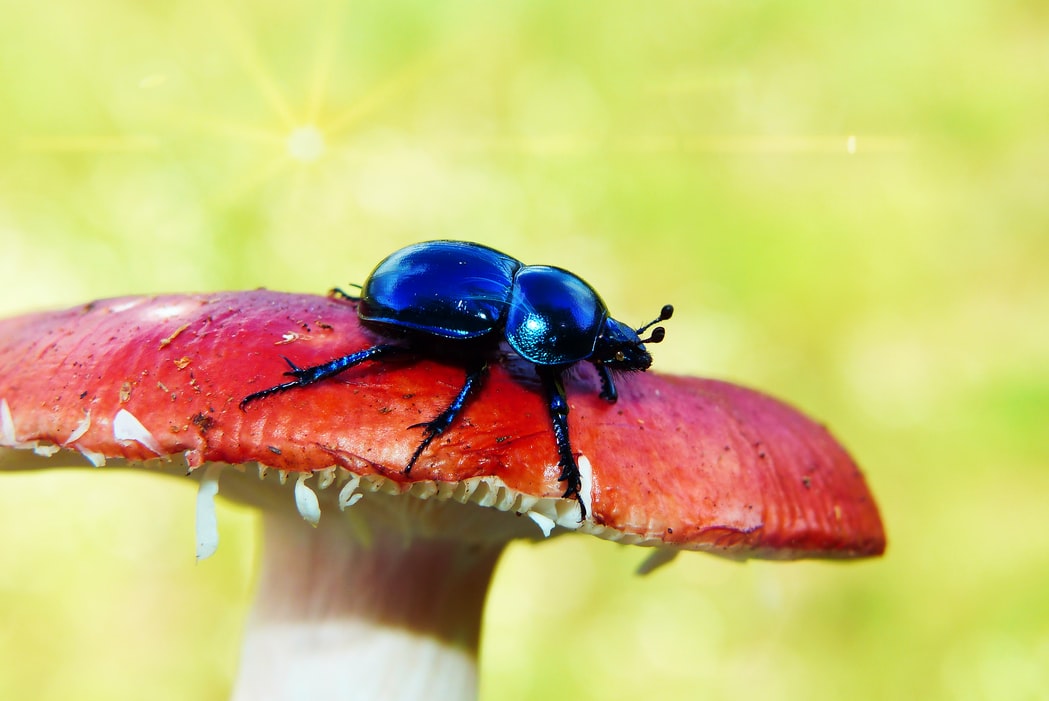
Based on this hypothesis, Jason Slot and his colleagues discovered a clue: the genes responsible for producing psilocybin appeared to have migrated to an environment with many mushroom-eating insects. An observation that took on new meaning by focusing on the effects of the substance.
Once inside the body, psilocybin interferes with a specific neurotransmitter and disrupts its function. Although this mechanism of action primarily causes hallucinations and other “magical” effects in humans, it has a slightly different effect in insects: it reduces their appetite. “We think fungi have evolved to be hallucinogenic because it reduces the chance of being eaten by insects,” explains Jason Slot.
“Psilocybin likely doesn’t just taste bad or have the ability to poison predators; these fungi alter the ‘mind’ of insects—if they have one—to serve their own needs,” he says. The substance would then serve as a survival mechanism. For insects, that is… we humans, on the other hand, actually enjoy them all the more precisely because they’re so psychedelic!


