

Over 6,600 people search for "microdosing truffles" every month
We at Dutch-Smart spotted it in our search data: "microdosing truffles" and its variations generate over 6,600 monthly searches. Many of those people want practical answers: which protocol, which truffle, what dose. We answer those questions here.
Below we compare two protocols side by side: the Fadiman schedule (every three days) and the Stamets schedule (four days on, three off). We list dosages per truffle strain, and at the bottom you will find a day-by-day plan for four weeks.
What counts as a microdose?
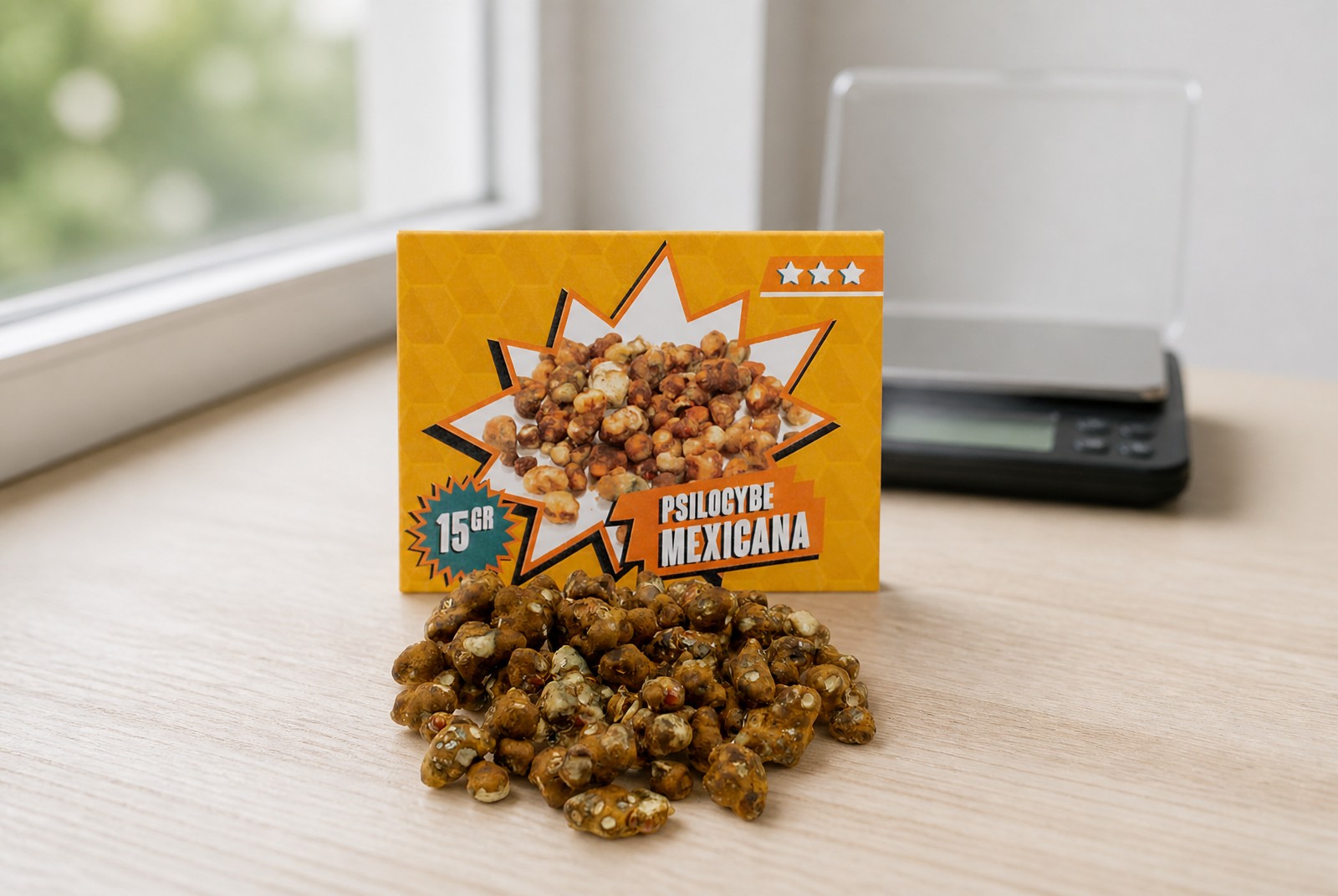
A microdose of psilocybin is an amount too low to cause hallucinations or a "trip." With fresh truffles that typically falls between 0.3 and 1.0 grams, depending on the strain. For comparison: a full trip dose of Mexicana truffles is 10 to 15 grams.
The aim is subtle: users report slightly improved focus, creativity or mood. Whether these effects rise above placebo is scientifically unresolved (more on that further down), but the protocols researchers use are concrete and well documented.
Why truffles and not mushrooms?
In the Netherlands, psilocybin-containing mushrooms (the above-ground fruiting bodies) have been banned under Schedule II of the Opium Act (Opiumwet) since December 2008. Sclerotia, the compact underground mycelial masses we know as truffles, were deliberately left out of that amendment. The Dutch parliament was aware of the distinction; the RIVM report by the CAM (Coordination Centre for Assessment and Monitoring of New Drugs) concluded that the health risks of truffles were very low.
Truffles are therefore not a "tolerated" product like cannabis, but an unscheduled consumer good under the Commodities Act (Warenwet). You can buy them legally in smartshops, including online at Dutch-Smart. That makes them the most practical option for microdosing in the Netherlands.
The Fadiman protocol: every three days
Psychologist Dr James Fadiman introduced this schedule in his 2011 book The Psychedelic Explorer's Guide. It is the most widely studied microdosing protocol in the world and the starting point for most clinical research.
The rhythm is straightforward. Day 1: microdose. Day 2: no dose (transition day, to observe any residual effects). Day 3: no dose (return to baseline). Day 4: microdose again. Repeat for four to eight weeks, then pause for two to four weeks.
The rest days serve a real purpose. Psilocybin builds tolerance quickly: a second dose within 24 hours produces noticeably weaker effects. A full tolerance reset takes roughly 48 hours. The Fadiman schedule is the tightest practical rhythm that preserves the full effect of each dose.
With fresh Mexicana truffles you take 0.5 to 1.0 grams on each dose day. Because psilocybin concentration varies between batches (0.85 to 2.5 mg per gram fresh, depending on growing conditions), a precision scale is non-negotiable. Start low (0.5 grams) and increase only after at least two full cycles.
The Stamets protocol: four days on, three off
Mycologist Paul Stamets devised a different schedule and patented it in 2017. The core idea: combine a psilocybin microdose with Lion's Mane mushroom and niacin (vitamin B3). Stamets calls this the "Stamets Stack."
The rhythm is more intensive. Four consecutive days with a microdose, then three days off. Stamets suggests 0.1 to 0.2 grams of dried cubensis per dose, supplemented with 50 to 200 mg of Lion's Mane and 100 to 200 mg of niacin. The niacin causes a flush (warmth, skin reddening) and is thought to act as a vasodilator, distributing the other compounds further through the body.
An important caveat: this protocol has not been clinically validated. The reasoning sounds plausible (Lion's Mane stimulates nerve growth factor, psilocybin promotes neuroplasticity), but as of 2026 no double-blind, placebo-controlled trial has tested the combination in humans. The protocol rests on a hypothesis.
Translated to fresh truffles (instead of dried mushrooms): count on 0.5 to 1.0 grams of mild strains like Mexicana or Tampanensis, or 0.3 to 0.7 grams of a stronger strain like Atlantis.
Dosage per truffle strain
Not every truffle is equally potent. Psilocybin concentration ranges from 0.09% to 1.78% of dry weight (Gotvaldová et al., 2022, published in the Journal of Natural Products). In practice that breaks down as follows.
Mild: Mexicana and Tampanensis
Microdose: 0.5 to 1.0 grams fresh. Mexicana is the classic beginner's choice; Tampanensis (also known as Philosopher's Stones) sits in the same range. A single 10-gram pack yields roughly 10 to 20 microdoses.
Medium: Atlantis
Microdose: 0.3 to 0.7 grams fresh. Atlantis contains more psilocybin per gram than Mexicana. Start at the lower end and increase cautiously.
Strong: Hollandia and Valhalla
Microdose: 0.2 to 0.5 grams fresh. These strains are intended for experienced users. At microdose level the dosing is harder to keep precise. We recommend them for microdosing only if you already have experience with a milder strain.
A useful rule of thumb: 1 gram of dried cubensis is roughly equivalent in psilocybin content to about 5 grams of fresh truffles. However, truffles vary more between batches than cultivated mushrooms, so weighing each dose remains a must.
Schedule: four weeks of Fadiman with Mexicana (0.5 g per dose)
Below is a concrete plan. You can pick any starting day, as long as the 1-on-2-off rhythm stays intact.
Week 1: Monday dose, Tuesday rest, Wednesday rest, Thursday dose, Friday rest, Saturday rest, Sunday dose.
Week 2: Monday rest, Tuesday rest, Wednesday dose, Thursday rest, Friday rest, Saturday dose, Sunday rest.
Week 3: Monday rest, Tuesday dose, Wednesday rest, Thursday rest, Friday dose, Saturday rest, Sunday rest.
Week 4: Monday dose, Tuesday rest, Wednesday rest, Thursday dose, Friday rest, Saturday rest, Sunday dose.
Total: 10 dose days in 28 days. Consumption at 0.5 grams per dose: 5 grams of Mexicana. One 10-gram pack covers a full two-month Fadiman cycle.
Schedule: four weeks of Stamets (0.5 g Mexicana + Lion's Mane + niacin)
Week 1: Monday through Thursday dose, Friday through Sunday rest.
Week 2: Monday through Thursday dose, Friday through Sunday rest.
Week 3: Monday through Thursday dose, Friday through Sunday rest.
Week 4: Monday through Thursday dose, Friday through Sunday rest.
Total: 16 dose days in 28 days. Consumption at 0.5 grams of Mexicana per dose: 8 grams. That is more than the Fadiman protocol, and the higher dosing frequency increases the chance of tolerance build-up. Hence the three consecutive rest days at the end of each week.
What does the research say?
The honest state of affairs in 2026: the evidence is mixed.
Researchers at Leiden University conducted three double-blind, placebo-controlled longitudinal trials (Prochazkova, Marschall, Van Elk et al., published in Neuropharmacology, 2025). With 171 participants this is one of the largest datasets in the field. Their finding on creativity: no significant difference from placebo on standardised measures.
A self-blinding study from Imperial College London (Szigeti et al., 2021) initially found improvements in well-being and convergent thinking, but those disappeared once expectancy effects were factored into the analysis.
At the same time, a review of 19 placebo-controlled studies (Polito and Liknaitzky, 2024, Journal of Psychopharmacology) showed that microdosing produces measurable neurobiological and subjective changes compared to placebo. And animal studies demonstrate that repeated low doses of psilocybin alter dendritic spine density in the prefrontal cortex and hippocampus, correlating with improved cognitive flexibility in rodents.
In short: some effects appear real, but the placebo debate is not settled. Anyone who microdoses is, for now, doing so partly on the basis of personal experience and anecdotal evidence.
Safety and when to avoid it
Psilocybin is physiologically low in toxicity; there are no documented cases of fatal overdose in healthy adults. That said, there are situations where microdosing is unwise.
Do not use psilocybin if you are taking lithium or other MAO inhibitors: the combination can cause serious adverse effects. Anyone with a history of psychotic disorders (schizophrenia, bipolar disorder type I) is strongly advised against any use of psychedelics. Pregnancy and breastfeeding are also contraindications due to the lack of safety data.
Practical tips: take your microdose in the morning, preferably on an empty or light stomach. Avoid driving or operating machinery, even though the effect is sub-perceptual. Store fresh truffles in the fridge (up to two months in the original vacuum packaging) or dry them for longer shelf life. And keep a short journal of your dose days and rest days; it helps distinguish real effects from expectations.
Frequently asked questions
How many truffles do I need for a month of microdosing?
On the Fadiman protocol (10 doses per 28 days) at 0.5 grams per dose: 5 grams. One Mexicana pack (10 grams) therefore covers two full cycles. On Stamets (16 doses): 8 grams per cycle.
Can I combine microdosing with medication?
SSRIs (fluoxetine, sertraline) reduce the effect of psilocybin; the combination is not dangerous, but also not useful. Lithium and MAO inhibitors are a hard contraindication. If in doubt, consult a doctor.
Will I feel anything from a microdose?
The idea is that you do not consciously notice it. If you experience visual changes, a lightheaded sensation or heightened emotionality, the dose was too high. Reduce by 0.1 to 0.2 grams.
Which truffle is best for beginners?
Mexicana is the standard: mild, consistent and widely available. Tampanensis (Philosopher's Stones) is a comparable alternative. If after a few cycles you want something stronger, try Atlantis, but start again at the low end of the dosing range.