


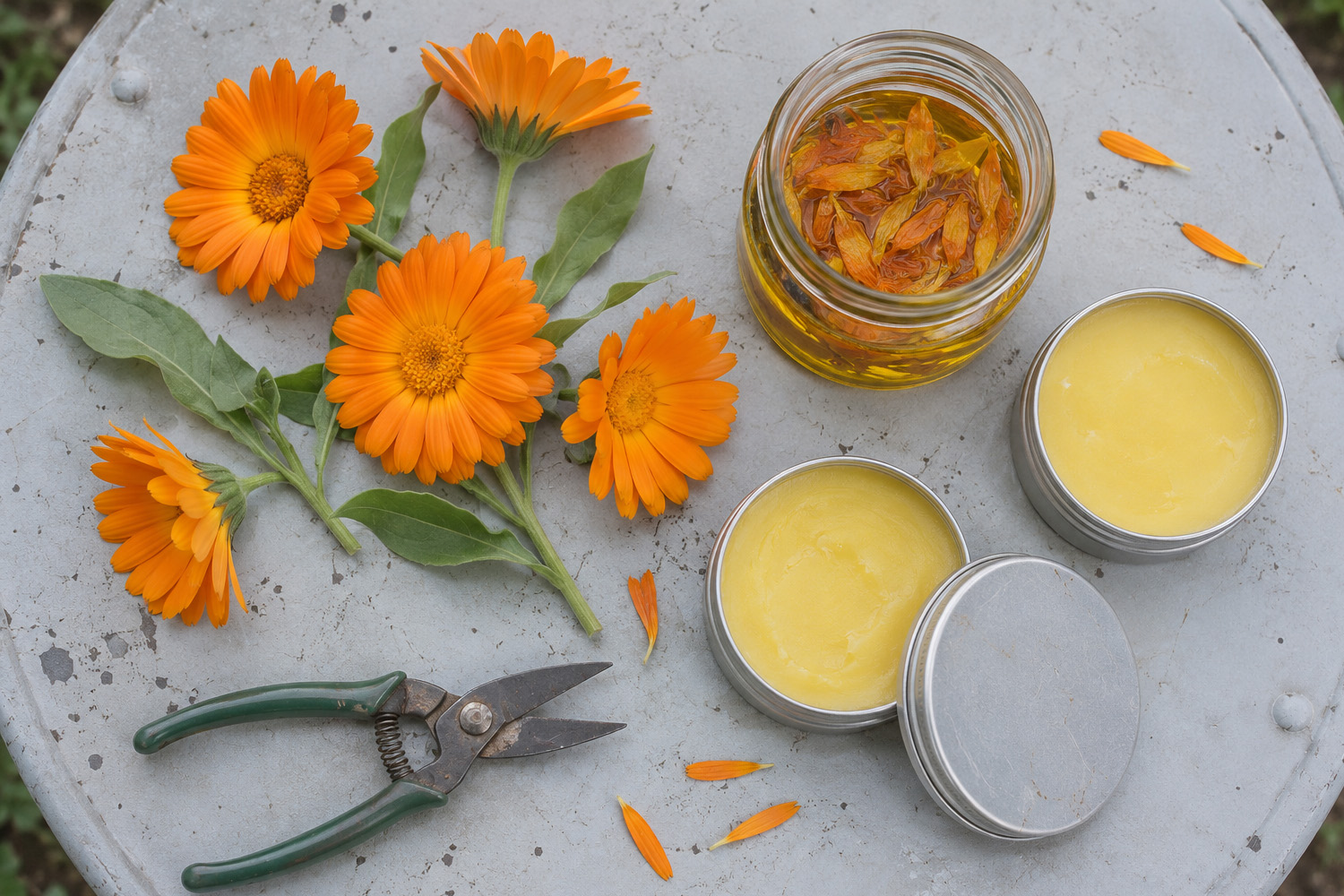
Calendula, or pot marigold, is one of the easiest flowers for your garden or balcony. You sow it once and it flowers from June until the first frost, in bright orange or yellow. The petals are edible, you can make tea from them and you can use them to make oil and salve. In this guide you'll read how to recognise true calendula, how to grow and dry it, and how to make calendula tea, calendula oil and calendula salve step by step.
What is calendula?
Calendula (Calendula officinalis) is an annual plant from the daisy family (Asteraceae). It grows 30 to 60 centimetres tall and has light green, slightly sticky leaves with a faintly herbal scent. The flower heads are 4 to 7 centimetres wide, orange or yellow, single or double. After flowering it forms curved, sickle-shaped seeds, which it uses to self-seed easily. In Dutch it's called goudsbloem.
Calendula or Tagetes?
In English both plants are called marigold, which is why they're often mixed up.
| Calendula | Tagetes | |
|---|---|---|
| Botanical name | Calendula officinalis | Tagetes (various species) |
| English name | Pot marigold, calendula | Marigold, French or African marigold |
| Leaf | Lance-shaped, entire, slightly sticky | Finely divided, deeply cut |
| Scent | Mildly herbal | Strong and pungent |
| Seed | Curved, sickle-shaped | Straight and black, like a needle |
| For the tea, oil and salve in this guide | Yes | Not for these recipes |
When buying seeds or plants, always check the botanical name on the packet: Calendula officinalis.
What's in it?
The orange colour comes from carotenoids, such as lutein and beta-carotene. The flowers also contain flavonoids, saponins and a small amount of essential oil. People used to colour butter, cheese and rice with it, which is why calendula was also called poor man's saffron. No health claims have been approved for calendula in the EU, so we don't promise any effects.
Which form should you choose?
| Form | Use | Suitable for |
|---|---|---|
| Fresh flowers | Petals in salad, soup or rice | Anyone growing their own |
| Dried petals | Tea, oil and salve | Anyone who wants to brew or make oil |
| Marigold 1:1 extract | Drops in water or tea | Anyone who wants it quick and easy |
You'll find more dried herbs in the health herbs category and more extracts in the tinctures category.
Growing calendula in 5 steps
- Sow outdoors from March to May, or in a pot on your balcony. Place the seeds about 1 centimetre deep, 20 to 30 centimetres apart.
- Choose a sunny spot. Ordinary soil is fine, very rich soil gives lots of leaves and fewer flowers.
- Keep the soil moist until the seeds germinate, usually within one to two weeks.
- After about eight weeks it flowers. Cut off spent flowers and it will keep making new ones.
- At the end of summer, let a few flowers go to seed. It will self-seed and come back in your garden next year.
Harvesting and drying
Pick the flowers when they're fully open, on a dry day, once the dew has dried. Lay them face down on a rack in an airy, shady spot. After one to two weeks they'll be crispy dry. Store them in a dark, airtight jar.
Brewing calendula tea
Take 1 to 2 teaspoons of dried petals and pour a cup of boiling water over them, about 250 ml. Let the tea steep for 5 to 10 minutes and strain it. The taste is mild, slightly bitter and a little herbal. It goes well with chamomile and lemon balm. Also read our blog on brewing chamomile tea.
Making calendula oil in 5 steps
- Take a clean, dry glass jar and fill it halfway with dried petals. Don't use fresh flowers, the moisture will make the oil go mouldy.
- Pour olive oil or sunflower oil over them until the flowers are well covered.
- Close the jar and place it in a warm spot out of direct sun for 4 to 6 weeks. Shake it every few days. A water bath is faster: 2 to 3 hours on low heat, without the oil getting hotter than about 50 °C.
- Strain the oil through a clean tea towel and squeeze the flowers out well.
- Pour the oil into a dark bottle, write the date on it and store it somewhere cool. It keeps for about a year.
Making calendula salve
With beeswax, calendula oil becomes a salve. Melt about 10 grams of beeswax in 80 to 100 ml of calendula oil in a water bath. Stir until the wax has fully dissolved, pour it into small, clean jars and let it cool without the lid. For a firmer salve, use a little more wax. Calendula salve has traditionally been used on the skin, but we make no promises about its effects. Don't apply it to open wounds, and test it on a small patch of skin first.
Safety
- Allergy: if you're allergic to plants in the daisy family, such as chamomile, chrysanthemum, ragweed or arnica, don't use calendula, not even on your skin.
- Pregnancy or breastfeeding: don't drink calendula tea, its safety hasn't been established.
- Medication: if you take sleeping pills or sedatives, check with your doctor or pharmacist first.
- Skin: if you get itching, redness or a rash, stop.
- Ornamental plants from the garden centre: these are often treated with pesticides. Only eat or use flowers you grow yourself or buy as a herb.
Common mistakes
- Using Tagetes: always check for the name Calendula officinalis.
- Making oil with fresh flowers: the water in the flowers spoils the oil. Dry them first.
- Heating the oil too much: above 50 °C the scent and colour are lost.
- Not deadheading: without cutting off spent flowers, flowering stops sooner.
- Picking too early: wait until the dew has dried, wet flowers dry badly.
- Storing them in a warm, light place: the orange colour fades. Store them dark and airtight.
Frequently asked questions
Is calendula edible?
Yes, the petals of Calendula officinalis are edible. Sprinkle them over a salad or cook them with rice for a yellow colour. Only use flowers that haven't been sprayed.
What's the difference between pot marigold and calendula?
There's no difference. Pot marigold is the common English name for Calendula officinalis.
Is calendula tea healthy?
Calendula has been used for centuries, but no health claims have been approved for calendula in the EU. Drink it in moderation.
How long does homemade calendula oil keep?
About a year, if you use dried flowers and store the oil somewhere dark and cool. If it smells rancid, throw it away.
Does calendula come back every year?
The plant itself is annual, but it self-seeds easily. Let a few flowers go to seed and it will come back by itself.
Where can I buy calendula?
You'll find Calendula officinalis dried petals in the health herbs category and the Marigold 1:1 extract in the tinctures category.
Sources: Wikipedia (EN), Calendula officinalis, Wikipedia (EN), Tagetes.


