


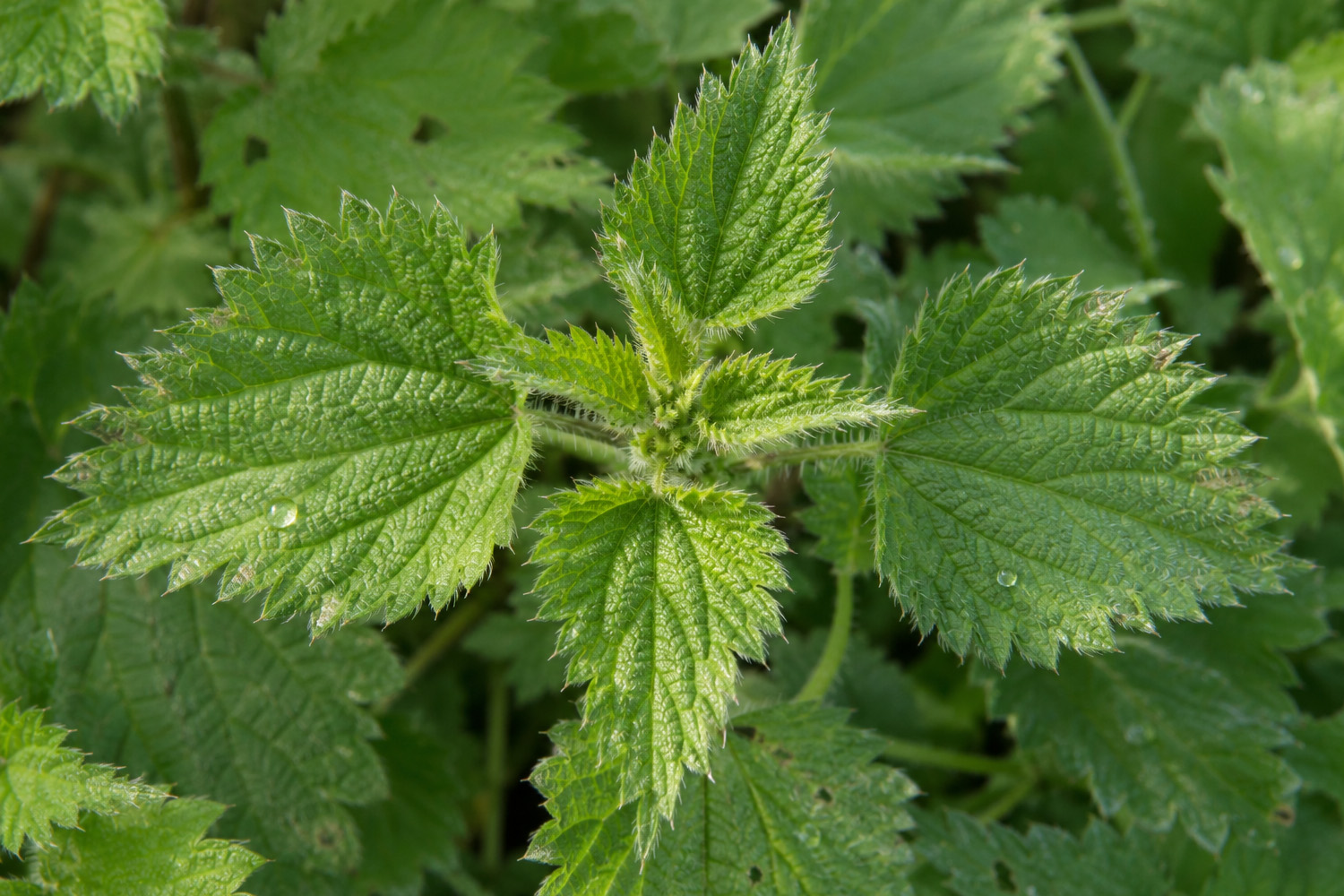
Stinging nettles grow almost anywhere the soil is rich in nitrogen: along ditches, next to compost heaps and at the edges of meadows. Everyone knows the sting, but few people know that the young tops make a mild, green tea. Once dried or cooked, they no longer sting. In this guide you'll read how to recognise the common nettle, when and how to pick it, how to brew nettle tea and what to watch out for.
What is stinging nettle?
The common nettle (Urtica dioica) is a perennial plant from the nettle family (Urticaceae). It grows 50 to 150 centimetres tall and spreads through yellow, creeping rhizomes, which is why it often grows in large patches. The stem is square and the leaves are heart-shaped with a serrated edge. Dioica means "two houses": there are separate male and female plants. From June to September it carries green, hanging flower clusters that are easy to overlook.
Common nettle, annual nettle or dead-nettle?
| Common nettle | Annual nettle | White dead-nettle | |
|---|---|---|---|
| Botanical name | Urtica dioica | Urtica urens | Lamium album |
| Height | 50 to 150 cm | 10 to 50 cm | 20 to 60 cm |
| Lifespan | Perennial, in patches | Annual, single plants | Perennial |
| Flower | Hanging green clusters | Short green clusters | White lipped flowers in whorls |
| Stinging hairs | Yes | Yes, often stings harder | No |
You can use both nettles. Dead-nettles look like nettles but don't sting. You can tell them apart by their white, purple or yellow lipped flowers.
Why does a nettle sting?
The leaves and stems are covered in hollow stinging hairs with a brittle tip made of silica. When you touch one, the tip breaks off and the hair injects a tiny amount of fluid into your skin, containing histamine, acetylcholine and serotonin, among other things. That causes the burning feeling and the bumps. Drying, cooking or blending breaks the hairs, after which they no longer sting.
What's in it?
Nettle leaf contains chlorophyll, flavonoids and minerals such as calcium, potassium and iron. Fresh leaves also contain vitamin C. No health claims have been approved for nettle in the EU, so we don't promise any effects. What you do get is a mild, slightly grassy tea without caffeine.
Which form should you choose?
| Form | Use | Suitable for |
|---|---|---|
| Fresh tops | Tea, soup, pesto or like spinach | Anyone picking their own in spring |
| Dried leaf | Tea, all year round | Anyone who wants to build a stock |
| Stinging nettle 1:1 extract | Drops in water or tea | Anyone who doesn't want to pick and dry |
Want to make your own extract? Read our blog on how to make a tincture. You'll find more extracts in the tinctures category.
Picking nettles in 5 steps
- Pick in spring, from March to May, before the plant flowers. That's when the leaves are young and tender.
- Choose a clean spot, away from busy roads, sprayed fields and places where lots of dogs are walked.
- Put on sturdy gardening gloves and bring a pair of scissors.
- Only cut the top four to six leaves of each stem. The plant will simply grow back.
- Use the tops the same day, or spread them loosely on a rack in a dry, shady spot. After a week they'll be crispy dry. Store them in an airtight jar.
After flowering, the leaves get tougher and more bitter. Many foragers leave them alone then, or cut the plant back so it produces young tops again.
Brewing nettle tea in 5 steps
- Take a small handful of fresh tops, about 5 to 10 leaves, or 1 to 2 teaspoons of dried leaf.
- Briefly rinse fresh tops under the tap.
- Pour a cup of boiling water over them, about 250 ml.
- Let the tea steep for 5 to 10 minutes. The longer, the fuller and greener the taste.
- Strain out the leaves. Drink it plain, or with a slice of lemon or a little honey.
Tasty combinations
Nettle tastes mild and grassy, a bit like green tea without the bitterness. It goes well with mint, lemon balm and ginger. A few drops of peppermint extract make it fresher. You'll find more tea herbs in the tea category.
Eating nettles
You can use young tops like spinach: boil or braise them briefly and they no longer sting. Nettle soup with potato, onion and stock is a classic. You can also blanch them and use them in pesto or an omelette.
Leave a corner wild
Nettles are important for butterflies. The caterpillars of the peacock, the small tortoiseshell and the red admiral feed on them. If you have a garden, leave a sunny corner with nettles. There's no need to sow them, they come up by themselves on moist, nutrient-rich soil.
Safety
- Medication: nettle can affect how blood thinners, diuretics, lithium, blood pressure medication and diabetes medication work. If you take medication, check with your doctor or pharmacist first.
- Pregnancy or breastfeeding: don't drink nettle tea, its safety hasn't been established.
- Heart or kidney problems: check with your doctor first.
- Stings: a few bumps usually disappear within a few hours. Rinse with cold water and don't rub.
- Allergy: if you get itching, a rash or stomach complaints, stop.
Common mistakes
- Picking by the road or in a dog-walking area: find a clean spot.
- Picking too late: after flowering the leaves are tough. Pick young tops.
- Taking the whole plant: the top leaves taste best.
- Storing it damp: half-dried leaves go mouldy. Dry them completely.
- Mistaking dead-nettle for nettle: that's not a problem, but it's a different plant with a different taste.
- Picking without gloves: you can, but you'll feel it for the rest of the afternoon.
Frequently asked questions
Is nettle tea healthy?
Nettle has been eaten and drunk for centuries, but no health claims have been approved for nettle in the EU. Drink it in moderation and check with your doctor if you take medication.
How much nettle tea can you drink per day?
Two to three cups a day is a common limit. If you're pregnant or take medication, check with your doctor first.
Does nettle tea sting?
No. The boiling water breaks the stinging hairs, and dried leaves don't sting either.
When do you pick nettles for tea?
In spring, from March to May, before the plant flowers. Cut the top four to six leaves.
Can you eat nettles raw?
Only if you break the stinging hairs first, for example by blending the leaves into a pesto. Boiling, braising or drying is easier.
Does nettle tea contain caffeine?
No. Nettle tea is caffeine-free, so you can drink it in the evening too.
Where can I buy nettle?
You'll find the Stinging nettle 1:1 extract (Urtica dioica) in the tinctures category. More tea herbs are in the tea category.
Sources: Wikipedia (EN), Urtica dioica, Wikipedia (EN), Urtica urens, Butterfly Conservation.


