

Five products, two compound groups, and the choice actually matters
We at Dutch-Smart sell five Lion’s Mane products. Two liquid extracts, a jar of capsules, a bag of loose powder and an organic extract. When customers ask which one to pick, our answer always starts with the same counter-question: what are you looking for?
Lion’s Mane (Hericium erinaceus) contains two families of bioactive compounds located in completely different parts of the mushroom. One product concentrates the first group, another product the second. That makes the choice less arbitrary than most supplement websites would have you believe.
Hericenones and erinacines: two names worth remembering
The fruiting body, the white, shaggy ball you sometimes see hanging from a tree trunk, contains hericenones. These are aromatic compounds that, in laboratory research, stimulate the production of NGF. NGF stands for nerve growth factor, a protein your body needs to to grow and maintain nerve cells.
The mycelium, the underground network of fungal threads, contains erinacines. Those are cyathane diterpenoids. Sounds like a chemistry lecture, but the relevant point is straightforward: according to preclinical research, erinacine A crosses the blood-brain barrier and stimulates NGF production directly in brain tissue. For hericenones, that hasn’t been demonstrated in human studies yet.
Fruiting body = hericenones. Mycelium = erinacines. Both stimulate NGF, but through different pathways.
Liquid extract: fastest absorption, most flexible dosing
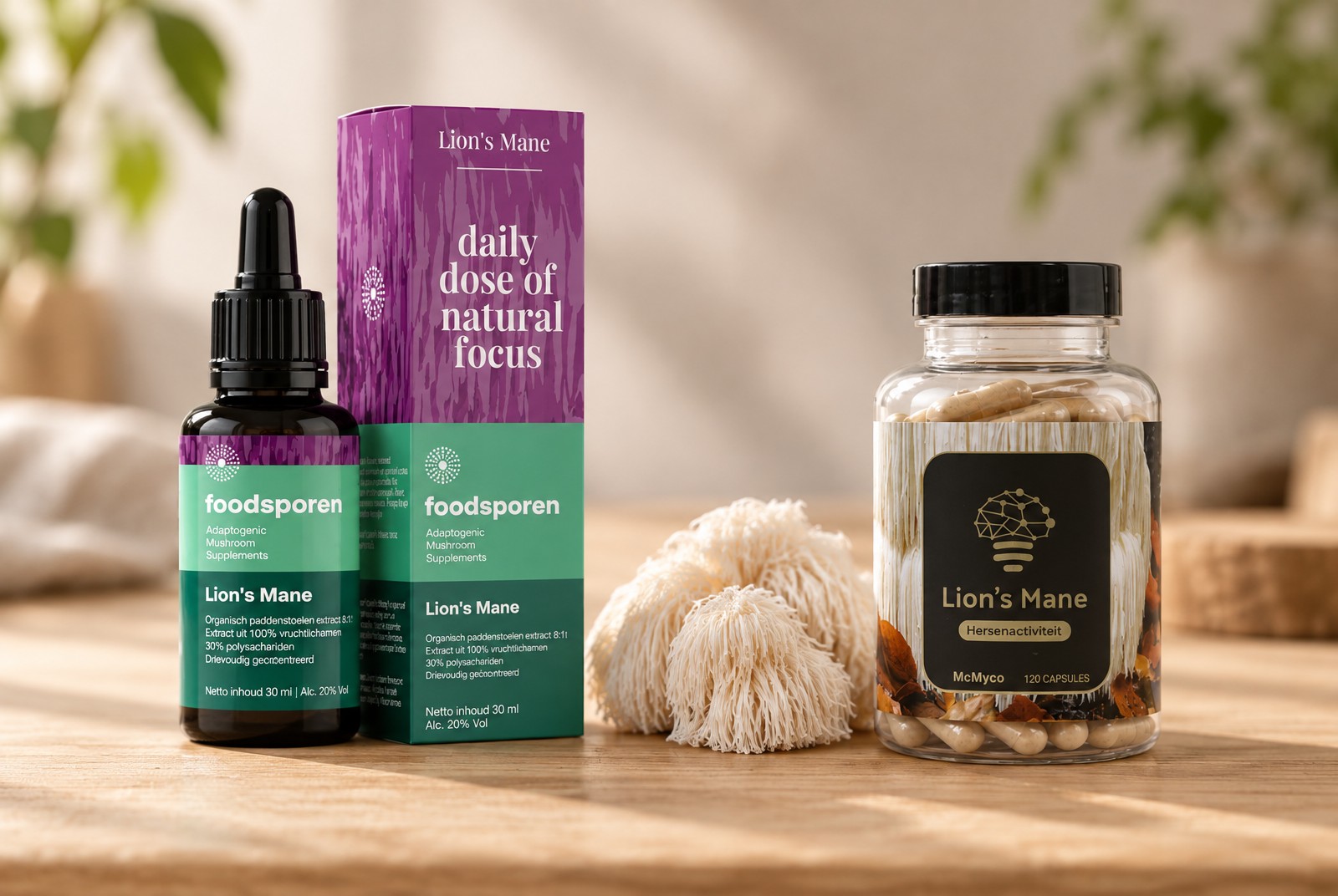
Our Lion’s Mane extract (30 ml) from Foodsporen contains 830 mg of Lion’s Mane per ten drops, plus cinnamon and vitamin B3. The bottle is made of MIRON violet glass, which blocks UV light and keeps the active compounds intact longer.
The recommended dose is five drops twice daily. Place them under your tongue and the compounds reach your bloodstream through the oral mucosa, faster than going through the stomach. Can’t handle the taste? Honestly, it’s quite intense. Mix the drops into tea or juice and absorption simply takes the digestive route instead.
The big advantage of drops is that you can adjust. Three drops on a quiet day, ten on a day when you need hours of focus. You don’t get that flexibility with capsules.
Capsules: fixed dose, 100% fruiting body
Our Lion’s Mane extract capsules (120 count) contain 400 mg of organic extract per capsule, sourced exclusively from the fruiting body. That means hericenones, no mycelium, no grain substrate mixed in. Two capsules a day, done.
Convenience isn’t the only selling point. Because the extract comes from 100% fruiting body, you know exactly what you’re getting. Some cheaper brands on the market pack their so-called mycelium extract with a significant amount of grain filler, sometimes 60-70%, which dilutes the actual concentration of active compounds. Not an issue with these capsules.
Are they slower than drops? Yes, slightly. Capsules have to pass through the stomach and liver before the compounds enter your bloodstream. Pharmacologists call that first-pass metabolism. But in practice, you’ll barely notice the difference unless you’re used to the quick onset of sublingual absorption.
Powder: cheapest per gram, but watch out for chitin
Our Lion’s Mane powder (100 grams) is currently out of stock. Still, we get asked about powder regularly, so here’s how it compares.
Raw mushroom powder, dried and ground without extraction, contains chitin. That’s the insoluble fibre in fungal cell walls, and your digestive system barely breaks it down. As a result, hericenones and beta-glucans stay partially locked inside the cell structure and simply don’t fully reach your bloodstream.
Extract powder is a different story. There, the chitin barrier has already been broken down through hot water or dual extraction, making the active compounds far more available. If the label just says "Lion’s Mane powder" without the word extract, you’re probably looking at the raw version.
The three forms side by side
Drops absorb sublingually in minutes. Capsules go through the stomach, expect half an hour to an hour. With powder, it depends on the extraction method. Concentration per dose also differs: 830 mg per 10 drops for the extract, 400 mg per capsule. In terms of active compounds, the capsule delivers proven hericenones from the fruiting body, while a liquid extract may capture a broader spectrum.
Want more background on what Lion’s Mane can do for you? Read our earlier article on Lion’s Mane and health. And if you’re curious how Lion’s Mane fits into the bigger picture of nootropics, our piece on nootropics and focus is a good next read.
What we recommend
Just start with the capsules. Not because they’re better in every way, but the barrier to entry is low, the dose is fixed, and you know for sure you’re getting hericenones from the fruiting body. After a month you’ll know whether it’s working for you.
And if you ask us: extraction quality matters more than the form. A good fruiting body extract does more than a kilo of raw powder full of chitin. That’s really the most important thing to keep in mind when browsing our full medicinal mushrooms range!