
Three ways to use wild dagga, and when each one makes sense
Wild dagga is one of those products customers email us about with essentially the same question: "I ordered it, but what exactly do I do with it?" We sell it as loose herb, as a concentrated 20x extract, and as a liquid alkaloid extract. Three forms, three applications, and the difference matters more than you'd think.
Leonotis leonurus, the botanical name, is a plant from the mint family native to South Africa. The Khoikhoi smoked the dried leaves for a calming, mildly euphoric sensation. That is where the name "wilde dagga" comes from, because the effect vaguely reminded them of cannabis. But the comparison is actually misleading.
Leonurine is not THC
The active compound in wild dagga is called leonurine, a pseudo-alkaloid that dissolves in water. THC binds to CB1 receptors in your brain. Leonurine does not. A British pharmacological study from 2025 showed that leonurine acts on TRPA1 and TRPV4 ion channels, completely different pathways than cannabis. The flowers also contain a substance called docosatetraenoylethanolamide that does interact with CB1, which probably explains why some users still report a cannabis-like feeling.
So yes, it feels somewhat related. But pharmacologically it is a completely different story. Wild dagga belongs to the mint family, cannabis to the hemp family. The only thing they share is that people smoke both of them.
Smoking: fast and short
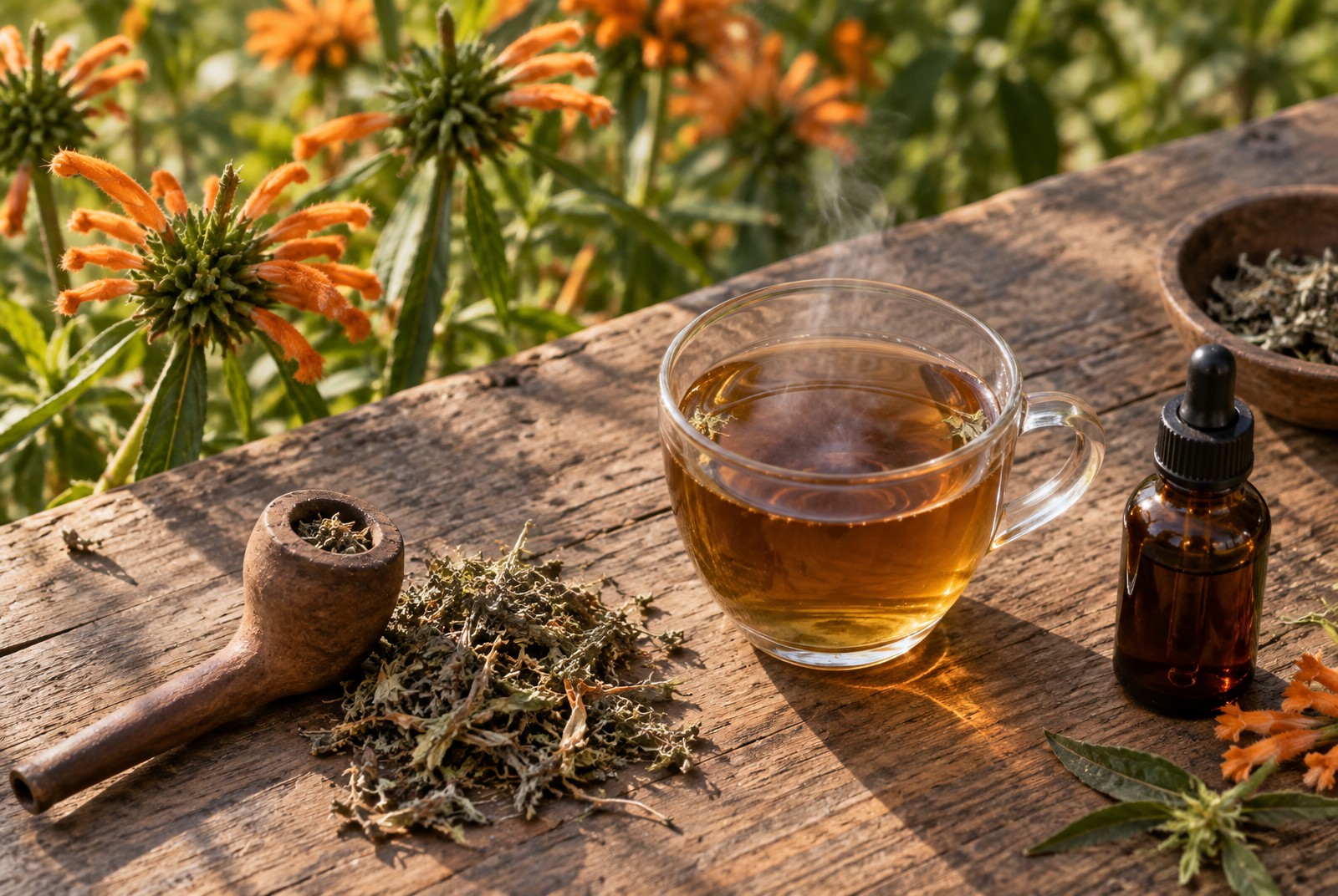
The classic method. You pack the dried leaves from our Wild Dagga 10 grams into a pipe or roll them in a joint, optionally mixed with tobacco or another herbal blend. After a few puffs you feel a mild, warm, relaxed sensation within about about five minutes.
The effect is subtle. Don't expect a heavy trip or a thick cannabis high. Users describe it as a light euphoria with a relaxed body, as if you just spent half an hour lying in the sun. After twenty to thirty minutes it fades again.
The downside: the smoke is quite harsh. That is just how it is with plants from the mint family, not much you can do about it. A water pipe or vaporizer makes it more bearable. We recommend the Wild Dagga 20x extract if you find the taste too intense. You only need about a quarter gram for the same effect, so less smoke, less harshness.
Tea: slower and softer
Leonurine dissolves well in water, so making tea works. Take a teaspoon of dried herb, pour hot water over it and let it steep for at least ten minutes. Longer is fine. It won't become toxic, just more bitter.
The difference from smoking: you won't feel it until after half an hour, sometimes longer. The effect is softer, more calming than euphoric. Great for an evening where you just want to wind down without alcohol. Does it taste good? Honestly, no. Wild dagga tea is bitter with an earthy undertone. A spoon of honey and a slice of lemon help enormously!
The alkaloid extract: concentrated and precise
Our Wild Dagga 5% alkaloid extract is a liquid concentration of the active compounds. A few drops under the tongue, done. No smoke, no bitter tea, no hassle.
Dosing is more precise than with loose herb, and absorption through the oral mucosa is faster than through the stomach. For people who want to know exactly what they are taking, this is the most predictable option. The price per dose is higher, but you also don't waste any of it.
Wild dagga versus klip dagga
We also sell Klip Dagga (Leonotis nepetifolia), a related species. Same family, similar effects, but they really are two different plants. Klip dagga has spherical flower heads instead of the typical layered orange whorls of wild dagga. On forums some users claim klip dagga works slightly stronger, but that has not been scientifically confirmed. Which one you choose is a matter of trying both.
And for the growers among us: with our wild dagga seeds you can grow the plant yourself. In a Dutch garden it only survives winter if you bring it indoors, but on a sunny balcony or in a greenhouse it thives from April through October.
Is it legal?
Yes. Wild dagga is not listed on Schedule I or Schedule II of the Dutch Opiumwet (Opium Act). You can freely buy, possess and use it in the Netherlands. Some other countries have different rules, Latvia and Poland have placed leonotis on their lists of controlled substances. But here in the Netherlands, no issues at all.
Which form suits you?
Smoking is for the quick-effect seekers who enjoy the ritual. Tea is for those who want to unwind quietly without inhaling. The extract is for those who want precise dosing without the taste. We at Dutch-Smart see the loose herb most often in orders alongside other relaxation herbs like kanna or blue lotus, as part of a custom blend.
One more important thing: the effects of wild dagga vary from person to person and are always mild compared to cannabis. Think of it more as an unusual herbal tea with a light buzz than a hard-hitting smoking alternative. Start slow, see what it does for you, and don't expect miracles.