



If you’ve landed here on the Dutch-Smart blog, chances are you’ve already experienced a magical psychedelic journey. A magic mushroom trip, for example, an evening of peyote fun, or maybe even an intense ayahuasca session. But did you know that you might not necessarily need these substances to trip at all? In fact, according to new research, it’s not these substances but our own brains that could be the most powerful psychedelics ever… Because it turns out: even a placebo can take you to the stars.
Read also: Finnish researchers take a closer look at psychedelic experiences
Contact highs
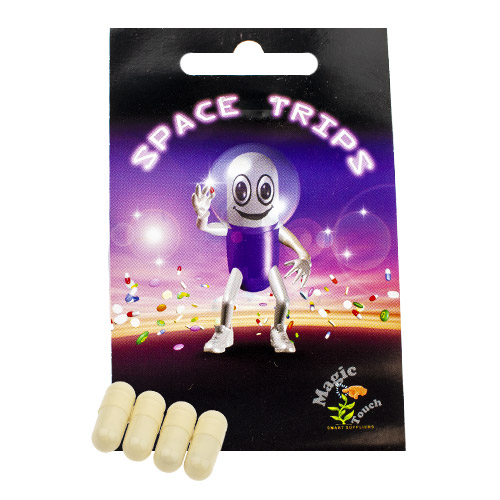 Tripping on a placebo? How does that work? Well, new research recently published in the journal Psychopharmacology shows that genuine placebo pills can, on their own, cause psychedelic effects, including perceptual changes. The findings highlight the importance of expectations and context when taking psychedelic substances. The study also examined the mystery of so-called “contact highs,” which means you can trip just by being near a psychedelic user!
“I’m interested in placebos in general and, in particular, in maximizing their effects. When I read clinical trials involving psychedelic drugs, I was surprised by the low placebo effects reported in many studies,” study author Jay Olson, who recently earned his PhD in psychiatry at McGill University, told PsyPost. For this study, the researcher was particularly curious about the effects of placebos on psychedelic effects.
Read also: Danish scientists turn brewer’s yeast into psilocybin
Placebo-induced psychedelic effects
“We have other evidence that people can experience psychedelic effects without taking the drug. For example, in the case of ‘contact highs,’ where people feel the effects of drugs simply by being around people who have used the drug. Or other people have reported having experiences after taking fake drugs, such as consuming blank blotting paper instead of LSD. So we thought that with the right context, we could promote strong placebo-induced psychedelic effects.”
“The painting moves. The colors don’t just change; they move. It changes itself...”
For the study, 33 college students were told they would be participating in an experiment to investigate the effects of a psychedelic drug on creativity. The researchers told the participants that they were receiving iprocin—a homologue of psilocybin, the active ingredient in magic mushrooms and magic truffles—and that they would experience changes in consciousness over the course of 4 hours. However, that didn’t happen: all 33 students were actually given a placebo.
The participants then spent four hours together in a room decorated like a true psychedelic party. Think colorful paintings, colored lights, and—of course—a DJ. To make the setting seem credible and conceal the deception, ten research assistants in white lab coats, psychiatrists, and a security guard were also involved in the study. During the session, the participants also completed a questionnaire to report on their changing states of consciousness.
Read also: New research demonstrates promising effects of microdosing
“The colors are changing and moving”
You guessed it: the results were quite remarkable. Although many participants reported noticing nothing unusual, 61% of the participants did indicate that they experienced some effect from the placebo. Scores on the altered states of consciousness scale varied widely, with some participants reporting only very mild effects, while others described massive changes comparable to high doses of magic mushrooms or moderate doses of LSD. “It’s moving. The colors aren’t just changing; they’re moving. It’s changing itself,” said one of the participants, for example, about a painting.
But how does this actually work? Olson has an answer for that, too. “With the right context and expectations, some people can experience psychedelic effects after taking an inert drug. We’ve known for a long time that ‘set and setting’—mindset and expectations—can strongly influence the psychedelic experience. Our research shows that set and setting may also be partially responsible for creating the experience rather than just modulating drug effects,” Olson further told the online magazine.
Read also: Seniors are also using cannabis in droves these days!
Microdosing
One of Olson’s colleagues, cognitive anthropologist Samuel Veissière, adds that these effects may also apply to the increasingly popular practice of microdosing. “Placebo effects may be underestimated in psychedelic studies. The current trend toward ‘microdosing’ (consuming small amounts of psychedelic drugs to enhance creativity), for example, may have a strong placebo component due to widespread cultural expectations that frame the response.”


